Thursday, June 8, 2023

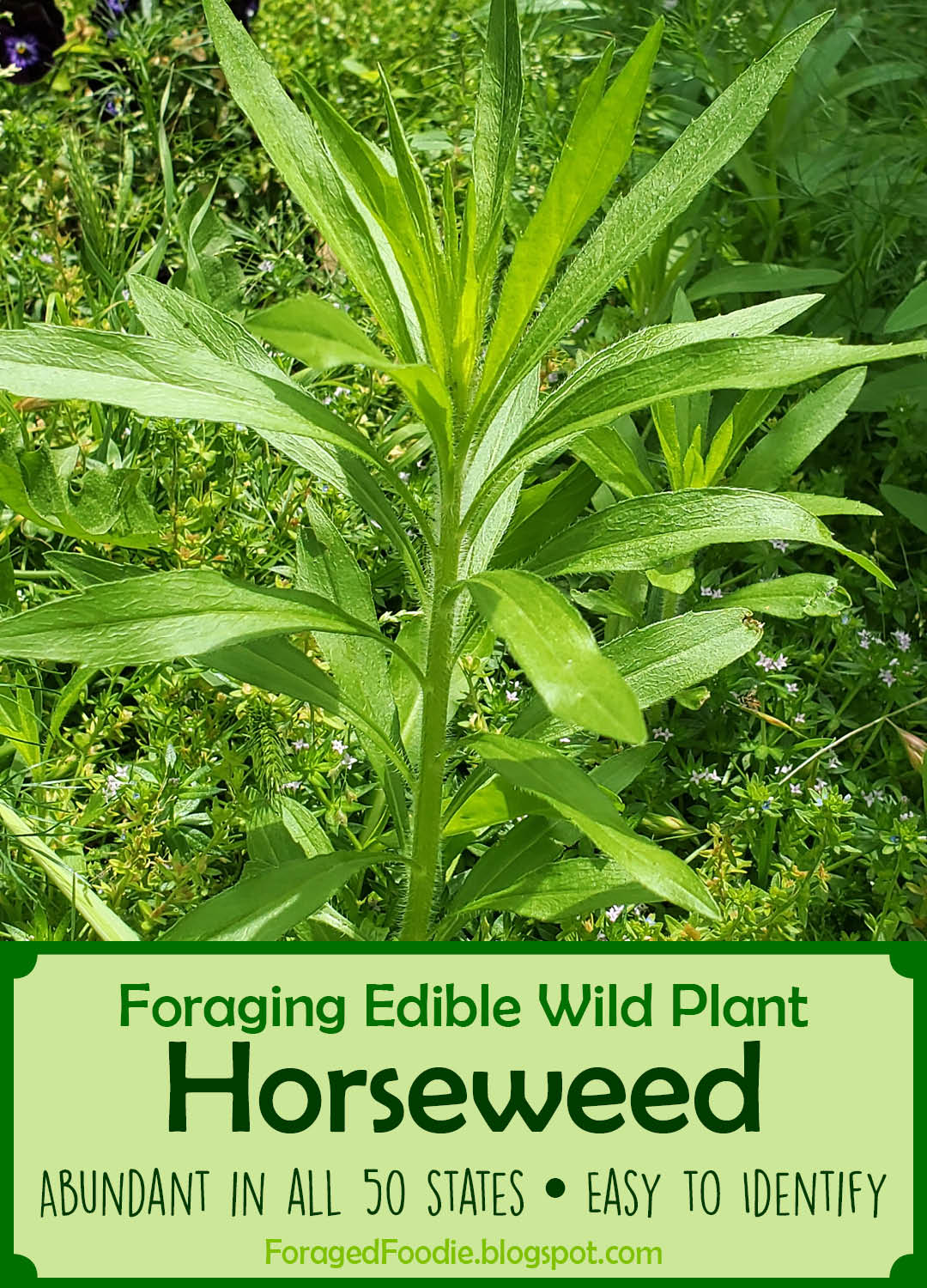
Foraging: How to identify edible wild plant Horseweed. Abundant and easy to ID


Horseweed, also known as Erigeron canadensis and formerly as Conyza canadensis, is a widespread, native, edible wild plant in the greater Aster family, Asteraceae. In some areas it's known as fleabane, butterweed, mare's tail or colt's tail.  

It's incredibly abundant as it grows natively in the 48 continental states, and has been introduced into Alaska and Hawaii. In Canada, you can find it all throughout British Columbia and P.E.I. and along the southern edges of every Provence except Labrador, Nunavut and the Northwest Territories. It can be found throughout Mexico and in most of the non-island Central American Countries.

It's almost certainly in your neighborhood. 

Horseweed patch from my yard, early May

Horseweed gets little attention in the foraging community, with no really good reason as to why. It's easy to identify, less bitter than the well-known dandelion or plantain, more flavorful than clover, and provides more food than wood sorrel. Despite this, horseweed is only barely mentioned, while those others are brought up every season. 

Perhaps it's because horseweed has an unpleasant tendency to grow in some of the least savory of places, including out of sewer grates in the middle of dense and dirty cities. In fact, while I will often find a plant or two on my neighborhood stroll, I often find horseweed growing most densely and abundantly in urban environments: city parking lots, sewers and underneath highway overpasses. 

Horseweed is actually quite popular in the survivalist communities, though not as food! But more on that later. 

Fortunately, a large patch recently chose to grow right in my own yard! So I've finally been able to see what all the fuss is about, and, let me tell you, this is one tasty little (actually, BIG) weed!


Horseweed taste; edible and medicinal uses

When plants are quite young, 3-4 inches, you can use the whole plant. The central stem gets tough and stringy very quickly, after the plants are around 5 inches high, you will only want to use the leaves. Once the plant is over a foot high or so, you will only want to use the leaves at or near the top, the rest will be dry and flavorless. Once the plant is flowering, it's no longer good for food. 

Apparently horseweed is most commonly steeped as a tea, though I only recently tried it that way.

Horseweed can also be used as a flavorful herb, which is how I've been applying it. Simply strip the leaves off the central stalk, chop and add to your dish. I would describe the flavor as being a bit like oregano, but with a freshness like parsley, some almost citrusy brightness and, at the back of the pallet, some anise or tarragon flavor. For me this taste only ever comes at the end of the meal, which is interesting. 

Once the flower stems form the leaves are no longer flavorful, but you can harvest the flower buds. These can be added directly into dishes as a vegetable, or pickled if you like. Make sure to get the buds and not the post-bloomed flowers. 

Horseweed lends itself to Italian and Indian dishes for sure and I'm looking to branch out further in my experimentation. 


Horseweed identification

Growth and Stem features

  • Hairy stalk
    Horseweed grows as a single, straight central stalk, no branching until flowering
  • Horseweed can grow up to 8 feet tall, but will most often flower between 4 and 5 feet, though you won't want to be harvesting when it gets that old
  • When fully grown, the stalk will develop a hollow core, but again, you probably won't want to eat the plant at that stage. 
  • The stalk is quite hairy, and have shallow vertical grooves or striations running up the whole length
  • The leaves grow directly off the stem on slender petioles (leaf stems), no fibrous stems
  • The leaves rotate around the stalk as they grow, they do not grow in opposite pairs


Horseweed leaves | Left: young leaf, still a little rounded
Center: assorted mature leaves to show variations
Right: leaf detail to show barbs

Leaf features

Hairy leaf underside and edges,
also note the veins that run parallel to the leaf edge
  • Horseweed leaves are lanceolate, which is to say they are much longer than they are wide; they will become even more so as they age
  • Like the stalk, the leaves also have hair, though only on the underside and around the edge of the leaf, not on the top side.
  • Horseweed leaves are sometimes described as serrated (like the edge of a saw or a bread knife), but I think this is misleading; rather, they have occasional "barbs" on the leaf edges, anywhere from 2-6 per leaf, (older leaves can have 8)
  • These barbs start out as small triangles, but will develop a more fish-hook shape as the leaf ages and grows larger
  • One of the best identification features is the randomness of these barbs; almost every leaf will be unique in number of barbs, unique barb positioning, and unique barb size
  • All leaves will have prominent veins that run parallel to the central vein, and to the leaf edges; this is easier to see on the underside of the leaves

Flowers

  • Before flower buds form, horseweed will start to grow lots of small stems/branches at the top of the stalk. These stems will be 4-12" or so long, and will vary in length with the height of the plant.
  • Once these stems form, the plant is no longer good for food as the leaves will become papery and flavorless
  • If you are familiar with the aster family as a whole, horseweed has very typical aster flowers - the petals are so narrow they almost appear like hairs or lashes around the bloom
  • The petals are white and the centers are yellow
  • Each flower is about the size of an American or Canadian dime
  • Once bloomed, the flowers will turn into puff heads, similar to dandelion's, but smaller


Look-a-like plants

Note: as long as you are careful about looking for hair, there are no poisonous look-a-likes for horseweed, though there may be allergens that effect some people strongly, even dangerously, on an individual basis. 

Thursday, May 25, 2023

Train wrecker or scaly sawgill. Wild edible mushroom identification


Behold Neolentinus lepideus, commonly known as the scaly sawgill or, in a somewhat antiquated use, the train-wrecker mushroom. If you are using older guidebooks (pre 1985) the Latin name will be listed as Lentinus lepideus. 

Though most commonly called the scaly sawgill, I simply love the drama of the name train wrecker, so that's what I'll be using here.
Just look at all that dense, bug-free mushroomy goodness

The train wrecker is edible, though often downplayed, invalidated and ignored. Called tough, woody, fibrous and bland, it's passed over for more popular late spring and early summer delights.

But that's a shame, because the train wrecker is, when SUPER fresh, not at all tough or woody and while it's not one of the most flavorful mushrooms, it's amazingly dense, meaty texture more than makes up for that fact. 

Also, this mushroom is only rarely attacked by insects.

The train wrecker can also grow quite large, providing quite a lot of food. Across North America it's rather uncommon, but can be regionally abundant.  If you are foraging in forests east of the Rockies that identify as "Piney Woods",  (New Jersey Pine Barens, Texas Piney Woods, etc), during the rainy season, there is a strong likelihood of encountering this mushroom, even if you aren't looking for it. 

N. lepideus can also be found in Western Europe, though apparently much less abundantly.


Train wrecker mushroom identification

Growth habits 

  • Found exclusively on dead conifer wood or stumps, especially pine, most often east of the Rocky Mountains
  • Note: The train-wrecker can also be found on cut logs and boards, both treated and untreated, especially west of the Rocky Mountains. These should not be consumed. The mushroom can pick-up toxins from the treatment and pass them on to you. Only eat mushrooms found growing on natural materials, in areas that seem unpolluted. 
  • Grows individually or in clusters of caps from a single stem


Cap and size 

  • This is a large mushroom. Caps range in diameter from 3" to 10". 
  • Cap is white, beige, yellow or even orange in the middle, and generally lighter means fresher.
  • The cap of N. lepideus has dark, chocolate- or amber- brown scales in the center. 

Gills 

  • The gills for the train wrecker are often described as serrated, or saw-toothed, but I don't personally like this description, as it implies triangular shapes that are fairly evenly sized and distributed.
  • To me, the gill edges are like torn paper, or the edges of very old books; they are jagged, irregular and often feature square shapes or small nicks.
  • Gills are moderately spaced, which means there is generally a gill-space in-between two adjacent gills.
  • The gills attach to the stalk (which is technically called a stipe), and are often decurrant (they extend down somewhat onto the mushroom stalk).


Stem/Stipe

  • The stipe (mushroom stem) for N. lepideus is quite distinctive. 
  • Stem features fibrous scales, facing upwards towards the cap (unusual), which peal backwards towards the base of the mushroom.
  • Fibrous scales start out as white, but will turn dark brown quickly, especially at the base
  • When broken or cut, the stem is like a thick, dense cotton in texture.
  • The stem is pretty much the same thickness along the whole length, it doesn't really taper, and is only wider at the base if it joins to other mushrooms. 
  • Clusters of caps can share a stem at the base, but the base may be buried in the wood, making stems appear separate.

Friday, May 19, 2023

Elderflower identification and foraging: don't confuse for deadly poisonous water hemlock

Identification difficulty: Intermediate

Warning: This plant has been mistaken for the very deadly water hemlock. Ingestion of water hemlock can kill in 15 minutes to 2 hours -- often less time than you can get to medical attention.

Even if correctly identified, parts of the elder plant: including roots, bark, leaves and green fruit are poisonous. Only the flowers and ripe fruit are edible, in moderation, and the fruit must be cooked. 

Thanks to their etherial beauty, it's easy to imagine elderflowers as magical


Elder quick history

The shrubs we call elder, members of the genus Sambucus, grow throughout most of the temperate regions of the northern hemisphere, and were once a staple food and medicine for many different peoples: Native Americans, Europeans, Asians and North Africans. Everywhere it grows its been revered, used as food, flavoring, in wine and liquor-making, medicine, basket making, for perfumes, natural dying and cosmetics, and ritualistically. In Europe especially, elder bushes were believed to have magical powers and to be inhabited by benevolent spirits.


Black elderberries are the most common U.S. varieties 
east of the Rocky Mountains
Elder varieties 

There are many individual species of elderberry, all in the the genus Sambucus. They are bushy shrubs or small trees bearing large clusters of white or off-white flowers, though some varieties have been cultivated to bloom pink.

Elderberries are most often defined by the color of their fruit: black, blue or red, though there will be many individual species and varieties producing fruit of each color. In Australia there are also white or yellow-white fruiting species, but I have no experience with them. 

Please note: in this post we will be looking at the flowers of black elderberry, but the tips here will also apply to the flowers of blue elder.  The flowers of red elder look quite different.

Finding black and blue elderflower 

It's hard to see in this picture,
but this enormous grove of elderberries
were growing alongside an old stone
millstream

Some of the best places to look for elder plants, flowers or berries, as well as places to avoid.

  • Old homesteads and farmlands, especially directly by the old home, or as the dividing edges between two farms. 
  • Along old millstreams, especially the kind with stone embankments. Beside old millhouses or lands that formerly had a millhouse.
  • River and creek banks, high bluffs over wetlands, and areas that occasionally experience seasonal flooding. All of these areas should have good drainage without long periods of standing water.
  • Drainage ditches that would border old farmland, orchards, pastures and especially vineyards. Don't risk contamination by picking from plants growing in culverts off highways, industrial areas, or active farms using pesticides or chemical fertilizers.
  • Suburban parks and residential developments built on former farmlands or wetlands.
  • Elderberries do not like standing water or areas that flood frequently and remain soaked. If you find a similar-looking plant in these kinds of environments, you most likely have deadly water hemlock, and you should avoid!


Identifying elder in the flowering stage

Elder is reasonably easy to identify when fruiting, but when it's in flower the list of potentially poisonous look-a-likes grows significantly longer and more dangerous. 


Elderberry growth 

Blue and black elderberries are large shrubs or small trees that can grow up to around 10-12 feet tall. 

Sometimes elders grow quite bushy and filled-in, but when crowded into a forest with other trees they will often grow more like a tree--with branches spaced thinly, spread out to catch the light. 

Elder bushes will start to produce flowers and fruit at about 2 years old, often when the shrub is as short as 3ft tall. 

However, at this age it may still have green stems with no bark. If you are inexperienced, it's advisable to wait till the shrub has bark, as the safest way to rule out deadly poison hemlock. 

All 7 of the "leaflets" on the left make up one true leaf. The same with the 9 leaflets on the right.


Elderberry leaves

Elderberry leaves are "oddly pinnately compound". 

Compound means that each leaf is actually made up of multiple "leaflets", see the picture above for more detail. Pinnately means that the leaflets are directly opposite one another, not offset. And oddly refers to the fact that there are an odd number of leaflets, with one sticking out at the end. 

The entire leaf will be up to 13" inches long, with 5 to 11 leaflets, with 7 or 9 being most common.

Be VERY CAREFUL if you see leaves like those on the right. 

As the leaf grows bigger, the leaflets will appear to branch off into triplets (groups of 3). These are actually new leaf stems (petioles) with new compound leaves forming. Only some varieties of elderberry will grow this way. 

However, this is very similar to the growth of deadly poisonous water hemlock. If you see bottom leaf division like this, make extra sure to check all the other identifying features to confirm you do not have water hemlock. 

Leaf images are for identification only. Elderberry leaves are poisonous. 

Leaflet detail of the black elderberry

Elderberry leaflets  

Each individual black elderberry leaflet is an elongated oval shape with a pointed tip. They also attach to the leaf stem at a point (Red elderberry leaves are more round). 

Leaflets have a subtly serrated edge, which is to say they are saw-like or toothed. The key word is subtle. Elderberry serrations are shallow, often curved partially inward towards the leaf and are very irregular in size and shape.

Deadly poisonous water hemlock has deep serrations that come to sharp points. They angle upwards but don't curve back on themselves, and they are fairly regular in depth, shape and size. 

The veins on elderberry leaflets are shallow, they do not pucker the leaf material. 

Most importantly, elderberry leaflet veins MOST OFTEN terminate with the tip of the serration. 

Water hemlock veins most often terminate in the groves between serration points. 


Elderflowers

Just as the leaves of elder are compound, so to are the flowers. Each flower head, known as an umbel, is made up of tiny white or off-white flowers, each with 5 petals. 

Each flowerhead looks like it's made of lace.

The flowers grow off the very end of the bush branches. They are not nestled into the leaves.

When the flowers bloom, they weigh down the flower head such that it bends backwards, creating a shape like an umbrella, hence the name "umbel". 


Stems/trunks

One of the most important aspects of elderberry identification is the presence of bark on mature plants, which rules out the most dangerous similar-looking plant: water hemlock. Water hemlock is a weedy plant which dies off each fall and grows back. It will never have true woody stems or bark. 

Young elder plants will not have bark yet (it takes 2-3 years) but they also most LIKELY won't flower or fruit. To be on the safe side, make sure your perspective elder plant has bark before harvesting -- it's better to potentially miss out than to risk consuming one of the most deadly plants in the world. 

Tuesday, May 16, 2023

Horseweed pesto with foraged backyard weeds

In the winter of 2021, when Texas was completely covered in layers of ice and snow, experiencing completely unprecedented levels of prolonged cold, we lost many of the bushes from the front of our house. 

These bushes, while not exactly my style, were planted originally when the house was built in 1974, making them a touch older than I am. These were large bushes too, over 4 feet tall, and each covering a diameter of about 6 feet or so. They left a considerable amount of bare ground in their absence. 

Since then, my husband and I have been at an impasse on what to do with the space. Ultimately we want to cover it with low-water, low-maintenance (no maintenance, really) native plants or shrubs, but everything we've tried to do ourselves has been . . . unattractive at best or straight up dies within days at worst. We will most likely have to hire a landscaper who specializes in that sort of thing, but for now, we have better things to spend money on. 

Right now, its a very messy patch of wild plants--weeds to be honest, which I try to keep below the legal height (12") for weeds in our town. I would love if native or low-water wildflowers would move in, and I've tried to plant daisies, lavender, sage. . .but mostly just the wild lettuce abounds. 

I don't care for wild lettuce, its quite bitter. 

Horseweed patch last week, 
this week it was over 12 inches tall!

On the plus side, a large patch of horseweed has taken over the area near the house, FINALLY giving me access to enough clean horseweed to cook with. You see, I usually find horseweed in all sorts of unsavory areas, such as the cracks in the sidewalk in downtown Dallas. Sometimes it even grows up through the storm drains from the sewer. Not appetizing. 

So even though I've known about horseweed for years, this has been the first chance I've had to really experiment with it in the kitchen, from a source I know to be clean and contaminate free. 

My husband, who prefers a tidy yard, is being extremely patient with me, so long as I keep it from growing too tall, as horseweed can grow to nearly 5 feet!

I was doing alight for a while nipping bits here and lopping the tops of plants there, but all of the sudden the patch decided it was gonna GROW. In one week the plants ranged from 4" - 6" to 12"-18", and my husband was like, "we need to harvest and use a LOT of horseweed this weekend".


The largest plant in the yard, separate from the main patch. 
It shot up to 2feet from 8inches in one week!


With that in mind, I decided to try a pesto, and I'm glad I did. 

A pesto is one of the best ways to get a comprehensive sense of the flavor profile of a plant. Just nibbling on a leaf really doesn't give your palette enough to draw on. When I taste horseweed raw, all I taste is herbs, mostly oregano and parsley. While horseweed tastes great raw, when cooked a whole new array of flavors open up. 

Honestly the plant tastes like an herbal blend. I get the freshness of parsley upfront, with a citrus-y brightness, like a mix of lime and grapefruit zest, after that the herbal oregano flavor hits, and then the sweetness of anise on the back of the palette. Really quite spectacular. 

People keep telling me I need to try horseweed tea, and while I'm generally not a weedy tea kinda gal, the flavor of the pesto and the smell of the cooked horseweed makes me want to try it. 


Disclaimer: At first I thought the walnuts were too strong for the horseweed, but after tossing it with the pasta, they mellowed out and the flavors really came together. That said, I would use fewer walnuts next time. One thing I would recommend is cutting down the number of walnuts you use, as indicated by my picture above. 


Horseweed pesto

1 colander full of horseweed leaves and very soft tops 
1 1/2 lb dried pasta 
3 tablespoons of walnuts
4 oz of parmesan or other hard cheese, or vegan cheese, roughly sliced
1/3 cup of olive oil + extra 
3 cloves of garlic, sliced
salt 

  1. Start around 4-6 cups of lightly salted water boiling in a large pot for the pasta. 
  2. Heat a drizzle of olive oil in a small frypan; toast the walnuts, tossing occasionally, until blackened on at least one side. Remove the nuts from the pan.
  3. Heat more olive oil in the frypan, add in the garlic and sauté, stirring, until garlic is fragrant, soft and ever so slightly darkened. Remove from heat. 
  4. When the water comes to a boil, blanch the horseweed before straining out with a slotted spoon. Then add the pasta to the water. 
  5. While the pasta continues to cook, add the blanched horseweed, the blackened walnuts, the cheese, garlic and olive oil to a food processor and puree. If needed, pause to push down the sides before continuing. Taste and season with salt as needed. 
  6. Toss with the cooked pasta, I found that this coats about one and a half pounds of pasta to the coverage I like, shown in the pic at the top. 

This pesto is delicious immediately, but it's just as good reheated later, as the flavors will come together more. 

You can make this dish vegan with vegan cheese.