Showing posts with label yellow mushroom. Show all posts

Friday, October 6, 2023

What's this yellow mushroom growing in my houseplant or garden

Nothing edible to share today, but I wanted to make a post about a mushroom that gets asked about all the time on Reddit and Instagram.  

The question "What is this yellow mushroom growing in my house plant / planter / garden?" is one I see every day, and today I'm here to answer it.

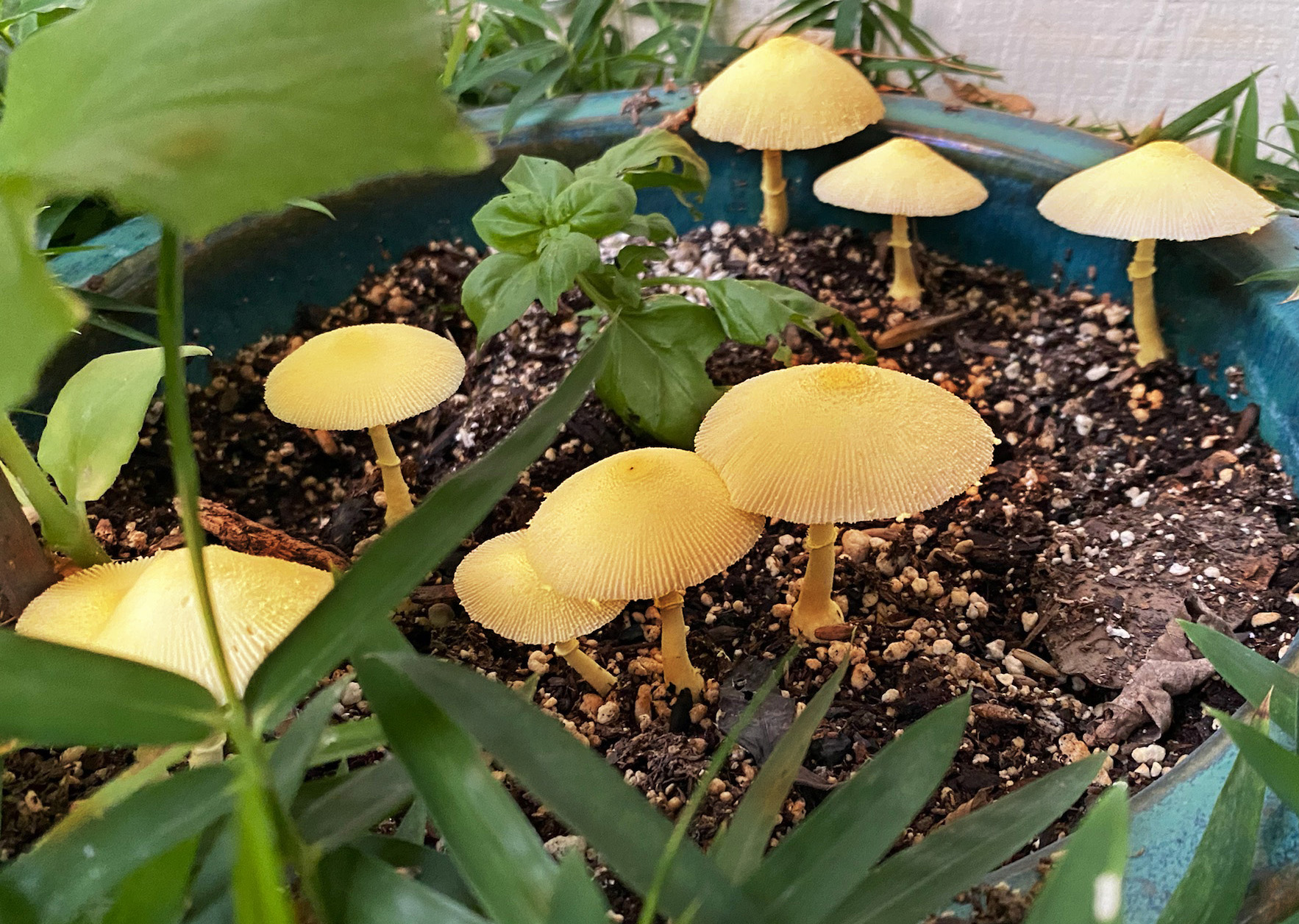
95% of the time you are looking at Leucocoprinus birnbaumii, sometimes called the yellow parasol mushroom, the painted dapperling, or the flowerpot parasol. Yes, it's so common in flower pots that it actually has that in the common name. The other 5% of the time you might be looking at the closely related Leucocoprinus straminellus, which is generally a paler shade of yellow, or Leucocoprinus flavescensm which generally has a brown area in the center of the cap.

Both L. birnbaumii and straminellus are tropical or subtropical mushrooms, so finding them in nature in the continental US, Canada or northern Mexico is extremely rare, but extremely common in potting and gardening soil. This is most likely due to the common usage of tropical materials, like orchid bark, in purchased soils. These organic materials may be contaminated with L. birnbaumii spores which then grow mushrooms when conditions are warm enough.

For most North Americans this means late spring, summer or early fall, but if you have a greenhouse, the yellow parasol might pop up anytime. 

Bell shaped when young


Yellow parasol mushroom description 

A bright, dainty mushroom that's yellow all over, cap, stalk and gills. L. birnbaumii is bright yellow and L. straminellus is pale or whitish yellow.

The cap shape starts out as a bell or cone or occasionally a marshmallow shape, then expands to an umbrella, and then the classic, nearly flat, parasol shape. When in the umbrella stage, the edges of the cap generally have fine striations (lines) and the cap will have small fibrous or warty raised areas all over, and the middle area will usually be raised -- this is called an umbo. At maturity, the cap will be anywhere from 1.5" to 3.5" in diameter. 

The stems are narrow near the cap and thicker at the base, even somewhat bulbous as they enter the soil. The stems will usually feature a ring, sometimes a double ring. The mushroom should be 2" to 3.5" high at maturity, but might be as tall as 4.5" in rarer cases. 


Is the yellow parasol mushroom poisonous or edible?

Reports are conflicting on whether L. birnbaumii is toxic, but it definitely should NOT be eaten. Many  Leucocoprinus species are severe sickeners, and symptoms can be dangerous. 

Thursday, May 25, 2023

Train wrecker or scaly sawgill. Wild edible mushroom identification


Behold Neolentinus lepideus, commonly known as the scaly sawgill or, in a somewhat antiquated use, the train-wrecker mushroom. If you are using older guidebooks (pre 1985) the Latin name will be listed as Lentinus lepideus. 

Though most commonly called the scaly sawgill, I simply love the drama of the name train wrecker, so that's what I'll be using here.
Just look at all that dense, bug-free mushroomy goodness

The train wrecker is edible, though often downplayed, invalidated and ignored. Called tough, woody, fibrous and bland, it's passed over for more popular late spring and early summer delights.

But that's a shame, because the train wrecker is, when SUPER fresh, not at all tough or woody and while it's not one of the most flavorful mushrooms, it's amazingly dense, meaty texture more than makes up for that fact. 

Also, this mushroom is only rarely attacked by insects.

The train wrecker can also grow quite large, providing quite a lot of food. Across North America it's rather uncommon, but can be regionally abundant.  If you are foraging in forests east of the Rockies that identify as "Piney Woods",  (New Jersey Pine Barens, Texas Piney Woods, etc), during the rainy season, there is a strong likelihood of encountering this mushroom, even if you aren't looking for it. 

N. lepideus can also be found in Western Europe, though apparently much less abundantly.


Train wrecker mushroom identification

Growth habits 

  • Found exclusively on dead conifer wood or stumps, especially pine, most often east of the Rocky Mountains
  • Note: The train-wrecker can also be found on cut logs and boards, both treated and untreated, especially west of the Rocky Mountains. These should not be consumed. The mushroom can pick-up toxins from the treatment and pass them on to you. Only eat mushrooms found growing on natural materials, in areas that seem unpolluted. 
  • Grows individually or in clusters of caps from a single stem


Cap and size 

  • This is a large mushroom. Caps range in diameter from 3" to 10". 
  • Cap is white, beige, yellow or even orange in the middle, and generally lighter means fresher.
  • The cap of N. lepideus has dark, chocolate- or amber- brown scales in the center. 

Gills 

  • The gills for the train wrecker are often described as serrated, or saw-toothed, but I don't personally like this description, as it implies triangular shapes that are fairly evenly sized and distributed.
  • To me, the gill edges are like torn paper, or the edges of very old books; they are jagged, irregular and often feature square shapes or small nicks.
  • Gills are moderately spaced, which means there is generally a gill-space in-between two adjacent gills.
  • The gills attach to the stalk (which is technically called a stipe), and are often decurrant (they extend down somewhat onto the mushroom stalk).


Stem/Stipe

  • The stipe (mushroom stem) for N. lepideus is quite distinctive. 
  • Stem features fibrous scales, facing upwards towards the cap (unusual), which peal backwards towards the base of the mushroom.
  • Fibrous scales start out as white, but will turn dark brown quickly, especially at the base
  • When broken or cut, the stem is like a thick, dense cotton in texture.
  • The stem is pretty much the same thickness along the whole length, it doesn't really taper, and is only wider at the base if it joins to other mushrooms. 
  • Clusters of caps can share a stem at the base, but the base may be buried in the wood, making stems appear separate.

Saturday, December 4, 2021

The velvet foot or velvet shank mushroom: Flammulina velutipes. Identification tips and toxic look-a-likes


Caution: this is NOT A BEGINNER's mushroom.

This mushroom cannot be positively identified by observing features alone. A spore print must be made for positive identification. This mushroom has many lookalikes, some of which are deadly, others will make you sick. Use the following tips as a guideline only, but confirmer your identification with other reliable sources and a trusted local expert.


As always, it's your responsibility to make 100% sure of any while plant or mushroom you consume.


Identification difficulty level: Intermediate

Flammulina velutipes, commonly known as the velvet foot, velvet shank, velvet stem, or winter mushroom, is officially a cold-weather fruiting fungus, which can be harvested even in the dead of winter in some places. This makes it a great find for winter survivalists, or for any forager who just can't get enough, and wants to hunt year round.


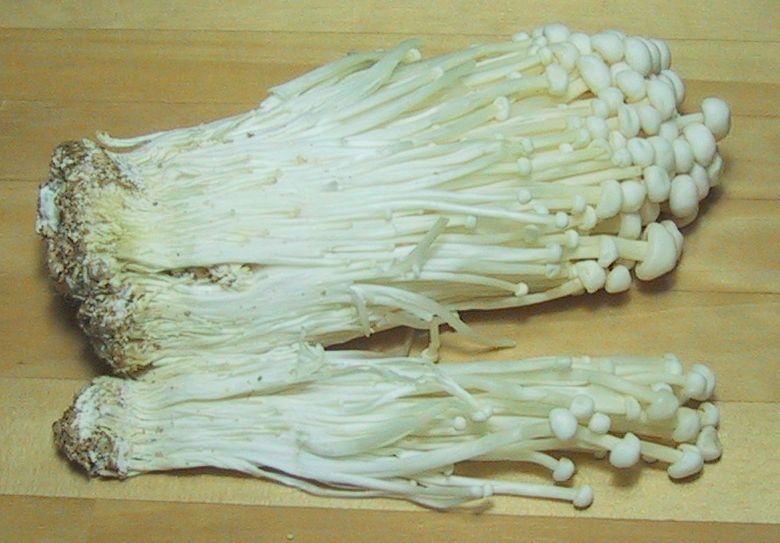
Cultivated Flammulina velutipes, called enoki mushrooms.
Image courtesy of Wikipedia user Chris 73, via Wikipedia Commons


Do you know the enoki mushroom?

If you know the skinny white enoki mushrooms you buy in the store, then you actually know the velvet shank, kind of. The enoki is also Flammulina velutipes, but it's cultivated in very specific ways, to make it look, and in many ways taste, like a different mushroom. By growing it in complete darkness, it turns white instead of cinnamon brown, and forcing the stems to grow long and skinny keeps them tender, where in the wild they are tough and chewy. 

Despite the more tender texture of the cultivated variety, I GREATLY prefer the stronger, more umami flavor of the wild version. When cultivated they become tender and mild, but wild they are a very exciting mushroom, with a very meaty texture and a buttery, nutty flavor. 

Keep reading to learn more on how to accurately identify the velvet foot mushroom, and avoid the very similar-looking, DEADLY Galerina.

Friday, July 30, 2021

How to identify Golden Chanterelles, gourmet edible wild mushrooms


Identification difficulty: Intermediate

Warning: despite the frequency with which these are foraged, I feel that the risks associated have been downplayed. I personally believe there is the potential for confusion with deadly species. That said, I believe you can learn how to rule those out. 

Summer 2021 is turning out to be a nation-wide bumper year for the greater chanterelle family, which includes cinnabar red chanterelles, black trumpets, and, of course, golden chanterelles. 

Facebook foraging and mycology groups, Reddit foraging and mycology boards are all flush with pictures of, well, flushes of mushrooms. There's a lot of books, websites, etc out there that talk about how to identify golden chanterelles, so I wasn't really sure how necessary another post would be, but at the same time I'm seeing a lot of misinformation or incomplete information going around on social media. 


Overview and history

The term chanterelle can be used to describe a group of related genera (that's plural for genus): Cantharellus, Craterellus, Gomphus, and Polyozellus. Craterellus includes the black trumpets and yellow foot mushrooms, Gomphus includes the pig's ear, Polyozellus is a one-species genus that contains the blue chanterelle, and Cantharellus contains several species of golden chanterelles, red or cinnabar chanterelles, the smooth chanterelle and the white chanterelle. The lobster mushroom, Hypomyces lactifluorum, looks similar but it is unrelated and, while also being a choice edible, tastes completely different from chanterelles of any kind. 

For most people, however, when they think of chanterelles, only the golden chanterelle comes to mind. 

Golden chanterelles are a gourmet wild mushroom, one of the "big five" mushrooms that command the highest prices globally. The "big five" include truffles, matsutake, chanterelles, morels, and porcini. These are the five most expensive mushrooms for their CULINARY value; there are some fungi which sell for higher prices due to their use in Eastern medicine. 

We don't know exactly when humanity began it's love affair with the golden chanterelle. Asian, African and European cultures all have long histories of the mushroom, and we can safely assume it was eaten before it was recorded as well. In Europe, chanterelles were reserved for the nobility for many centuries.

Chanterelles are a mycorrhizal species, they grow in symbiosis with trees. This makes them very difficult and expensive to cultivate, as one would need to both own a forest and be willing to wait for decades while the trees and the fungi mature, before the fugal mycelium would grow mushrooms. 

At one point in time, all golden chanterelles were believed to be Cantharellus cibarius, and older books will still refer to them this way. With the advent of DNA testing, we now know that there are many, many kinds of golden chanterelles, some with sub-varieities, and that C. cibarius only grows in Europe. 


Golden Chanterelles as a group

Since "golden chanterelles" are a group, there are many, many color variations. There are species that are all golden or egg-yolk yellow, some that have white areas, such as a white stem, white gills or a white cap, and some that have those same variations except pink instead of white.

For the sake of this article, the term "golden chanterelle" will apply to any species that is 50% or more "egg-yolk yellow"., We won't be trying to identify individual golden chanterelle species, as all are edible, all are choice and they share many identification features. 

NOTE: Some chanterelles have a tan or deep yellow spot at the center of the cap. I would personally avoid these. And you must avoid all potential "chanterelle" species that have a cap or stem that is entirely tan or brown as it may be a potentially deadly look-alike in the genus Paxillus. Also spore print any all-yellow mushroom with decurrent gills where the stem seems thin for the cap size. 


Why I think chanterelles are an intermediate difficulty to ID

Overall, I think most foraging and mushroom hunting books leave out important potential look-a-like species for the chanterelle. They generally talk about false chanterelles, Hygrophoropsis aurantiaca, and jack o' lanterns, Omphalotus species, as the only real danger. Both these mushrooms can make you sick, Omphalotus can make you seriously sick, but neither will kill you. 

I'm more concerned about Paxillus species, which have the potential to be deadly poisonous. Paxillus are not super common and don't STRONGLY resemble chanterelles, at least not in America. However, there are yellow varieties in Australia, which could always make the cross-ocean trek on tree roots. And there are brown-yellow varieties in North America and Europe which we will go into in greater detail.

As I've said on the page where I define these terms, if I feel there is potential for confusion with a deadly species, then I consider it to be an intermediate difficulty identification.