Showing posts with label oval leaves. Show all posts

Sunday, April 24, 2022

Foraging: Identification of edible, young spring pokeweed / poke sallet


Identification difficulty: Novice

This post is a long time coming, I really should have made this post a long time ago. You see, it's bothered me for a while that pokeweed, Phytolacca americana, is such a popular edible wild plant, such a well-known plant, such a historically significant plant, and yet there is so very little info out there helping identify it when it's young and harvestable. 

There is a ton of info to help identify the mature plant, which is very easy to ID. But as I wrote once before, you can't EAT pokeweed when it's mature -- it becomes fatally poisonous. 

But in the early spring, they young shoots and leaves can be harvested, and, if properly prepared, are safe to eat -- even delicious. Like the best baby spinach you've ever imagined. 

It's such a popular food of the American South that it's been a part of our nation's cultural heritage, even becoming the theme of a hit song, Poke Salet Annie, in the late 1960s. 

If you've been curious about how to safely identify pokeweed when it's young, you've come to the right post!


Common places to look for pokeweed

Pokeweed is a transitional understory plant. Transitional meaning it thrives in the transitional period where as field and meadow become forest. It gets crowded out fairly easily by trees, so you will rarely find it in deep forest, instead look for small forest clearings (usually where a massive old tree has fallen, leaving an open space), on the edges of meadows or farmland and along man-made or animal trails. In nature, "washes" -- places where spring rainwater frequently comes down the sides of hills, clearing out small trees, frequently grow pokeweed.

This pokeweed is too mature to eat.
But it is growing in a classic spot: on
the edge between a field and woodlands
Pokeweed seed reproduction is very complicated. The seeds can't germinate UNLESS they've been swallowed and digested by a bird--exposed to that specific mix of chemicals inside an avian GI tract--and deposited in the highly acidic bird feces. 

However, if pokeweed roots get broken up, any piece of root about 2-3" long can grow a new plant. For this reason, human activity can spread pokeweed around like crazy. During excavation, construction and earth-moving, people may inadvertently break up a pokeweed plant, creating dozens more at the edges of construction, where the root-bearing dirt has been deposited. 

Consequently, look for pokeweed for along the edges of suburban developments built within the past 5 years, or along any area kept clear of trees by human activity: farms, parks/playgrounds, the edges sporting fields and along trails are all good places to look. 

The most pokeweed I personally ever saw was when my parents had their new Connecticut home build in 1990, when I was 10. The land had been farmland until the early 1900s, at which point it had been allowed to grow feral, reverting to forest, with tree ages not that much older than 50 years at most. There were also several clearings. In one of those clearings, where my parents build their house, there must have been at least one pokeweed plant, because when they dug the foundation, they disturbed those roots. For several years after, we had literally HUNDREDS of pokeweed plants surrounding the clearing of our home, until eventually small saplings started to grow into small trees, forcing the pokeweed out. 


Young spring pokeweed identification 

Many North Americans already know mature pokeweed by sight. It's hard to miss, as the plant can grow 6 feet tall and equally wide, in arching red boughs, bearing large, deep green leaves and 4-6 inch clusters of deep purple-black fruit on red stems.  

The problem is, by the time pokeweed is easy to spot and identify, it's well past the point where it can be safely eaten. This post will help you identify young pokeweed in the spring, when its safe to consume (after proper preparation): 

Super young pokeweed growth. Note the stalks of last year's plants in the background

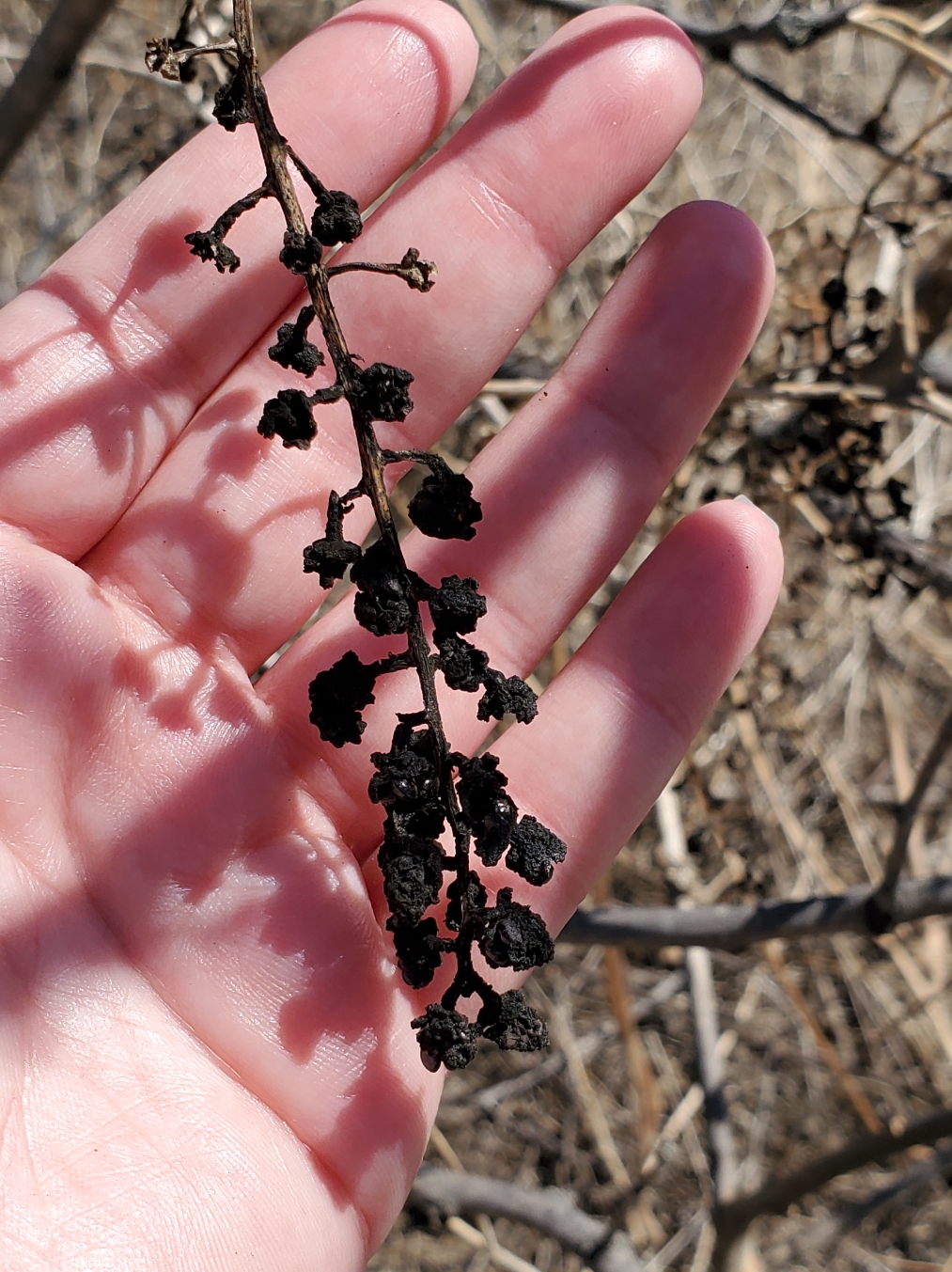
Dried up old fruit is the 
best way to pre-find pokeweed

Finding young pokeweed

When it first pokes out of the ground, pokeweed will mostly be visible by the leaves, which at this stage will be bright green, almost neon, wrinkled, ruffled at the edges, and with very prominent underside veins. 

Pokeweed is perennial: once established, it will regrow from the roots year after year. For that reason, you can find pokeweed before it grows by finding last year's plants. 

The stalks of pokeweed plants are long, hollow tubes that are beige in color, but often feature grey or black streaking and spotting. There will always be some dried up clusters of pokeweed fruit dangling from one branch or another. 

Side note: because old pokeweed stalks are hollow, breaking up the tubes makes an excellent tinder/fire starter, as long as they are very dry. 


The stalk is the most important way to identify pokeweed. 
Note in the slightly older plants on the right, the skin should be peeled away from the plant base
before preparing it for consumption


Stalk color and growth pattern

Pokeweed is safest
when the skin is
super thin, like this
The stalk is the most important identification feature for young pokeweed. The leaves and overall plant shape resemble many other wild plants (some poisonous) but the stalk is very unique -- once you know what to look for. 

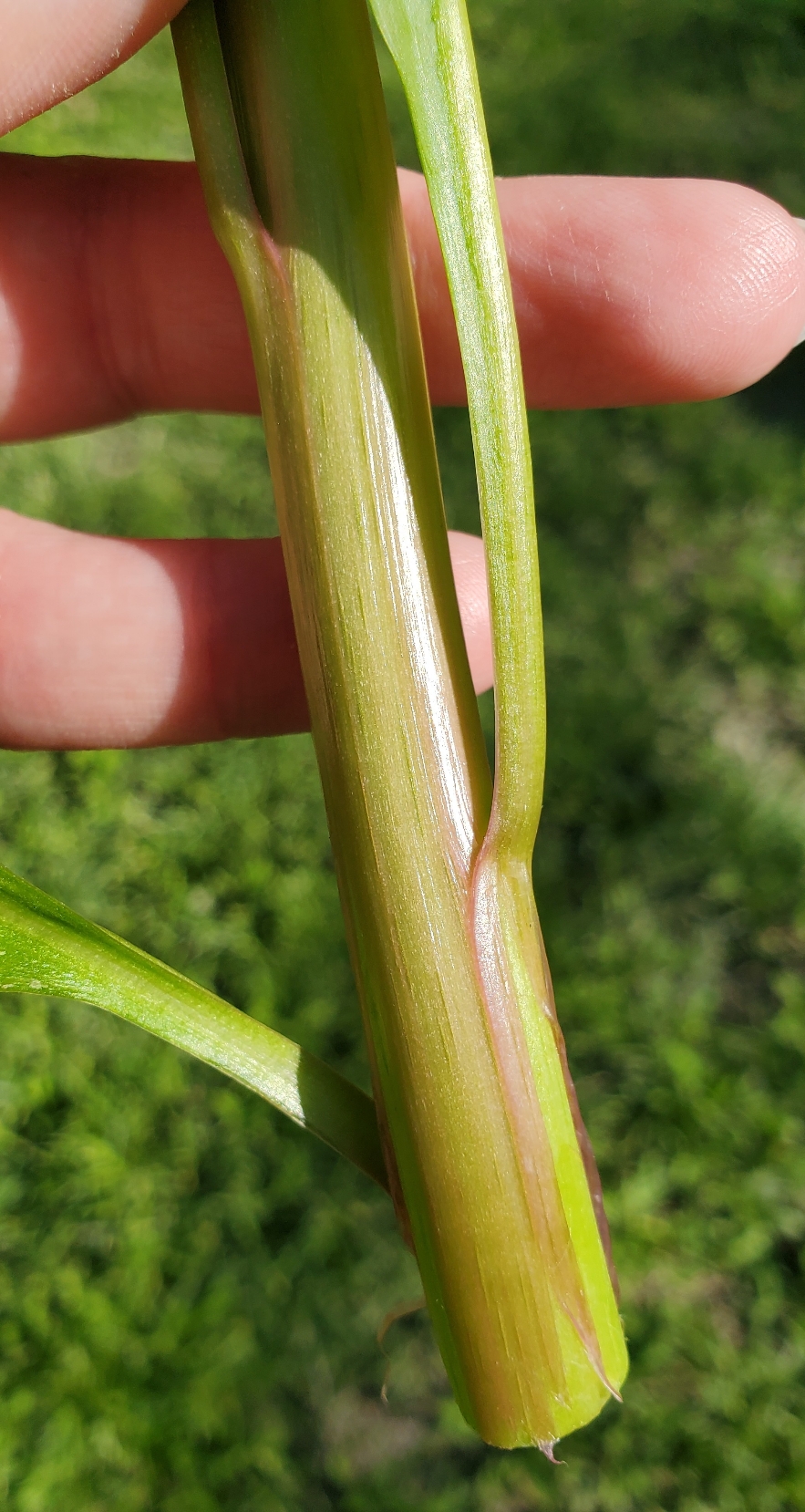
The stalk of young pokeweed is translucent neon green tube around a white core, covered with a super thin, translucent skin that peels away pretty easily from breaks. 

The white core of the stalk is actually made up of parallel, horizontal chambers, which you can see easily by breaking into the stalk with a vertical cut. However, the younger the plant, the closer and tighter together the chambers will be, making them harder to see. 

The skin should be green, yellowish or faintly red. If the red coloring is more than just a hint, or faint streaks, then your pokeweed is too mature and should not be eaten. 

There is no hair on the stem, in fact if feels super smooth -- like plastic.

As the plant grows, the skin becomes thicker, and easier to peel away as a whole unit, without tearing. The group of pictures above shows two plants, the core on the left is at the perfect stage of size and growth. The middle and right are at just the last stages, and require a little extra prep work.  Notice on the left how the skin holds together and doesn't tear when pealed away from the central stalk. On plants of this age, I would peel the skin away from the base of the plant, and not cook it. The skin carries more of the dangerous chemicals than the green interior. 

Friday, September 9, 2016

Foraging: identifying and sustainably harvesting wild Virginian (American) persimmons


So last September, I think on Labor Day weekend, I went out for a forage, and I found wild persimmons, Diospyros virginiana. They were hard as rocks, and quite unripe, so I looked them up and figured they'd be ready to go in November. So I waited, came back in November, and the trees were completely bare. 

This Labor Day weekend, I went out again, and found them to be just starting to ripen. So what the season for these guys is, I don't quite know yet. 

I do know that I got my first taste of wild Virginian (or American) persimmon, and it was amazing. They taste so much better than the cultivated varieties, which have always been bland and rather chalky to me. These are sweet, mellow and with subtle tropical flavors: guava, mango, peach and banana, maybe. They're hard to describe. 

These are actually somewhat underripe, and leave a tang on the tongue. I'll be harvesting more this coming weekend, and see if that astringency goes away. Still they are very very tasty. 

But if you're in North Texas, they are coming into season for you right now, so I'll show you what to look for.

Saturday, May 7, 2016

Identifying and sustainably harvesting Smilax (greenbriar, carrionflower)


Smilax species, often called greenbriars, bullbriars, or catbriars, are a plant not often addressed in foraging circles, and I'm not sure why. Maybe because identification, while actually pretty easy, seems so complicated at first.

Identification difficulty: Novice

I was scared to eat greenbriar too; I had tried it when in the company of more experienced foragers, but unwilling to forage it on my own.

After all, it has over 300 varieties, with a wide array of leaf shapes, colors and mottling. Leaves are a big part of identification, and it's easy to get distracted by the differences. And then there's the berries, which can be dramatically different too: red, blue, black, hanging in clusters like grapes or in pairs or globes! Finally, there are so many dangerous vines to look out for, it just seemed like too much risk to  take.

Well after spending a little time with the plant, which grows abundantly in Texas, I'm pleased to say that greenbriar are actually a very easy ID.  Yes, the leaves of different varieties look different from each other, but they do have key similarities, and leaf shape is only a secondary element to identification.

As always, please read the disclaimer before using these tips to identification.

Greenbriar quick history

Smilax is a rite of spring in the Black Sea region, like Turkey and Georgia (the country). It was also used in Central and South America to enhance male libido. Early European settlers brewed a drink from the roots, early sarsaparilla, and used it not only as an aphrodisiac, but also to treat genital diseases, like syphilis. I would seriously doubt it's effectiveness on STDs, but I'll leave amorous experimentation up to you.

Thursday, March 3, 2016

Foraging: Identifying Wild Edible Chickweed


Many people describe chickweed (Stellaria media) as their favorite wild edible green of spring. Many gardeners consider it a difficult-to-remove, annoying weed. Those gardeners just haven't tried it yet!

The foodie world is starting to follow along with the former group, and chickweed is showing up on menus of restaurants that focus on seasonal and/or local organic produce. Chickweed is also starting to show up in places like farmers markets and in the form of herbal supplements and teas at Whole Foods.

There's really everything to like about chickweed: it has a mild, fresh sweetness which some people compare to young corn or iceberg or boston lettuce, it grows in super abundance, easy to harvest and quick to grow back in the early spring when little else is growing, fairly easy to identify AND it even looks pretty!

Technically, chickweed isn't native to the Americas, so it's also an invasive species. Of course, it's been here for generations, so any ecological damage has already been done, but if you're into invasivore eating (eating invasive species) that's something to consider as well.

So let's get started on how to find, identify, harvest, prepare and eat this tasty little weed!

Identification difficulty: Beginner

Friday, November 27, 2015

Foraging: Identifying American Beautyberry: Nature's Pop Rocks!


Happy Thanksgiving! Today's post is a fun, quick one that I should have posted in September or October, when the berries were actually ripe. The house hunt was just very time consuming and I never got around to doing the write-up--sorry about that.

American Beautyberry (Callicarpa americana) is very easy to identify, easy to spot, and fairly common throughout the South and west into Texas, making it a good plant for new foragers. In addition to finding it in the wild, Beautyberry is also used in landscaping, great for urban and suburban foraging as well.

Identification difficulty: Beginner

Sunday, June 24, 2012

Foraging: Identifying Juneberries (Serviceberries & Shadbush)


Identification difficulty: Beginner

This year, the sheer abundance of berries made them impossible to ignore. For the past 3+ weeks, I have made berry pancakes, berry drinks, various breads and muffins, added berries to frozen banana "ice cream" and even made a sweet and spicy sauce with mulberries and chipotle for chicken. (I'll get around to a mulberry post soon, I promise!)


Monday, April 30, 2012

Foraging: Identifying and Sustainably Harvesting Ramps


Identification difficulty level: Novice

Allium tricoccum, called sometimes wild leeks, spring onions, wood leeks, or ramson, but most commonly known as the ramp or Ramps, are one of the most sought after wild foods.

Recently "discovered" by the gourmet world, Martha Stewart, the New York Times, the Food Network, and more have just learned what foragers and people of the Appalachian mountains have known for generations. . .that Ramps are the delicacy of the onion family!