Showing posts with label brown mushroom. Show all posts

Thursday, May 21, 2026

Foraging: Deer mushroom identification


Latin name: Pluteus cervinus, Pluteus petasatus, Pluteus exilis and related species
Common names: Deer mushroom, deer shield mushroom, fawn mushroom
Season: Spring, summer, fall (late fall in the southern states)
Edible: Yes
Flavor: Acceptable
Medicinal: No
Nutritional: Unknown, most likely similar to other mushrooms

Identification difficulty: Novice

The deer mushroom is the largest and most commonly encountered member of the genus Pluteus. It's encountered frequently in both North America and Europe, probably contributing to its rather long history, as this mushroom was first documented in 1774.

The common names actually indicate one of the key types of identification of this mushroom, the tendency of the cap to shimmer with subtle reflectivity, similar to the silky sheen of a fawn's coat. But more on that in the identification section. 

Warning: This is NOT an easy mushroom to identify, and there are a fair number of dangerously poisonous and even deadly mushrooms that look similar. Close inspection to gill attachment is required for safe identification. Spore color is an important identification aspect of these mushrooms, so I recommend that if you are inexperienced with this mushroom, you wait until the gills turn pink OR do a spore print before consuming.


A note on Pluteus species

The mushrooms we call "deer mushrooms" and historically identified as "Pluteus cervinus" are actually 3 or more distinct species of the Pluteus genus, including Pluteus exilis and Pluteus petasatus. There might actually be more species that are still yet to be identified with DNA testing. These mushrooms can't really be distinguished by physical characteristics and must be separated by habitat. More on that below. From a foraging/edibility perspective they can be treated the same. 


Identifying deer mushrooms


When and where to find deer mushrooms

Deer mushrooms can be found throughout all states of the continental United States, though they aren't found in the northern halves of the northernmost states. Pluteus cervinus is generally found east of the Rocky Mountains, while Pluteus exilis is found on the west coast. However, Pluteus cervinus has also been reported infrequently in San Francisco, California. 

Like all Pluteus species, deer mushrooms grow exclusively on wood. The true "deer mushroom," aka Pluteus cervinus, grows on logs at the bases of dead or dying trees and on stumps. It seems to prefer well-decayed wood and even when growing on trees that are still alive, it will choose to fruit in areas that have lost their bark. The related Pluteus petasatus can also be found in wood chips. Occasionally, you will find deer mushrooms growing on buried wood or roots that seem to just grow from the ground. I recommend avoiding these specimens as it makes it harder to safely identify them. 

Deer mushrooms can be found spring, summer and fall, and even into mild winters in the Southern states.


Cap identification features

Deer mushrooms grow rather quickly and top out at large sizes. Caps start out as convex (like an umbrella) but are flat at maturity. Mature caps are 2" to 5.5" in diameter.  The mushrooms below grew from the tiny caps on the left to the 4.5" mature caps on the right in just 2 days.

As size is an important identification feature, you might want to avoid specimens with caps smaller than 3" in diameter. Unlike most mushrooms, the young "buttons" don't seem to be superior to mature specimens in either flavor or texture, so you don't miss anything by waiting. 

The caps range from medium brown to tan to taupe (greyish) to beige, often with pinkish or pinkish orange undertones. They also generally have an "ubmo" or bump in the middle of the cap. The center is most often darker than the edges, but that can be subtle. The caps also have subtle striations from the middle of the cap to the edges. 

When mature, the caps have a lot of shimmer / iridescence as seen in the video clip below. This is especially true if the caps became wet from rain or even just dew and then dried. 


Gill & spore features

An essential identification feature of the deer mushroom is that the gills are separated from the stalk. They don't touch it, not even by a notch. 

Pink gills at the early stage of maturity. Notice how the gills don't touch the stem. 

When young deer mushrooms have white gills, but they quickly turn a pale pink or a pale peach, then darken to a dusty rose before eventually becoming a tawny taupe with pink undertones. By the time they become that dark they will most likely be buggy though. 

I recommend NOT harvesting the mushrooms until the gills are pink, as it's much easier to confuse them with other species when the gills are still white. 

When slightly more mature gills darken to a dusty rose. These are already a little past prime.

Officially, deer mushrooms have "pinkish brown" spore prints. Unofficially, there's a broad range of spore print colors for these mushrooms, varying from orange-brown to rusty-brown, to pinkish brown, brownish pink, cinnamon, peachy blush, coppery blush, and various shades of darker Caucasian skin tones. 

A natural rusty-brown spore print left on one mushroom
from the overlapping cap of another. 

The strip below shows some of the colors you might find. If you don't know how to do a spore print, check out my guide here. 

The flesh inside the cap is white and doesn't bruise blue or any other color when pressed, cut or otherwise damaged. 


Smell

Many people say that deer mushrooms smell faintly of radishes or watermelon rind. I'm afraid I have a terrible sense of smell and rarely smell what other people do. That said, I have picked up on those notes, very, very subtly, exclusively on very fresh specimens. Smell is not an essential identification feature, but I thought it was worth mentioning. 


Stem features

The stem of a deer mushroom is white, rather straight or with a slight taper towards the top. Stems are between 3" - 6" long and are subtly, vertically striated. They may have raised brown fibers, though I believe this to be much more common on P. exilis than P. cervinus. The stem has no ring, skirt or ring zone. 

The stem is narrow in relation to the size of the cap, being generally between 1/3 - 5/8 of an inch on mature specimens. The base isn't bulbous, nor does it look to be enclosed in an egg-like sac. Little to nothing is below the ground or the wood where the mushroom attaches, except some white fibrous "roots" that are really mycelium. 

As with the cap, the stem doesn't bruise blue or any other color when damaged. And just as a reminder, the gills do NOT touch the stem. 


Look-a-like species

To rule out potentially dangerous look-a-like species, you should wait for the mushrooms to mature enough that their spores turn pink, perform a spore print and double, triple check that the gills do not attach to the stem. Doing these things will rule out anything potentially dangerous, but we will still break down the look-a-likes below. 


Entoloma species - Potentially poisonous


There are over 2000 Entoloma species and are in many ways dead ringers for the genus Pluteus. Thus, larger Entoloma can easily be mistaken for deer mushrooms, including the most dangerous Entoloma, E. sinuatum. This mushroom is a violent sickener and has been linked to the passing of some who ingested it. Entoloma rhodopolium, shown above, is also a sickener, but hasn't been linked to any deaths. 

Like deer mushroom, Entoloma species have broad caps, relatively straight, narrow white stems, gills that start out white and turn pink and pink or peach spore prints. In fact, the Enoloma family are often called the "pink gills" as a common name.The most important way to rule out an Entoloma is to check the gill attachment. Entoloma gills will touch the stem; Pluteus are separate from it. 

However, Entoloma gills MAY be attached only by a notch, appearing separate at first glance. You must do a thorough inspection of the gills. 


The grey knight - Deadly poisonous

Photo by user Strobilomyces, curtesy of Wikimedia Commons. 
Used with permission, view the original here.

The so-called "Grey Knight" or "Grey Guard" mushroom, Tricoloma terreum, was once considered to be edible but we now know that repeatedly consuming this mushroom can lead to kidney failure and potentially death if life-long dialysis isn't performed or a transplant found. 

In overall shape, size and coloration, it can resemble the deer mushroom, having a grey-brown cap, a straight white stem, and white gills. The gills of T. terreum are attached to the stem, but they are attached by a notch, appearing to be separate. While the cap of the grey knight can't get as large as that of the deer mushroom, the largest grey knights will overlap in size with the smallest deer mushrooms. 

The best way to rule out the grey knight is by waiting to see if the mushroom's gills turn pink, or by performing a spore print. Tricoloma species have white spores and so their gills will remain white. 


Saturday, December 4, 2021

The velvet foot or velvet shank mushroom: Flammulina velutipes. Identification tips and toxic look-a-likes


Caution: this is NOT A BEGINNER's mushroom.

This mushroom cannot be positively identified by observing features alone. A spore print must be made for positive identification. This mushroom has many lookalikes, some of which are deadly, others will make you sick. Use the following tips as a guideline only, but confirmer your identification with other reliable sources and a trusted local expert.


As always, it's your responsibility to make 100% sure of any while plant or mushroom you consume.


Identification difficulty level: Intermediate

Flammulina velutipes, commonly known as the velvet foot, velvet shank, velvet stem, or winter mushroom, is officially a cold-weather fruiting fungus, which can be harvested even in the dead of winter in some places. This makes it a great find for winter survivalists, or for any forager who just can't get enough, and wants to hunt year round.


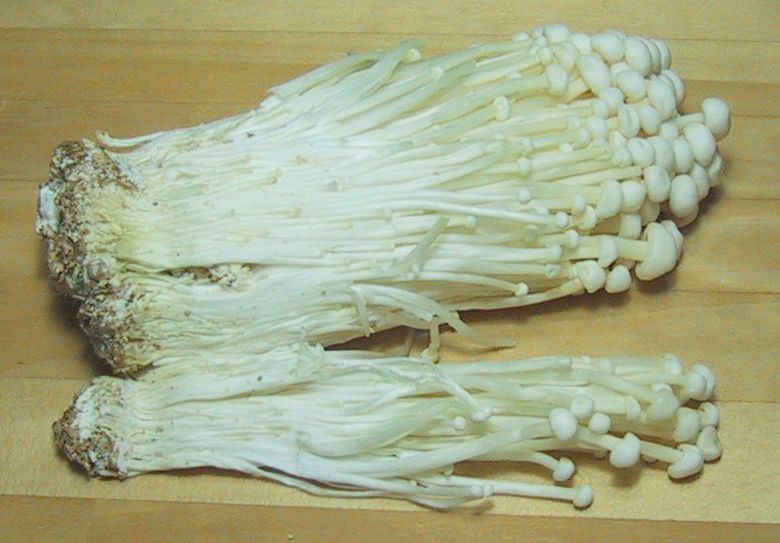
Cultivated Flammulina velutipes, called enoki mushrooms.
Image courtesy of Wikipedia user Chris 73, via Wikipedia Commons


Do you know the enoki mushroom?

If you know the skinny white enoki mushrooms you buy in the store, then you actually know the velvet shank, kind of. The enoki is also Flammulina velutipes, but it's cultivated in very specific ways, to make it look, and in many ways taste, like a different mushroom. By growing it in complete darkness, it turns white instead of cinnamon brown, and forcing the stems to grow long and skinny keeps them tender, where in the wild they are tough and chewy. 

Despite the more tender texture of the cultivated variety, I GREATLY prefer the stronger, more umami flavor of the wild version. When cultivated they become tender and mild, but wild they are a very exciting mushroom, with a very meaty texture and a buttery, nutty flavor. 

Keep reading to learn more on how to accurately identify the velvet foot mushroom, and avoid the very similar-looking, DEADLY Galerina.

Monday, October 8, 2018

Mushroom identification: the pigskin poison puffball or earthball


This rotund little mushroom is Scleroderma citrinum, commonly known as the pigskin poison puffball (from here on referred to as PPP).

Pigskin poison puffballs live near the bases or exposed roots of trees, especially oak, maple and conifers. 

PPPs are a very common mycorrhizal species, usually found at the bases of older trees (though sometimes young trees can have them as well), and often among exposed roots. (Mycorrhizal means they have a symbiotic relationship with plants, in this case trees).

As a child, this was my favorite mushroom. In late September and early October I would run around the neighborhood oaks and give each PPP I found a tentatively gentle squeeze. If it felt ready--less firm and slightly squishy--I would stand up, back off, and run two or three steps to jump on the mushroom as hard as I could, so that it would truly explode in a cloud of spores.


Friday, March 3, 2017

The edible and medicinal wood ear mushroom: Auricularia species. Foraging, identifying and preparing this wild mushroom.


  Identification difficulty level: Beginner

2022 Update Note:
Between 2013 - 2015, extensive DNA analysis was done on the mushrooms previously known as Auricularia auricula, and it was discovered that what was believed to be one species was actually a cluster of closely related species. This information was not confirmed until 2019, and not widely published until recently. 

Auricularia auricula-judae was discovered to actually be multiple different species that look and act very similar. The name Auricularia auricula-judae now only applies to the European species.

The Asian species have been renamed as Auricularia heimuer and Auricularia villosula, and the American species are Auricularia angiospermarum (on broadleaf trees) and Auricularia americana (on conifers). 

I have gone ahead and edited this post to simply refer to the mushroom as Auricularia species, as all the identification features remain the same. 


Auricularia species are better known as the wood ear, jelly ear, or tree ear, it also has an outdated name of jew's ear. In China it's called the black fungus, cloud fungus, black mushroom, or black jelly mushroom. It's widely used as both food and natural medicine, having anti-tumor (anti-cancer), anticoagulant, cholesterol-lowering, and hypoglycemic effects.


As a bonus, it's a fairly easy mushroom to identify, though there are similar looking fungi, they aren't poisonous, and many are actually edible. But, as always, it's your responsibility to make sure you are 100% positive you have a correct identification, by corroborating with several reliable sources and/or local experts.

One note of caution: because of the anticoagulant effects, it's important not to consumer wood ear if you are on blood thinning medications.

Now, on to identification and cooking tips!

Thursday, December 29, 2016

Winter oyster mushroom identification tips for foragers, locavores and more! Easy winter foraging for wild food.


Identification difficulty: Novice

December 2016 saw an abundance of one of my favorite mushrooms: the winter oyster (Pleurotus ostreatus). I wasn't the only one finding abundant flushes, Instagram was filled with pictures from all over the country.


Winter oysters are one of the best edible mushrooms. They're frequently HUGE - I've found caps that are 9 inches across when fully mature, though 4 - 6 is more common. They have a super-dense, meaty texture, even more so than summer or store-bought oyster mushrooms. They make an exceptional vegan alternative to meat or seafood, especially when properly prepared. They are also great on the grill.

NOTE: there is another mushroom sometimes called the fall or winter oyster mushroom. It looks very similar to Pleurotus ostreatus, but it's actually totally different -- even in a different family. It's Latin name is Panellus serotinus, and it's edible too, but can be bitter, and requires a LOT of long, slooow cooking. It has a different stem and often a different color. Keep reading for more information.

While not exactly a beginner's mushroom, I personally consider the winter oyster mushroom to be a pretty straightforward identification, even for the novice. Summer oysters are actually harder to ID, because there are more similar looking species when it's warm. In just 5 simple steps, you too could be enjoying these tasty foraged mushrooms!

Saturday, November 5, 2016

The ringless honey mushroom: Desarmillaria caespitosa (Formerly Armillaria tabescens)


Identification of the ringless honey mushroom, Armillaria tabescens, is not for beginners. This edible wild mushroom is excellent for foraging, but take care to follow all the advice for identification. #ForagedFoodie #armillariatabescens #armillaria #honeymushrooms


Warning: this is NOT A BEGINNER's mushroom. 

This mushroom cannot be positively identified by observing features alone, a spore print must be done for positive identification. This mushroom has many lookalikes, some of which are deadly, others will make you very sick. Use the following tips as a guideline only, but confirm your identification with other reliable sources and a trusted local expert.   

As always, it's your responsibility to make sure you are 100% sure of any wild plant or mushroom you consume.  

Finally, even when properly ID-d, ringless honeys are notorious for giving some people ACUTE GI problems. Always try a very small amount, like a single cap, for the fist time, then a small portion (3-4), before you consume a whole meal's worth.

Identification difficulty level: Intermediate 

Armillaria tabescens, commonly known as the ringless honey mushroom, is one of the most prolific edible wild mushrooms of early fall, at least some years. When they fruit, I find I can't go anywhere without tripping over hundreds of patches, still other years I won't see a single one. 

2022 Update Note:

Originally believed to be a species within the genus Armillaria (the ringed honey mushrooms), recent (2017-2019) Korean DNA sequencing has proved that ringless honey mushrooms are actually different enough to be their own, related, genus. 

The new name for this genus is currently Desarmillaria.

Further sequencing in late 2021 revealed that the North American and European species are not exactly the same, meaning the name Desarmillaria tabescens belongs to the European species (which was discovered first) and the new name of Desarmillaria caespitosa has been created for the North American species. I have updated this 2016 post accordingly. NO ID FEATURES HAVE CHANGED, ONLY THE NAME. 
 
Please read carefully all content below. Each step, including location and substrate, is essential to identification of this fungus. Wherever possible, I have tried to illustrate every single feature with a photograph, or two.

I chose to write this article because a blog post can show many, many more pictures than a book can, allowing me to really illustrate more features.