Showing posts with label scaly cap. Show all posts

Sunday, May 29, 2022

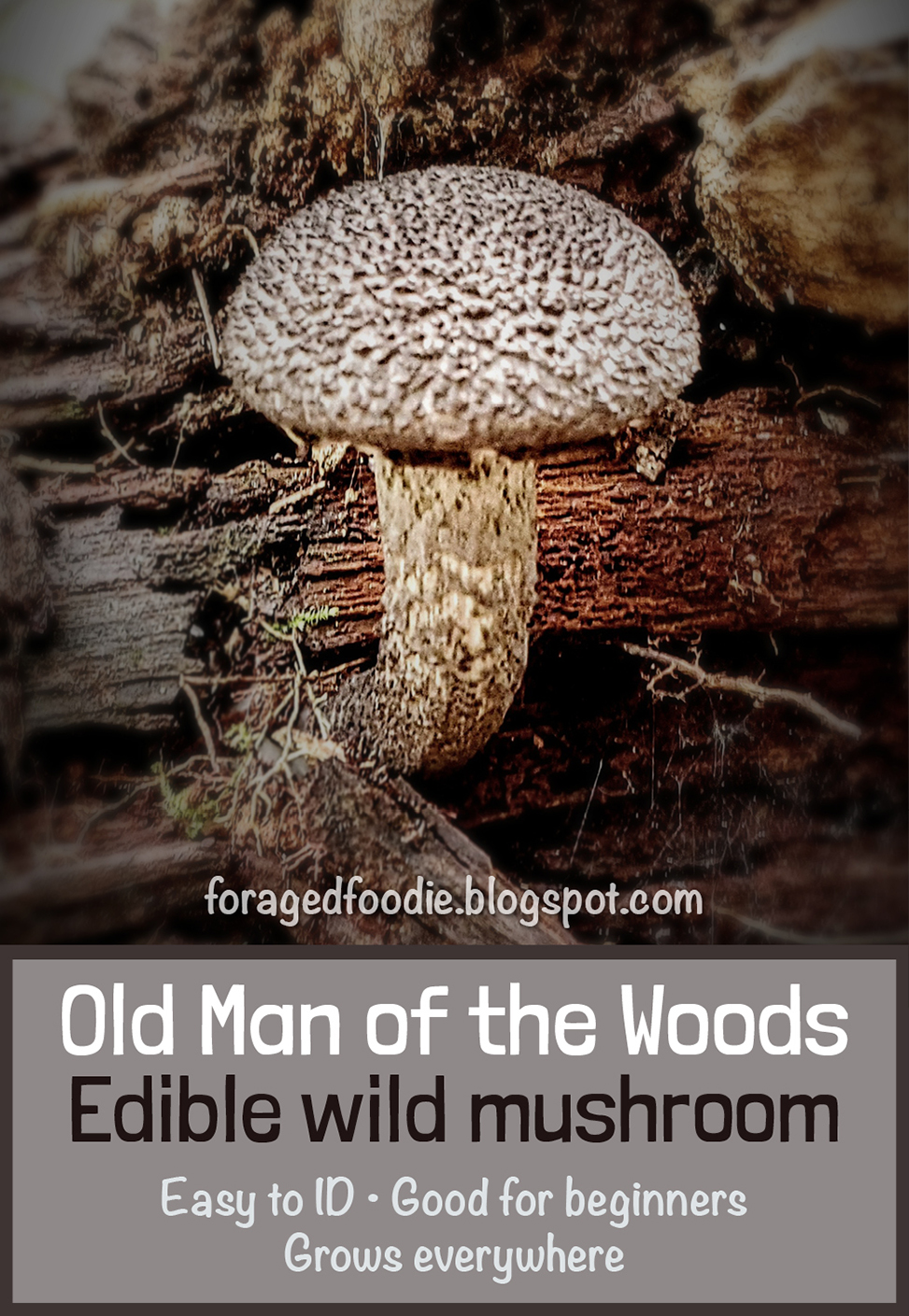
Beginner foraging: old man of the woods mushroom identification


Identification difficulty: Beginner

Meet the old MEN of the woods, "Strobilomyces strobilaceus" (though most books will use the term Strobilomyces floccopus) and Strobilomyces confusus. 

Old MEN, you ask? Yes, in the Americas the common name "old man of the woods" is often used interchangably for two different species of Strobilomyces that look rather similar. And there is still a different "old man of the woods" in Europe and Asia.

Confused yet? The naming gets worse.

The Latin name Strobilomyces strobilaceus applies only the European species. DNA studies have shown that the American mushrooms--previously believed to be identical--are genetically different, but a Latin name hasn't been chosen yet. 

From a foraging and edibility standpoint, none of this matters. All species share the same identification features, but if you're curious about species naming, check out the taxonomic confusion section at the end of this post. 

Old man of the woods identification
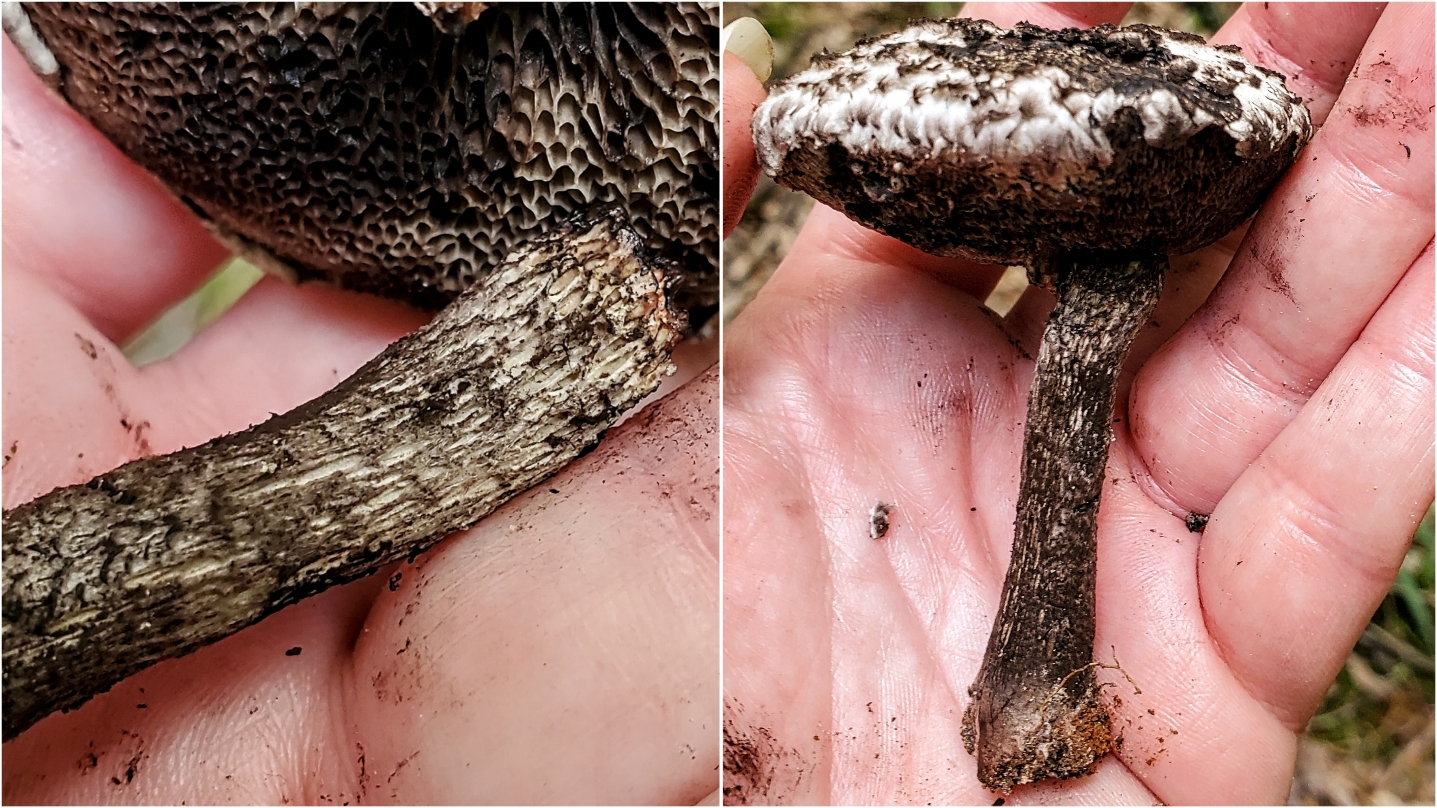
  • A cap and stalk mushroom 
  • Pores under the cap instead of gills.
  • Mushroom cap is light gray with dark gray to black textural elements. Textures can resemble large gray/black "flaps" that hang down (S. strobilaceus), or small gray/black pyramids that stick up (S. confusus). 
  • Pore surface is pale gray to charcoal gray to black. 
  • Pores aren't round, instead they are angular polygons, often elongated.
  • Stem is also dark gray or black and textural, with dark scales along most of the length.
  • Entire mushroom bruises pink or red when bruised or cut. This color slowly fades to gray or black. 
  • Found in the woods, growing terrestrially (on the ground) or on logs so well-decayed they are basically soil.

That's really all there is to know about identification, this really is an easy group of mushrooms to ID.

Monday, October 8, 2018

Mushroom identification: the pigskin poison puffball or earthball


This rotund little mushroom is Scleroderma citrinum, commonly known as the pigskin poison puffball (from here on referred to as PPP).

Pigskin poison puffballs live near the bases or exposed roots of trees, especially oak, maple and conifers. 

PPPs are a very common mycorrhizal species, usually found at the bases of older trees (though sometimes young trees can have them as well), and often among exposed roots. (Mycorrhizal means they have a symbiotic relationship with plants, in this case trees).

As a child, this was my favorite mushroom. In late September and early October I would run around the neighborhood oaks and give each PPP I found a tentatively gentle squeeze. If it felt ready--less firm and slightly squishy--I would stand up, back off, and run two or three steps to jump on the mushroom as hard as I could, so that it would truly explode in a cloud of spores.


Saturday, November 5, 2016

The ringless honey mushroom: Desarmillaria caespitosa (Formerly Armillaria tabescens)


Identification of the ringless honey mushroom, Armillaria tabescens, is not for beginners. This edible wild mushroom is excellent for foraging, but take care to follow all the advice for identification. #ForagedFoodie #armillariatabescens #armillaria #honeymushrooms


Warning: this is NOT A BEGINNER's mushroom. 

This mushroom cannot be positively identified by observing features alone, a spore print must be done for positive identification. This mushroom has many lookalikes, some of which are deadly, others will make you very sick. Use the following tips as a guideline only, but confirm your identification with other reliable sources and a trusted local expert.   

As always, it's your responsibility to make sure you are 100% sure of any wild plant or mushroom you consume.  

Finally, even when properly ID-d, ringless honeys are notorious for giving some people ACUTE GI problems. Always try a very small amount, like a single cap, for the fist time, then a small portion (3-4), before you consume a whole meal's worth.

Identification difficulty level: Intermediate 

Armillaria tabescens, commonly known as the ringless honey mushroom, is one of the most prolific edible wild mushrooms of early fall, at least some years. When they fruit, I find I can't go anywhere without tripping over hundreds of patches, still other years I won't see a single one. 

2022 Update Note:

Originally believed to be a species within the genus Armillaria (the ringed honey mushrooms), recent (2017-2019) Korean DNA sequencing has proved that ringless honey mushrooms are actually different enough to be their own, related, genus. 

The new name for this genus is currently Desarmillaria.

Further sequencing in late 2021 revealed that the North American and European species are not exactly the same, meaning the name Desarmillaria tabescens belongs to the European species (which was discovered first) and the new name of Desarmillaria caespitosa has been created for the North American species. I have updated this 2016 post accordingly. NO ID FEATURES HAVE CHANGED, ONLY THE NAME. 
 
Please read carefully all content below. Each step, including location and substrate, is essential to identification of this fungus. Wherever possible, I have tried to illustrate every single feature with a photograph, or two.

I chose to write this article because a blog post can show many, many more pictures than a book can, allowing me to really illustrate more features.