Showing posts with label spring mushrooms. Show all posts

Friday, April 17, 2026

How to identify superfood honeycomb fungus, perfect for beginners

Latin name: Favolus brasiliensis (and related species)
Common name: Honeycomb fungus, chicken breast mushroom
Season: Spring, fall, and cool, wet summers
Edibility: Entire mushroom
Flavor: Fair taste, very chewy texture
Medicinal value: Unknown
Nutritional value: Superfood status: protein, fiber, minerals, micronutrients

Identification difficulty: Beginner 

Favolus brasiliensis is commonly known in the United States as the honeycomb fungus and in South America as the chicken breast mushroom. It's a superfood you've never heard of that's cultivated for by the indigenous people of Brazil. It's incredibly easy to identify, with no poisonous look-alikes as long as some very basic features are checked off. 

Though F. brasiliensis is the type species for this genus, there are many other virtually identical species that can be found in the Americas, Asia and parts of Africa. One such is F. tenuiculus, the tropical honeycomb fungus, which might actually be what I found here, as this species also grows in Texas.

I have been looking for this mushroom for around 10 years, having first found it the fall of 2016 after we moved to Texas, but not realizing it was edible at the time. Despite finding it many times since then, it was always buggy, dried out, decaying or otherwise unpalatable. The relatively dry flesh of this fungus seems to make prone to going bad more quickly than similar mushrooms. 

Honeycomb fungus season and range

Unfortunately, the honeycomb fungus is not widely distributed in North America, being limited to the Gulf Coast states of Florida, Alabama, Mississippi, Louisiana, Texas, and their near neighbors, Georgia, Arkansas, South Carolina, and Oklahoma. It might also be found in North Carolina, Tennessee and Kentucky. It is common throughout Mexico, Central and South America, though, as always, this blog is specifically focused on the continental United States. 

It has a distant northern cousin, the hexagon-pored polypore or Neofavolus alveolaris that I have eaten in the past and found to be not very good. The hexagon-pored polypore is also much smaller and rarely grows abundantly, making it much less worthy to harvest. But given what I've learned about F. brasiliensis as a superfood, I wonder if N. alveolaris is as well. 

I've found this mushroom in both the spring and the fall and it's reported in the summer as well, if the summers are cool and wet. 

Honeycomb fungus growing conditions

F. brasiliensis is found exclusively growing on wood that is either recently dead or almost dead. The logs or trees should still have all or almost all of their bark. Though I've encountered it 8 years out of 10 in Texas, I've only ever encountered it on the same tree twice. This was specifically on a barely living tree, leading me to suspect that the honeycomb fungus requires undecayed tissue to consume.  

Cap and stalk features

Note the very short "stem" with decurrent pores
The honeycomb fungus grows like a shelf off of the log or tree. Shelves are between 2" and 6" wide and as much as 4" from the tree attachment to the edge. The mushrooms often grow in overlapping clusters.

The mushroom is often stalkless/stemless but sometimes has a stalk that is very short as compared to the size of the mushroom, no more than around 1" long, often half that. 

The edges of the caps are either smooth half-circles or ovals, or have large, smooth scalloped frills.

When fresh, the honeycomb fungus is pure white all over. It is also vaguely translucent at the thin edges. As it ages it becomes first soft white and more opaque, then cream or off-white and eventually yellowish, especially at the edges. 

The mushroom has an unusual texture. It feels somewhat hard and brittle, like a hard rubber or a rubberized plastic.

Pore surface features

Honeycomb fungus has pores on the underside, not gills! This is the most important identification feature. The pores are white or off-white like the caps and they are shaped like somewhat like elongated hexagons--hence the name "honeycomb fungus." This is an organic organism though, and the pores are rarely even or clearly defined as hexagons. But they are always large and most often elongated. 

The spore print is white, but doing a spore print isn't required for identification.

The pores are "decurrent" which means they run down the stem, if there is a stem present. 

Honeycomb fungus identification checklist

So, to summarize the above your honeycomb fungus should have all of the following:

  1. All white to cream color
  2. Grows on dead or dying wood that still has all it's bark
  3. Grows like a shelf off the wood
  4. No stem or a stem that is very short (around 1" or less)
  5. A pore surface on the underside--not gills!
  6. Pores are shaped like elongated hexagons
  7. Pores are decurrent--they run down the stem (if present)
  8. Hard and brittle texture that feels somewhat like hard rubber or rubberized plastic

Honeycomb fungus nutrition information

As I said before, the honeycomb fungus is a superfood that you've never heard of. And, in most English mushroom hunting and identification books it's listed as inedible, or even poisonous! But that's largely due to a lack of understanding and a Western preference for mushroom taste over nutritional or medicinal properties. 

Most of the mushrooms eaten in Europe and North America are selected for their sweet, nutty, umami, spicy or meaty flavors, but in Asia, parts of Africa and South America, nutrition and/or medicinal qualities are as important as taste--sometimes even more so!

Recently, the government of Brazil did a study of the wild foods eaten by it's indigenous peoples, one of which was the honeycomb fungus, Favolus brasiliensis. You can read the report abstract here.

But I'll summarize some of the highlights here for you. The honeycomb fungus contains a whopping 27% crude protein--a much higher percentage than any commercially available mushroom. It also contains 17% crude fiber, 1.5% ether extract (fatty acids) and 1.7% minerals. While this is a lower percentage of minerals than some other mushroom varieties, there is an enormous range of micronutrients included. Alongside the nitrogen, phosphorus, calcium, and potassium found in most mushrooms, we also find magnesium, sulfur, manganese, copper, zinc, cobalt and molybdenum. 

The protein, fatty acid and micronutrients that are more often found in meat and dairy, make this fungus especially interesting for vegans and vegetarians--though obviously only if it were ever grown commercially. 

Friday, October 6, 2023

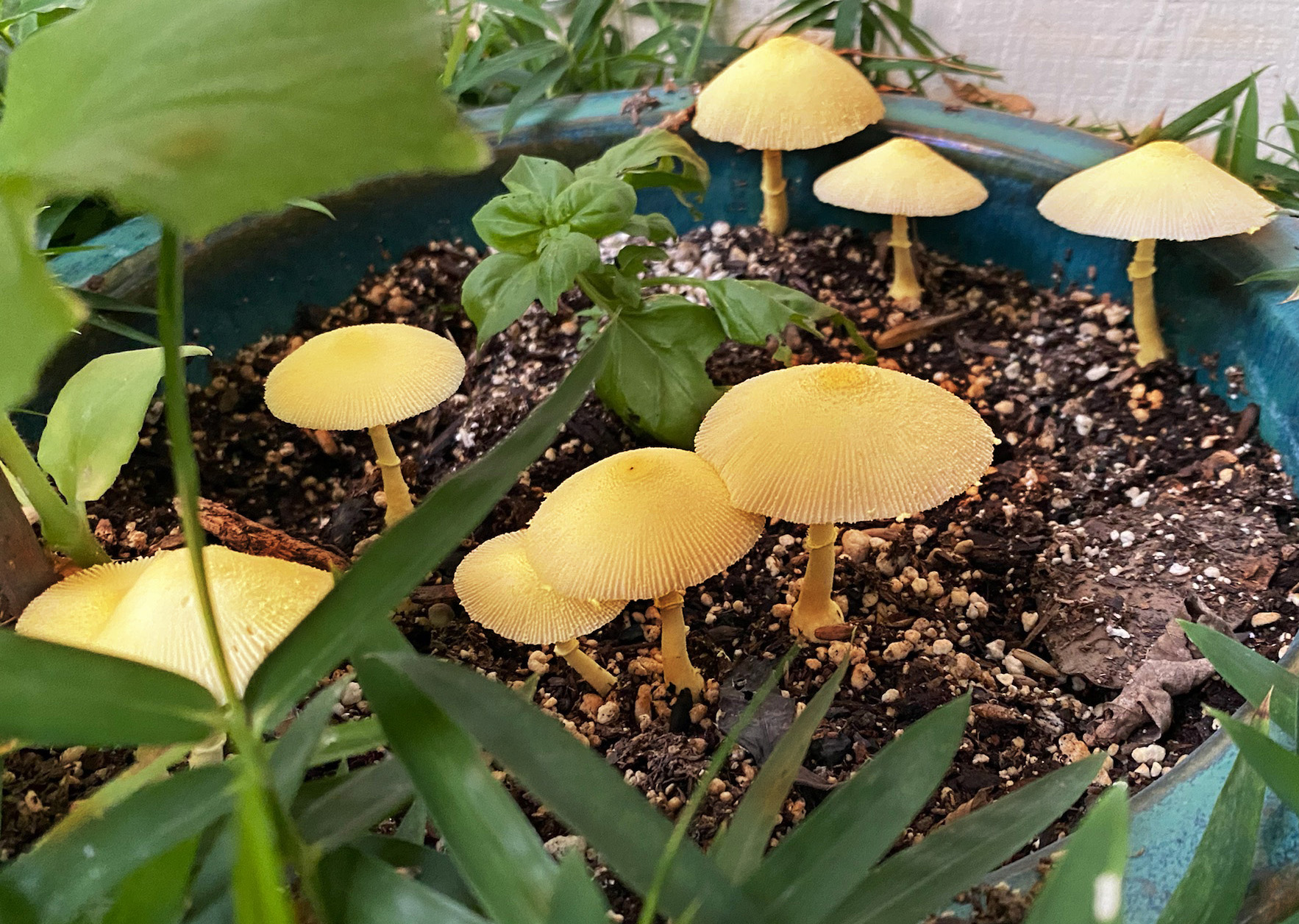
What's this yellow mushroom growing in my houseplant or garden

Nothing edible to share today, but I wanted to make a post about a mushroom that gets asked about all the time on Reddit and Instagram.  

The question "What is this yellow mushroom growing in my house plant / planter / garden?" is one I see every day, and today I'm here to answer it.

95% of the time you are looking at Leucocoprinus birnbaumii, sometimes called the yellow parasol mushroom, the painted dapperling, or the flowerpot parasol. Yes, it's so common in flower pots that it actually has that in the common name. The other 5% of the time you might be looking at the closely related Leucocoprinus straminellus, which is generally a paler shade of yellow, or Leucocoprinus flavescensm which generally has a brown area in the center of the cap.

Both L. birnbaumii and straminellus are tropical or subtropical mushrooms, so finding them in nature in the continental US, Canada or northern Mexico is extremely rare, but extremely common in potting and gardening soil. This is most likely due to the common usage of tropical materials, like orchid bark, in purchased soils. These organic materials may be contaminated with L. birnbaumii spores which then grow mushrooms when conditions are warm enough.

For most North Americans this means late spring, summer or early fall, but if you have a greenhouse, the yellow parasol might pop up anytime. 

Bell shaped when young


Yellow parasol mushroom description 

A bright, dainty mushroom that's yellow all over, cap, stalk and gills. L. birnbaumii is bright yellow and L. straminellus is pale or whitish yellow.

The cap shape starts out as a bell or cone or occasionally a marshmallow shape, then expands to an umbrella, and then the classic, nearly flat, parasol shape. When in the umbrella stage, the edges of the cap generally have fine striations (lines) and the cap will have small fibrous or warty raised areas all over, and the middle area will usually be raised -- this is called an umbo. At maturity, the cap will be anywhere from 1.5" to 3.5" in diameter. 

The stems are narrow near the cap and thicker at the base, even somewhat bulbous as they enter the soil. The stems will usually feature a ring, sometimes a double ring. The mushroom should be 2" to 3.5" high at maturity, but might be as tall as 4.5" in rarer cases. 


Is the yellow parasol mushroom poisonous or edible?

Reports are conflicting on whether L. birnbaumii is toxic, but it definitely should NOT be eaten. Many  Leucocoprinus species are severe sickeners, and symptoms can be dangerous. 

Thursday, January 26, 2017

Mid-winter foraging in Texas, what's in season? (Early spring plants for everywhere else)


I really love living in Texas. The fact that I can forage year-round, even in the dead of winter, makes me so happy. And I've been taking advantage whenever I can. In some ways, the stark landscape makes foraging easier, with no tree leaves to block the view.


I realized I hadn't done a "What's in Season?" post in quite a while, and I also thought that everyone might be curious about mid-winter foraging, especially if you live in the Southern US. So this is kind of a combo post. It's focused on what foraging you can find in Texas in mid-winter, but generally the same plants apply for early spring up in the Northeast and Midwest.

10 Edible plants & mushrooms in Texas mid-winter 


1. Purple deadnettle

Purple deadnettle, or Lamium purpureum, is a common, easy-to-identify, member of the mint family. Like all mints, it's an edible, flavorful, herb. But, it doesn't taste minty, not all mints do. Did you know that basil is a mint? Well it is, and so is oregano, sage, rosemary and more, including deadnettle. Deadnettle is named for its passing resemblance to nettles, the unrelated Urtica genus. Deadnettles LOOK like stinging nettles, with similar heart-shaped leaves, but they don't actually sting. They also have very different flowers, that look a bit like snapdragons and come in pink or purple.

Deadnettle can be eaten raw, though I prefer it cooked, as it has a bit of hair on the stems and leaves. It's very herby, and slightly bitter. Use it like baby kale!

Monday, April 14, 2014

Spring is Springing, and so are the Edibles


Young Ramps just starting to peek out.
Hello! Did you miss me? I wasn't the best blogger last fall, and I certainly was absent all winter. I had plans too. . . I was going to do book reviews during the winter months, but I just couldn't get excited about writing them. No more promises this year. . .I will post when I have something to share, and I won't when I don't.

Anyway, spring is back, kind of--due to the harshness of the season, it's about 2 weeks behind where it usaually is right about now.

If you are new and curious, now is actually a good time to start getting into foraging. Edibles aren't quite as abundant or as large as they will be in a couple of weeks, but they are in some ways easier to spot, as they generally come up earlier than cultivated plants. Of course, they are also harder to ID, since most websites and books don't show the young plants, they only showcase mature specimens.

With that in mind, there are some photos I would like to share, which showcase some of the things popping up right about now,

Before I begin, I want to reiterate the ground-rules. Proper identification is the responsibility of the harvester. I am giving you clues and tips as to how I identify things, it is your job to confirm them with reliable sources to your own satisfaction. If you are ever in the slightest doubt about a plant or mushroom--don't eat itAlso, don't harvest edibles from areas that may be contaminated. This would include areas that may have been exposed to pestasides, fungasides and weed-killers, areas near highways or busy streets, areas that may have had industrial or chemical run-off, and areas frequently trafficked by people walking their dogs. Finally, this guide is for Early Spring (usually late March to early April) in the Northeast, only! That is to say, New England and the Mid-Atlantic states, and north to Ontario and Quebec in Canada. What grows in your spring might be totally different. Even in the Northeast, remember to factor in "early" and "late" spring conditions.