Showing posts with label red stems. Show all posts

Friday, October 4, 2024

Foraging and Identifying EDIBLE black nightshade berries

Latin Name: Solanum nigrum, Solanum americanum and Solanum ptychanthum
Common Names: Black nightshade
Season: Summer through mid fall (northern states/Canada), early summer through fall and early winter (southern states/Mexico)
Edible: Yes, ripe fruit (see note about young green leaves)
Flavor: Excellent 
Medicinal and nutritional value: Undetermined, probably similar to tomatoes 

Identification difficulty: Intermediate

Warning: The plants known as "black nightshades" are in the nightshade family, which has some infamously poisonous and deadly members, including deadly nightshade, Atropa belladonna. The plants we will be discussing today are more closely related to tomatoes and eggplants, and have fruit that is edible when FULLY RIPE and cooked. Unripe fruit has been known to be deadly poisonous, especially to children. Even though we will go over how to safely identify and forage these plants, especial care should be given whenever foraging the nightshade family, and you must consult with several reliable sources regarding identification and safe consumption of these plants. As always, this blog is intended as a guide, but not the sole guide. 

Nightshade. The very name is nearly synonymous in our cultural consciousness with poison. This is odd because, unless you have an allergy, there's a good chance that you eat nightshades most every day. 

Tomatoes, potatoes, yams, eggplant, sweet and spicy peppers, these are all fruits in the nightshade family that are readily eaten in North America and Europe. Central and South American countries frequently eat even a wider variety of nightshades, including groundcherries, tomatillos, and naranjilla. In Southeast Asia one could also find goji berries among the list of commonly eaten nightshades. 

The plants we are going to talk about today are members of the genus Solanum, specifically Solanum nigrum (European black nightshade, African black nightshade or Old-World black nightshade), Solanum americanum (American black nightshade, glossy black nightshade or new-world black nightshade), and Solanum ptychanthum (Eastern black nightshade or Indian black nightshade). The three species of black nightshades are in the same genus as tomatoes, (Solanum lycopersicum), potatoes, (Solanum tuberosum), and eggplants/aubergines (Solanum melongena). 

Collectively, these plants are called black nightshades in North America, a name which encourages confusion and fear with another black-fruiting nightshade called deadly nightshade, or Atropa belladonna. In Europe, these species are sometimes known as garden huckleberries, but the name huckleberry refers to a completely different plant, related to blueberries, in North America. 

In honor of spooky season, I thought it would be fun to share this post in October. Happy Halloween, everyone!


Black nightshade caution and controversy

I'm trying to get more confident at identifying
black nightshades at this young stage so that I may 
try the cooked young leaves. 
There are many sources, including some very official ones, that will tell you that the fruit of black nightshade plants is poisonous. Many state websites state that the ripe fruit is less poisonous than the other parts of the plant, but poisonous nevertheless. Some people say they eat the ripe fruit raw, and still others say it must be cooked. 

Additionally, there are many sources which will tell you that the young leaves and stems are edible cooked and used as a pot-herb in many parts of the world. Still other sources will tell you that the plants may be edible in say, Africa, but become poisonous in North America. There is also the possibility that these nightshades might hybridize with other members of the genus Solanum, and that's why people have found poisonous leaves. . .

So what to believe? Well, I don't know everything, so I am only sharing with you here what I DO know. and that is that I have eaten the fully ripe, black berries, both completely raw and fully cooked and have suffered no ill effects. I have not eaten the young green leaves, but if I do I will let you know. I will not make any statement I have not personally tried myself. 

That said, I would be willing to try young black nightshade leaves, as I trust the sources who say they are edible, but personally I find the young plants difficult to distinguish from other, potentially poisonous nightshades. The plants are hard to tell apart before the flower buds form, and once the flower buds do form, you shouldn't be eating the leaves any longer. 

Mature old-world black nightshade plant, Solanum nigrum, growing on my own property,
portion of a woman's size 10 foot (mine) for scale.
Plant is covered in flowers and both ripe and unripe fruit. 
Photo taken north of Dallas in late May.


Mature American black nightshade, Solanum americanum, growing in one of the most disgusting alleyways in downtown Dallas TX, and absolutely loving it.
Covered in flowers and fruit (I didn't eat, given the location).
This picture was taken in mid-December.


Black nightshade identification

A special note on identification

The three "black nightshade" plants are different but have overlapping features, which makes grouping them together into one ID post rather tricky. Solanum nigrum and Solanum americanum are the most different, and Solanum ptychanthum is kind of like a mix between both features. In fact, some speculate that S. ptychanthum might be a hybrid species from intermixing between the native and introduced plants. Regardless, I will do my best to specify which features are the same and which are different between the species. 

  • S. nigrum, commonly known as black nightshade or European black nightshade is native to Eurasia but has spread throughout the Americas, Australia/Indonesia/New Zealand, and parts of Africa.
  • S. americanum, commonly known as American black nightshade or glossy nightshade, is native to northern South America, Central America, the southern and west-coast states of the United States, and--surprisingly--Australia. It has spread beyond it's native range and can be found throughout the Americas, and has been introduced to many warm-climate regions of the world, including the Mediterranean and many parts of Africa. 
  • S. ptychanthum, or eastern black nightshade is found throughout North America and into Central America. Whether it is native or not is debatable. If it is not native, it is debatable where it originated. There is speculation that it is a hybrid species between S. nigrum and S. americanum. Despite having a larger range than S. americanum, it is less commonly encountered than either of the above species. 
In my experience in the US, S. nigrum is far and away the most abundant of the black nightshades, followed by S. americanum (most abundant on the east coast), while S. ptychanthum is quite rare. Indeed, I am not 100% sure when I have identified it and that I wasn't actually finding a weird S. nigrum. 

S. ptychanthum leaves looking a bit more lanceolate than either other black nightshade, 
but with features that resemble the other 2, including some scalloped edges like S. nigrum,
but also some smoothness at the end of the leaf, like S. americanum.


Black nightshade plant and stem features

  • Black nightshade is a weedy looking plant, not much more than 2 feet tall, often much shorter, and between 8 inches and 4 feet in diameter. 
  • Black nightshade is multi-branching, and will grow stretched out where conditions are less than ideal, but will grow full and bushy where it has good soil and shade. 
  • Black nightshade stems are green (S. americanum) or green with red/purple branch nodes (S. ptychanthum and S. nigrum). In some cases of heavy sunlight, S. nigrum and S. ptychanthum will have fully red-purple stems.
  • Black nightshade will reach its full size somewhere in late spring, but will not fruit until summer.
Purple/red blotches at the stem joints of S. nigrum; also note the unripe fruit, (which is poisonous),
with calyxes that are smaller than the berry.


Scalloped leaves on S. nigrum; S. americanum has smooth leaf edges.

Black nightshade leaf features

  • Black nightshade leaves are generally diamond-shaped or pointed-egg shaped. Leaves are shorter on the side attached to the petiole (leaf stem) and elongated after the widest part of the leaf. In poor growing conditions these leaves can be more lanceolate.
  • S. nigrum leaves can be quite large when mature, as large as a deck of cards. These leaves will have large scallops on the leaf edges. S. nigrum leaves are a solid bright green to emerald green with a prominent central mid-vein. Veins branch off the mid-vein and angle forward to the leaf edge. 
  • S. americanum leaves are around 1/3 to 1/2 smaller, not much larger than an extra-large chicken egg, at the largest. American black nightshade leaves are emerald green and may have a "mottled" light green pattern, like a turtle's shell. S. americanum leaves have a central mid-vein, and the veins that branch off angle forward, but they don't go to the leaf edge, instead they curve into the next vein. 
  • S. ptychanthum leaves have features resembling both S. nigrum and S. americanum. 
  • Leaves do NOT appear as a compound leaf, which is to say, they do NOT appear like multiple leaflets growing off a central leaf stem. (More on this later)
  • Most black nightshade leaves are lighter on the underside than on the top, but only slightly. The undersides are definitely not silvery or white. S. ptycanthum, however, can have purple or dark grey on the underside of the leaf.

Both S. nigrum (left) and S. americanum (right) exhibiting what
I've termed "fractal threes" leaf growth. Many nightshades grow leaves like this.


"Fractal threes" leaf growth


Many plants in the nightshade family exhibit a leaf growth that I call "fractal threes" -- I'm not sure if there is a scientific name for the term. If you look at the image directly above, you will see that leaves grow in sets of 3, which then continually add in triads. 

The image of  S. nigrum (left) has 3 large leaves, but the 2 bottom leaves have grown 2 more leaves each, making them into new sets of 3. Additionally, the  2 smaller leaves on the top set each have tiny little leaves growing, again producing sets of 3. Unfortunately, many other nightshades, including poisonous ones, also exhibit this feature. 

Another detail of the repeating patterns of threes in nightshade leaf growth,
this example is S. nigrum


Black nightshade flower features

  • Black nightshade flowers have WHITE petals with yellow centers. Petals are not yellow, and especially not purple, blue, pink or burgundy. 
  • Black night shade flowers have 5 petals, arranged like a traditional star--NOT a bell or tube.
  • The petals of black nightshade flowers are straight at first, but eventually bend backwards, making the flower resemble a firework.
  • The yellow anthers, at the center of the petal cluster, are quite prominent and stick out significantly. 
  • Flowers grow in clusters, where each flower is on a stem, but the stems come together at a single point attaching to the branches. Together the flower stems bow slightly, reminding me of the ribs on an umbrella. 
    • Flowers do not grow individually, nor do they grow in a line

Focus on the calyxes

Black nightshade calyx features

The calyx is a "whorl" or "crown" of sepals (flower parts) after the flower has seemingly died away. The calyx is most often green and will resemble a leaf formation to the untrained eye. The calyx appears on top of the fruit, where the fruit stem attaches. 
  • Black nightshade berries have 5-part calyxes that are SMALLER than the diameter of the berry, and curve backwards towards the fruit stem. 
  • The calyx looks like leaves forming a crown at the top of the berry.
  • Black nightshade calyxes are green/dark green and not purple or reddish
  • Calyxes are rounded on the ends, or come to soft points; they do not come to long, sharp points that look like daggers or claws.

S. nigrum fruit showing green fruit, partially ripe red/green fruit and 
fully ripe black fruit. Only the ripe fruit should be eaten.


Black nightshade fruit features

  • Black nightshade fruits in summer and fall, into winter in the Southern United States. The plant will frequently have both flowers and fruit on it at the same time, helping with identification. 
  • Unripe fruit, which is poisonous, should not be eaten
    Black nightshade fruits are green when unripe and black* when ripe.
  • Fruit ripens from green to dark green to purple-green to black. It never has a yellow, orange or red phase. If you find fruit in these colors you have the wrong plant.
  • Fruit is small, slightly smaller than a pea (1cm/.4 of an inch) for S. americanum and S. ptychanthum, and slightly larger than a pea for S. nigrum. When green, fruit is the size of a pencil eraser. 
  • Berries are shiny/glossy for S. americanum, and matte or dull for the other two species of black nightshade.
  • Berries grow in clusters, NOT INDIVIDUALLY. The clusters hang from fruit stems, all of which come together at one point. The fruit also does not grow in a line. 
  • Ripe black nightshade fruit are filled with tiny seeds that surround a central core (rather like a tiny tomato). Between the seeds the flesh is juicy and translucent, like a grape but softer and purple. 
* Some varieties produce reddish-orange fruits, but these do not grow in North America, and should not be eaten if found unless you trust a local expert to identify them for you. 

Very young black nightshade

Very young black nightshade leaves are edible, but resemble far too many other members of the nightshade family, including poisonous or deadly species. I currently avoid young nightshades and recommend the same for anyone who isn't very experienced. 

Sunday, February 18, 2024

Foraging prickly sow thistle: pictures, flowers, leaves & identification for Sonchus asper

Latin Name: Sonchus asper
Common Names: Prickly sow thistle, spiny sow thistle, sharp sow thistle, rough milk thistle
Season: Early spring
Edible: Yes 
Flavor: Good
Medicinal and nutritional value: Vitamin rich, antioxidant strong, liver and kidney purifying 
Identification difficulty: Beginner


The leaves of this plant are at a good stage for harvest

Despite the texture, prickly sow thistle is one of the edible wild plants I look forward to the most every spring. 

If you can work around the prickles, which is easy enough to do when planning dishes that need to be pureed (like sauces and soups), you are rewarded with a wonderfully rich leafy green. The flavor is generally very mild with only a slight bitterness, comparable to swiss chard or belgian endive, to add complexity. Most everyone who eats leafy greens will enjoy properly prepared prickly sow thistle. 

Perhaps even better, prickly sow thistle is extremely common 


Nutritional & medicinal benefits

The sow thistle family (Sonchus) is one of the ones where a significant amount of research has been done into nutrition and potential medicinal benefits. Sow thistles have long been accepted as health foods, associated with liver and kidney purification. 

Recent studies have shown that the sow thistles, particularly the prickly sow thistle, are antioxidant powerhouses. Antioxidants have been shown to reduce the effects of aging, both on the body and mind. They also lower your cancer risk. 

While antioxidant extractions are available in pills, syrups, etc., studies show that the best way to gain the positive effects of antioxidants might simply be to incorporate a large number of antioxidant-rich foods into your diet. 

All three sow thistles were found to be rich dietary fiber and in vitamin E, though smooth sow thistle (Sonchus arvensis) had the highest concentrations. Like most leafy greens, sow thistles have a lot of valuable minerals, including potassium, calcium, magnesium, iron, zinc, sodium and selenium. Smooth sow thistle is the best of the 3 for potassium, common sow thistle has the highest concentration of iron and prickly sow thistle offers the most calcium. 

As an added bonus, sow thistles DO NOT have large amounts of oxalic acid, even though they exhibit red coloration. They contain less than 10% of the oxalic acid found in spinach or swiss chard, for example, and less than 5% of the oxalic acid in purslane. 

To learn more about the antioxidant properties of prickly sow thistle, check out this article from the National Library of Medicine. 

To learn more about the nutritional qualities of the sow thistle genus, please read this article from the National Library of Medicine. 


History as a food crop

There are three, common, wide-spread sow thistles: Common sow thistle (Sonchus oleraceus), prickly sow thistle (Sonchus asper) and smooth sow thistle (Sonchus arvensis). They are native to Europe, particularly the Mediterranean regions. They are now found throughout temperate North and South America, Australia and New Zealand, the Middle East, and much of Asia and Africa. 

A good-sized haul of prickly sow thistle leaves,
ready to cook and eat

Our earliest record of sow thistles as a food comes from the ancient Greeks, who considered it to be strengthening, and used the non-prickly varieties in salads, especially during winter time when greens were scarce.

Europeans in the middle ages valued the sow thistles for animal feed. The name "sow thistle" comes from farmers feeding the plant to sows with piglets; it was believed that this plant increased lactation.

As traditional agriculture became the standard in Europe and European colonies, like the U.S., sow thistles came to be regarded as common weeds, and a great deal is spent to eradicate them. 

But that is not always the case in areas where sow thistles have spread. 

As European agricultural practices spread with colonization, many native species of plants, which were essential food sources for the native peoples, were wiped out. Eurasian plant species had evolved a centuries-long history of competition, due to exposure to other plant species spread via trade routes. As a general rule, these plants could out-compete native species, which is why dandelions, plantains, sow thistles and others are considered common weeds today. 

But many native peoples have embraced the "weeds" traditional agriculture rejects, and have used them to supplement or replace native plants that have been decimated. Sow thistles in particular are consumed by the Māori of New Zealand and the by the native peoples of the rural Brazilian rainforest regions.

In addition to the three most wide-spread sow thistles there are many regional species, especially in Africa and some hype-local species in places like the Canary Islands, some of which are used for food. 

Sunday, April 24, 2022

Foraging: Identification of edible, young spring pokeweed / poke sallet


Identification difficulty: Novice

This post is a long time coming, I really should have made this post a long time ago. You see, it's bothered me for a while that pokeweed, Phytolacca americana, is such a popular edible wild plant, such a well-known plant, such a historically significant plant, and yet there is so very little info out there helping identify it when it's young and harvestable. 

There is a ton of info to help identify the mature plant, which is very easy to ID. But as I wrote once before, you can't EAT pokeweed when it's mature -- it becomes fatally poisonous. 

But in the early spring, they young shoots and leaves can be harvested, and, if properly prepared, are safe to eat -- even delicious. Like the best baby spinach you've ever imagined. 

It's such a popular food of the American South that it's been a part of our nation's cultural heritage, even becoming the theme of a hit song, Poke Salet Annie, in the late 1960s. 

If you've been curious about how to safely identify pokeweed when it's young, you've come to the right post!


Common places to look for pokeweed

Pokeweed is a transitional understory plant. Transitional meaning it thrives in the transitional period where as field and meadow become forest. It gets crowded out fairly easily by trees, so you will rarely find it in deep forest, instead look for small forest clearings (usually where a massive old tree has fallen, leaving an open space), on the edges of meadows or farmland and along man-made or animal trails. In nature, "washes" -- places where spring rainwater frequently comes down the sides of hills, clearing out small trees, frequently grow pokeweed.

This pokeweed is too mature to eat.
But it is growing in a classic spot: on
the edge between a field and woodlands
Pokeweed seed reproduction is very complicated. The seeds can't germinate UNLESS they've been swallowed and digested by a bird--exposed to that specific mix of chemicals inside an avian GI tract--and deposited in the highly acidic bird feces. 

However, if pokeweed roots get broken up, any piece of root about 2-3" long can grow a new plant. For this reason, human activity can spread pokeweed around like crazy. During excavation, construction and earth-moving, people may inadvertently break up a pokeweed plant, creating dozens more at the edges of construction, where the root-bearing dirt has been deposited. 

Consequently, look for pokeweed for along the edges of suburban developments built within the past 5 years, or along any area kept clear of trees by human activity: farms, parks/playgrounds, the edges sporting fields and along trails are all good places to look. 

The most pokeweed I personally ever saw was when my parents had their new Connecticut home build in 1990, when I was 10. The land had been farmland until the early 1900s, at which point it had been allowed to grow feral, reverting to forest, with tree ages not that much older than 50 years at most. There were also several clearings. In one of those clearings, where my parents build their house, there must have been at least one pokeweed plant, because when they dug the foundation, they disturbed those roots. For several years after, we had literally HUNDREDS of pokeweed plants surrounding the clearing of our home, until eventually small saplings started to grow into small trees, forcing the pokeweed out. 


Young spring pokeweed identification 

Many North Americans already know mature pokeweed by sight. It's hard to miss, as the plant can grow 6 feet tall and equally wide, in arching red boughs, bearing large, deep green leaves and 4-6 inch clusters of deep purple-black fruit on red stems.  

The problem is, by the time pokeweed is easy to spot and identify, it's well past the point where it can be safely eaten. This post will help you identify young pokeweed in the spring, when its safe to consume (after proper preparation): 

Super young pokeweed growth. Note the stalks of last year's plants in the background

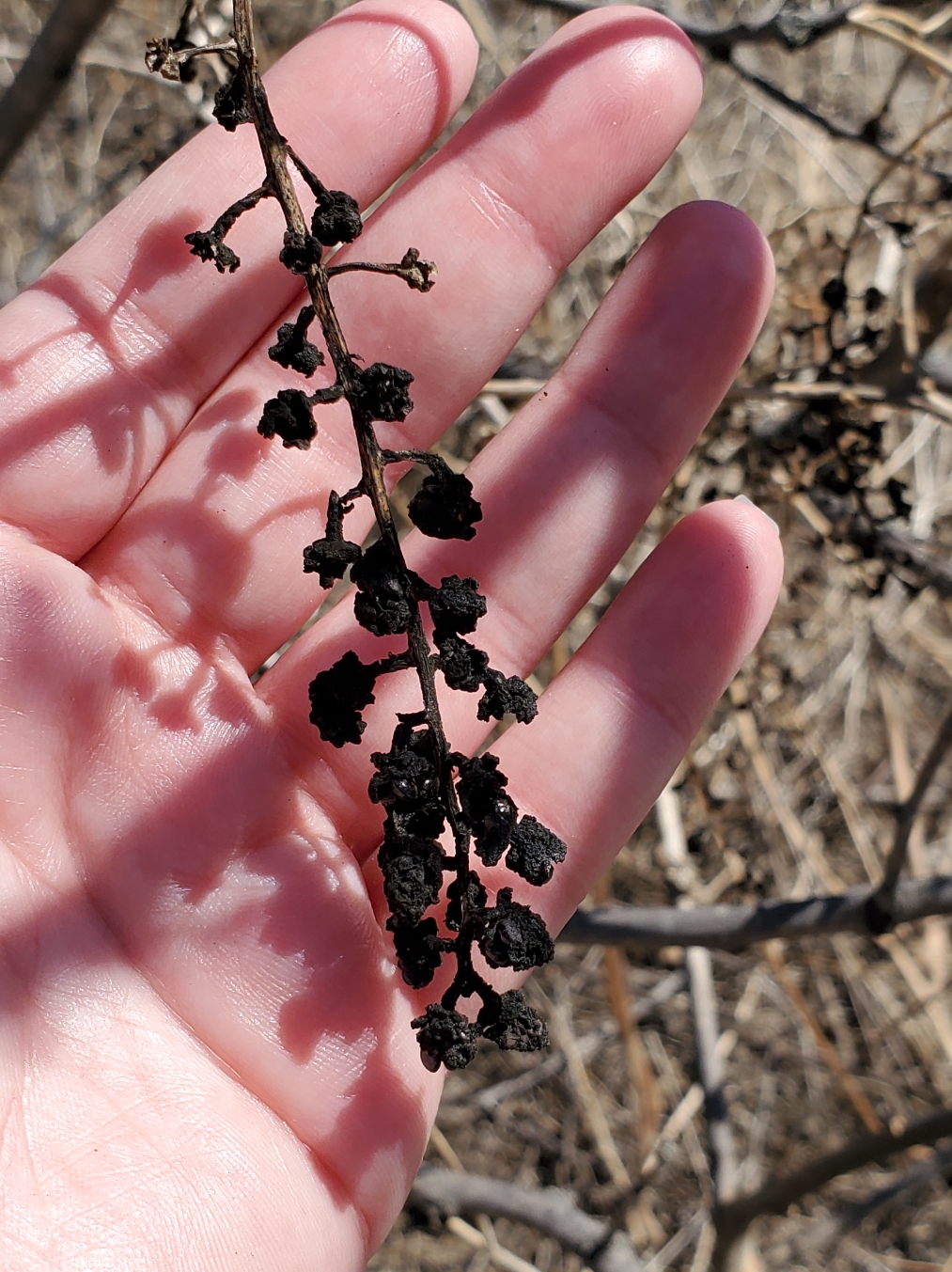
Dried up old fruit is the 
best way to pre-find pokeweed

Finding young pokeweed

When it first pokes out of the ground, pokeweed will mostly be visible by the leaves, which at this stage will be bright green, almost neon, wrinkled, ruffled at the edges, and with very prominent underside veins. 

Pokeweed is perennial: once established, it will regrow from the roots year after year. For that reason, you can find pokeweed before it grows by finding last year's plants. 

The stalks of pokeweed plants are long, hollow tubes that are beige in color, but often feature grey or black streaking and spotting. There will always be some dried up clusters of pokeweed fruit dangling from one branch or another. 

Side note: because old pokeweed stalks are hollow, breaking up the tubes makes an excellent tinder/fire starter, as long as they are very dry. 


The stalk is the most important way to identify pokeweed. 
Note in the slightly older plants on the right, the skin should be peeled away from the plant base
before preparing it for consumption


Stalk color and growth pattern

Pokeweed is safest
when the skin is
super thin, like this
The stalk is the most important identification feature for young pokeweed. The leaves and overall plant shape resemble many other wild plants (some poisonous) but the stalk is very unique -- once you know what to look for. 

The stalk of young pokeweed is translucent neon green tube around a white core, covered with a super thin, translucent skin that peels away pretty easily from breaks. 

The white core of the stalk is actually made up of parallel, horizontal chambers, which you can see easily by breaking into the stalk with a vertical cut. However, the younger the plant, the closer and tighter together the chambers will be, making them harder to see. 

The skin should be green, yellowish or faintly red. If the red coloring is more than just a hint, or faint streaks, then your pokeweed is too mature and should not be eaten. 

There is no hair on the stem, in fact if feels super smooth -- like plastic.

As the plant grows, the skin becomes thicker, and easier to peel away as a whole unit, without tearing. The group of pictures above shows two plants, the core on the left is at the perfect stage of size and growth. The middle and right are at just the last stages, and require a little extra prep work.  Notice on the left how the skin holds together and doesn't tear when pealed away from the central stalk. On plants of this age, I would peel the skin away from the base of the plant, and not cook it. The skin carries more of the dangerous chemicals than the green interior. 

Saturday, November 14, 2015

Foraging: Identifying and Eating Purslane (avoid poisonous spurge!)


Purslane: abundant, tasty, very nutritious, and pretty easy to identify--with just a couple pointers!


Purslane, (latin name: Portulaca oleracea), is a wonderful, edible "weed". It's tasty, versatile, highly nutritious, easy to find, grows everywhere and is relatively easy to identify. It's not native to North America, and so is generally considered to be an invasive weed. For those of you with an interest in sustainable eating, choosing invasive species for your meals is one of the most sustainable, locavore options. There's even a word for it: invasivore!

Purslane does have one dangerous look-a-like: the potentially deadly spurges. (Euphorbia varieties). I find that they really don't look that much alike, and there is one tried and true way to tell them apart--making purslane a good plant for even a novice forager. 

With that in mind, I'd like to tell you everything I know about purslane, including how to identify it, how to not confuse it with spurge, flavor profile and some basic cooking tips. 


Purslane quick history

Purslane has spread throughout all of the Old World, (Europe, North Africa, and Asia). I have heard conflicting accounts wether it originated in India, the Middle East, or the Far East. It't eaten fairly frequently through out it's range, especially in the Indian subcontinent. With European imperialism, purslane spread to Australia and North and South America, and it's eaten there too (especially Mexico)--just strangely not in the U.S. or Canada in the modern day. It was apparently eaten in parts of the US as recently as WWII.

Purslane can be found most anywhere, as can adapt itself to a variety of climates, from arid to damp, hot to cold, and sun to shade. (Not including Antartica and other uninhabitable places, like parts of Canada and Russia. :P  Just kidding!). It's a succulent, and can adapt itself to environments that experience the extremes of seasonal monsoons and months-long droughts.