Showing posts with label poisonous and deadly. Show all posts

Friday, October 6, 2023

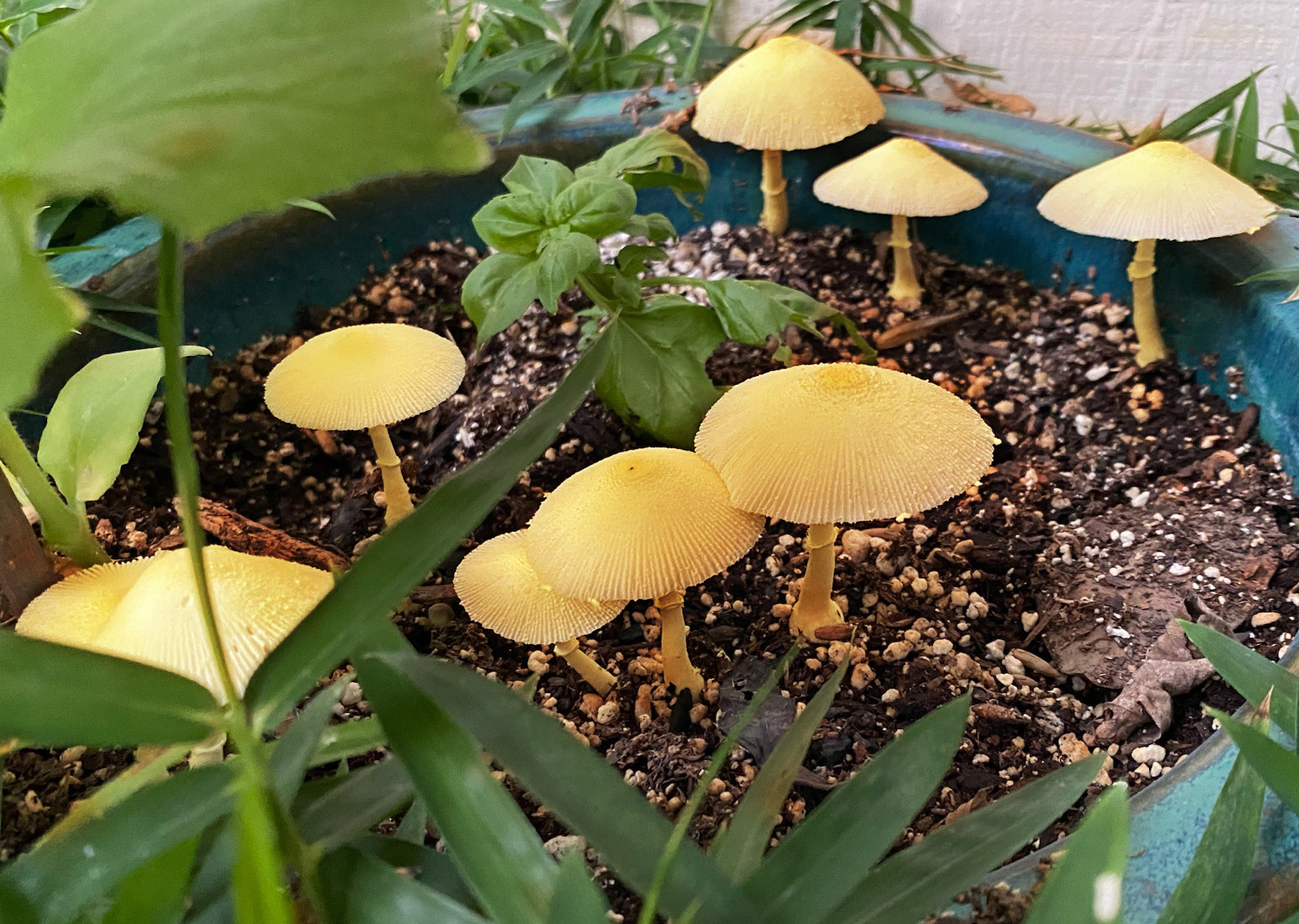
What's this yellow mushroom growing in my houseplant or garden

Nothing edible to share today, but I wanted to make a post about a mushroom that gets asked about all the time on Reddit and Instagram.  

The question "What is this yellow mushroom growing in my house plant / planter / garden?" is one I see every day, and today I'm here to answer it.

95% of the time you are looking at Leucocoprinus birnbaumii, sometimes called the yellow parasol mushroom, the painted dapperling, or the flowerpot parasol. Yes, it's so common in flower pots that it actually has that in the common name. The other 5% of the time you might be looking at the closely related Leucocoprinus straminellus, which is generally a paler shade of yellow, or Leucocoprinus flavescensm which generally has a brown area in the center of the cap.

Both L. birnbaumii and straminellus are tropical or subtropical mushrooms, so finding them in nature in the continental US, Canada or northern Mexico is extremely rare, but extremely common in potting and gardening soil. This is most likely due to the common usage of tropical materials, like orchid bark, in purchased soils. These organic materials may be contaminated with L. birnbaumii spores which then grow mushrooms when conditions are warm enough.

For most North Americans this means late spring, summer or early fall, but if you have a greenhouse, the yellow parasol might pop up anytime. 

Bell shaped when young


Yellow parasol mushroom description 

A bright, dainty mushroom that's yellow all over, cap, stalk and gills. L. birnbaumii is bright yellow and L. straminellus is pale or whitish yellow.

The cap shape starts out as a bell or cone or occasionally a marshmallow shape, then expands to an umbrella, and then the classic, nearly flat, parasol shape. When in the umbrella stage, the edges of the cap generally have fine striations (lines) and the cap will have small fibrous or warty raised areas all over, and the middle area will usually be raised -- this is called an umbo. At maturity, the cap will be anywhere from 1.5" to 3.5" in diameter. 

The stems are narrow near the cap and thicker at the base, even somewhat bulbous as they enter the soil. The stems will usually feature a ring, sometimes a double ring. The mushroom should be 2" to 3.5" high at maturity, but might be as tall as 4.5" in rarer cases. 


Is the yellow parasol mushroom poisonous or edible?

Reports are conflicting on whether L. birnbaumii is toxic, but it definitely should NOT be eaten. Many  Leucocoprinus species are severe sickeners, and symptoms can be dangerous. 

Monday, October 8, 2018

Mushroom identification: the pigskin poison puffball or earthball


This rotund little mushroom is Scleroderma citrinum, commonly known as the pigskin poison puffball (from here on referred to as PPP).

Pigskin poison puffballs live near the bases or exposed roots of trees, especially oak, maple and conifers. 

PPPs are a very common mycorrhizal species, usually found at the bases of older trees (though sometimes young trees can have them as well), and often among exposed roots. (Mycorrhizal means they have a symbiotic relationship with plants, in this case trees).

As a child, this was my favorite mushroom. In late September and early October I would run around the neighborhood oaks and give each PPP I found a tentatively gentle squeeze. If it felt ready--less firm and slightly squishy--I would stand up, back off, and run two or three steps to jump on the mushroom as hard as I could, so that it would truly explode in a cloud of spores.


Friday, August 24, 2018

An Overview of the Genus Cortinarius (Telluride pt. 4)


Note: this post was intended to be a micro-post, but ended up being a summary of pretty much everything I know about the genus Cortinarius, so it'd quite a substantial post indeed!

One of my fellow mushroom hunters in Telluride told me they have a joke out there, that mushrooms that look like these are called "Jac" for "Just Another Cortinarius".

Though from my experience, they could also call them "Jacki" for "Just Another Cortinarius, Kick It". So many of these mushrooms we found had been kicked over, whether from frustration at finding another non-edible species, or as a lazy technique for checking the underside for identification, I'm not sure.

Cortinarius species, commonly called corts or webcaps, are the largest Genus of Agaric (gilled) mushrooms known. They are generally non-edible, some are deadly poisonous, and even the edible ones are generally considered to be poor eating.

Sunday, July 8, 2018

Identifying hemlock, deadly plant, by its leaves. Resembles wild and cultivated carrots, parsley, celery and more.

Poison hemlock (Conium maculatum) leaves closely resemble the leaves of several edible plants.
Skull image designed by Vecteezy www.vecteezy.com

I want to talk to you about a plant that I HAVEN'T eaten.

Pin me!
I haven't eaten this plant, because if I had, I wouldn't still be here.

This plant is Conium maculatum, commonly known as Poison Hemlock. (Also: English or European hemlock, carrot fern, Devil's porridge, spotted hemlock, wild hemlock and poison parsley) It should probably be known as deadly hemlock, as it's one of the most dangerous wild plants you can encounter.

I have read that poison hemlock is so toxic, it has poisoned children who used the hollow stems as whistles -- simply the act of putting it to their lips and later licking them.

C. maculatum, and the closely related (and equally deadly) Water Hemlock (Cicuta species) are members of the greater Apiaceae family. The Apiaceae family is the carrot family, and provides us with many of our most important cultivated edibles, including carrots, parsley, parsnips, fennel, dill, coriander/cilantro, anise and celery. Europeans will also know the food plant "Alexanders".

Because the deadly hemlocks are so closely related to many edibles (including wild carrots/queen anne's lace, sweet cicely, cow parsley, and--more distantly, alexanders (Europe only), parsnips and fennel) they closely resemble them as well, and it's essential for any forager to completely familiarize themselves with hemlock BEFORE they attempt to eat any wild plants in the Apiaceae family.

It's a good thing for gardeners to know about this plant, as it can spring up in their garden, and will resemble carrots, parsley and celery.

But this post will help you safely identify and avoid poison hemlock.

Note: this post deals exclusively with the young, pre-flowering plant, when it is most likely to cause confusion with edible plants like carrot and parsley.

Tuesday, March 14, 2017

How I find and safely eat pokeweed shoots in early spring


Hi all, I'd like to start by saying, this post is my personal story about how I safely eat pokeweed, a plant which can be deadly if not properly harvested and prepared.

I prepare poke the way my Southern grandma did; many people say now that the old ways are too conservative, that the plant is safe to harvest older, and to spend less time processing. I believe that those people do what's right for them, but I don't think that there is a "right for everyone" way to eat this plant. 

Though I will share some tips for identification, this is not primarily an identification post, rather a personal experience post. Maybe I'll do an ID post down the line. 

Pokeweed should not be eaten by young children, or women who are pregnant, looking to become pregnant, or breastfeeding.

UPDATE: I now have an identification post for young spring pokeweed. Read on to learn how to prepare poke, but to identify, click here.


Pokeweed quick history

Pokeweed was extensively eaten throughout the Eastern and Southern United States until quite recently, sometime in the 1960s. It was an especially important food for the early colonists, some Native American tribes, African Americans, and the people of Appalachia. It's free, very abundant, easy to identify and one of the earliest greens that can be harvested in the spring. Pokeweed also has an important role as a dye for fabrics, and in the traditional medicines of the Native Americans and the people of Appalachia.

Pokeweed was most commonly prepared as "Poke Sallet", sometimes corrupted as "Poke Salad" but it's important NEVER to eat these plants raw, doing so can make you sick or worse. Poke sallet are boiled greens that are then fried up with bacon and butter to make a hearty meal perfect for the season: using the end of last years preserved meats with the fresh taste of new greens.

The Declaration of Independence is written in pokeweed ink, as were many of the letters Civil War soldiers wrote home. (It was free and readily available).  Supporters of 1844 Presidential candidate James Polk wore pokeweed on their lapels. (He went on to win, against the odds, and become the 11th President of the United States). Poke Salad Annie was a 1969 Billboard hit, about a poor Southern girl who has to eat poke, as it's free.

Sunday, September 20, 2015

More Dallas Area Hiking and Wild Plant Foraging


So with the weather cooling off slightly (temperatures of 95, instead of 105!), I'm trying to get outside more again. I'm still exploring the Dallas area, for exercise, interest and, of course, wild edible identification.

Being in an entirely new area and ecology really opens my eyes in a different way as I hike. I realized that back home my brain was mostly queued to look for only a handful of wild edibles--things that I knew well and knew I liked. But bereft of those plants and mushrooms, I'm constantly evaluating everything I see, trying to look for similarities with what I know, and just letting myself enjoy the experience.

Friday, September 4, 2015

Identifying the Most Common Poisonous Mushroom: Chlorophyllum molybdites (the Green-Spored Lepiota)

There is one mushroom which I get shown pictures of, and asked to identify, more than any other. It seems to be the most commonly encountered, or at least most commonly noticed mushroom in any region of the U.S. that I have lived.

Many times the request for information also comes with something along the lines of "it looks like it would be tasty!" And, in fact, this large, pristine, ubiquitous, and frequently abundant mushroom does look like it would be a great meal. . .

But looks are frequently deceiving.