Showing posts with label spring plants. Show all posts

Saturday, May 3, 2025

Edible Giant Ragweed Foraging and Identification

Latin name: Ambrosia trifida & Ambrosia trifida var texana 
Common name: Giant ragweed & Texas giant ragweed 
Season: Early spring through early fall
Edible: Yes, seeds, greens, buds, and flowers. But see potential toxicity warning below
Flavor: Fair 
Medicinal: Possible
Nutritional: protein and fats for the seeds, presumably standard green nutritional values for greens
See below for information regarding allergies and potential toxicity 

Identification difficultyNovice when mature, Intermediate when young

Identification note: If you live in a region where giant hogweed, Heracleum mantegazzianum, is known to grow, pay especial attention to the look-a-likes section of this article. Giant hogweed is deadly poisonous and can cause blindness and chemical-like burns from simple contact. 

Please note, I am honestly not sure if the images I have here are for giant ragweed, A. trifida, or its subspecies, the Texas giant ragweed, A. trifida var. texana. The share edibility and identification features. 

Giant ragweed distribution

Giant ragweed is a native North American plant found throughout most of southern Canada, 47 of the 48 continental United States (comically avoiding Nevada), and southern and central Mexico. It has been introduced and become invasive throughout much of Europe, parts of the Middle East, and east, southeast and northeast Asia. As always, my guides are intended only for readers in the United States, as I don't know about look-a-like species in other parts of the world. 

Giant ragweed and allergies

Ragweed pollen is second only to mold when it comes to the likelihood of triggering allergies in humans. Ragweed is generally the true cause of so-called "hay fever" in the late summer and fall, though this often gets attributed to goldenrod, or, well, hay. 

For anyone who has a high sensitivity to pollen-related allergies, asthma or any other raspatory disorder, I would advice avoiding this plant when it's flowering, including not consuming ragweed flowers. While it is possible that consuming ragweed pollen might help build immunity, there is no clear evidence backing that AND it's pretty much impossible to gather and use without inhaling a significant amount of pollen. Marie Viljoen of Gardenista recommends wearing a mask. I recommend foraging it before it begins pollination, so in late May, June or early July. 

In large part due to climate change, the range of introduced ragweed is spreading rapidly. Ragweed also produces more pollen in warmer years, increasing the allergy risk with global warming. 

Do an allergy test before consumption


Despite the high incidence of allergies to the pollen, what we know about the greens indicates they are safe for most people. Still, I would definitely start with a small amount at first and if you have ragweed pollen allergies, even do an allergen test on the greens before eating them. An allergen test involves grinding up a few leaves into a paste using a mortar and pestle. Then rub the paste over the inside of your elbow. Allow to sit for around 2 minutes then rinse off. Wait up to 5 days and see if the area develops any reaction, such as redness, blistering or itch. If you see any reaction, do not eat this plant, even in small amounts. Of course, if you have a severe reaction, even to a skin test, consider seeking out immediate medical attention. 

Giant ragweed history as a food crop

Seeds of a cultivated form of giant ragweed have been found in ancient sites of the Native Peoples of the Americas, most notably those of the southwest and plains states, including the Cheyenne, the Sioux and the Osage. 

These seeds are much larger than any that grow naturally, indicating that giant ragweed was important enough to prioritize size (and potentially nutritional content) when choosing which strains to cultivate. Despite some sources claiming that giant ragweed was merely ritual or medicinal in use, this focus on size would indicate food use. Other sources agree that giant ragweed was most likely cultivated for its seeds as a source of protein and fat. This cultivation goes back at least 2000 years, but ends between 500-800 years ago, most likely due to the spread of maize from the south. Maize (the precursor to corn) naturally grows larger and, while it lacks in protein and fat, it is higher in caloric value, due to being primarily carbohydrates. Additionally, the calories in maize are easier to utilize, since they do not require dehulling or winnowing.

Despite significant evidence of the seeds being eaten and even cultivated for larger yields, there is scant evidence that the greens were eaten, though many native tribes used them medicinally and/or ritualistically. Despite no clear history of human consumption, the foliage is desirable for most livestock.

Ragweed seeds make up an important part of the diet of game birds and migratory birds, small mammals and even larger mammals like deer.


Giant ragweed identification (mature plants)

A massive stand of giant ragweed, showing average mid-summer height of 4-6 feet


Plant size and location

  • Usually by early summer, June through July, giant ragweed is best identified by it's impressive fully-grown size, when the plants will be anywhere from 5' - 7' tall. However, they start out small, almost like a groundcover plant. 
  • Plants grow in a variety of conditions, including nearly full shade, but favor full or partial sun. Giant ragweed is a ruderal species, which means it likes to move in on disturbed soil. This means it's often found in creek bottoms and similar areas, but will also pop up where land has recently been cleared, such as for farming or construction. 

Depending on growing conditions and plant age, giant ragweed leaves vary greatly.

Leaf shape, size and texture

  • Giant ragweed leaves are always large to extra large in size for the size of the plant. Even when the plant is young, they will be over 4" long and 3" wide. When the plant is mature they will be between 8" and 12" long and 8" and 10" wide. 
  • Giant ragweed leaves are deeply lobbed. When young, the plants may only have 3 lobes but as they mature they should have 5, though sometimes the leaves at the top will still only have 3. 
  • Giant ragweed leaves have a lot of variety in how they are lobed. Sometimes they resemble maple leaves, with the lobs going down about half the length of the leaf. Other times the lobes will cut much deeper, cutting almost to the center of the leaf. 
  • The back of the leaves are silvery green in color and the underside of the leaf veins are covered in tiny hairs. This makes the leaf feel almost sandpapery underneath, its also why these greens should probably always be eaten cooked. The fine hairs can irritate the throat. 
Tiny hairs line the undersides of leaf veins. 


During the earlies spring weeks (March 7 here)
Giant ragweed leaves will look significantly different from the mature ones

Very early giant ragweed leaves

Identification of young plants (March - April)

Giant ragweed doesn't really start to bolt until mid to late spring, reaching around 3' - 4' tall by mid-April through May here in Texas. Before that, it stays small (under a foot) throughout March and early April. It even starts out looking like a groundcover. 

Very early in the season, the end of February through the first week of March here in north Texas, not only will giant ragweed be low to the ground, it will also almost never have any 5 lobed leaves, they will all be 3-lobed or even 2-lobed "mitten" shaped. 

By the middle of March the plants, while still groundcover height, will start to primarily growth their 5-lobed, mature leaf forms. Of course, these young plants will still have some 3-lobed leaves as even mature plants retain some of those. 

Same plants on March 18, you can see they are starting to grow a number of 5-lobed leaves.

Thursday, June 8, 2023

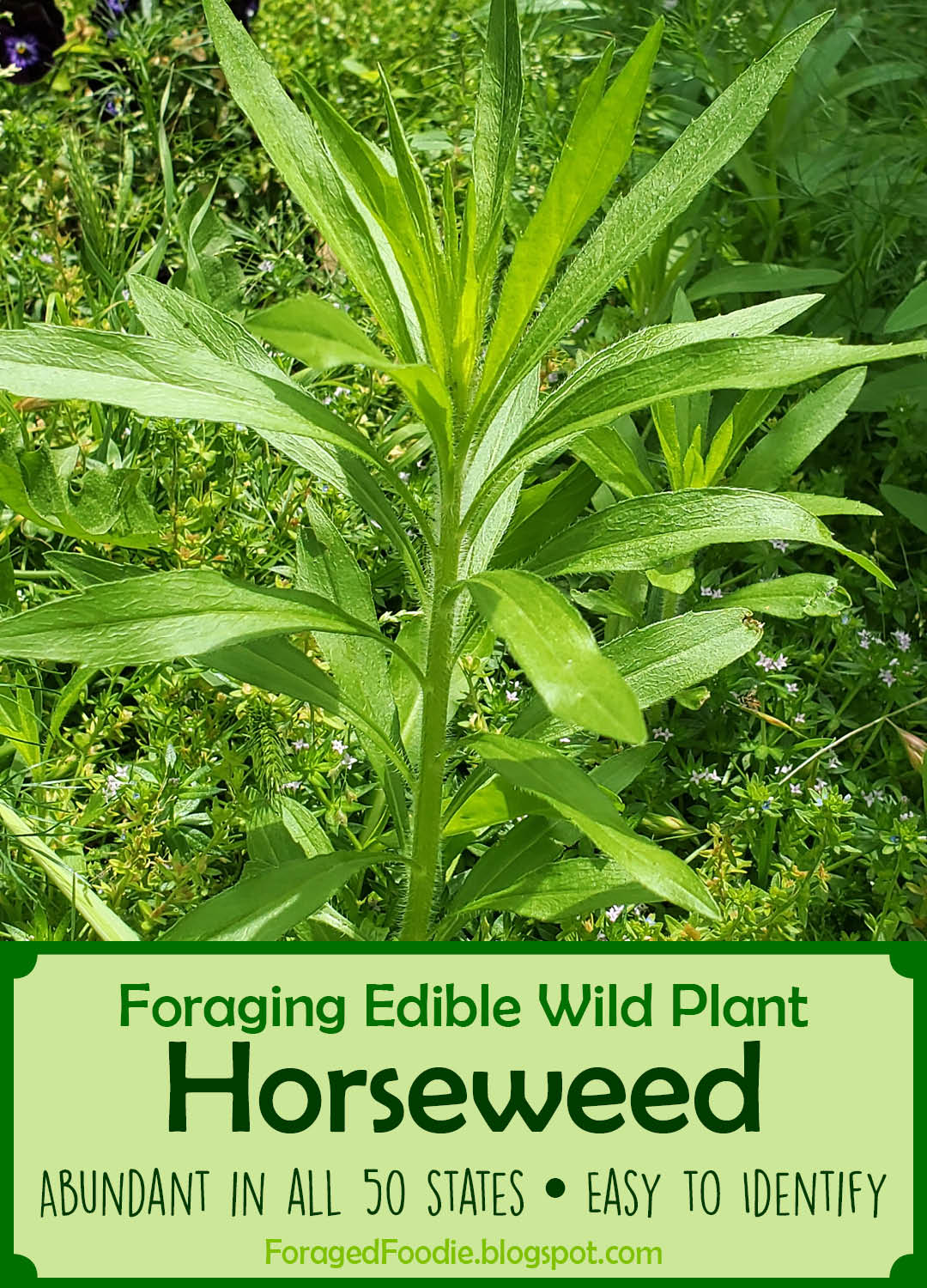
Foraging: How to identify edible wild plant Horseweed. Abundant and easy to ID


Horseweed, also known as Erigeron canadensis and formerly as Conyza canadensis, is a widespread, native, edible wild plant in the greater Aster family, Asteraceae. In some areas it's known as fleabane, butterweed, mare's tail or colt's tail.  

It's incredibly abundant as it grows natively in the 48 continental states, and has been introduced into Alaska and Hawaii. In Canada, you can find it all throughout British Columbia and P.E.I. and along the southern edges of every Provence except Labrador, Nunavut and the Northwest Territories. It can be found throughout Mexico and in most of the non-island Central American Countries.

It's almost certainly in your neighborhood. 

Horseweed patch from my yard, early May

Horseweed gets little attention in the foraging community, with no really good reason as to why. It's easy to identify, less bitter than the well-known dandelion or plantain, more flavorful than clover, and provides more food than wood sorrel. Despite this, horseweed is only barely mentioned, while those others are brought up every season. 

Perhaps it's because horseweed has an unpleasant tendency to grow in some of the least savory of places, including out of sewer grates in the middle of dense and dirty cities. In fact, while I will often find a plant or two on my neighborhood stroll, I often find horseweed growing most densely and abundantly in urban environments: city parking lots, sewers and underneath highway overpasses. 

Horseweed is actually quite popular in the survivalist communities, though not as food! But more on that later. 

Fortunately, a large patch recently chose to grow right in my own yard! So I've finally been able to see what all the fuss is about, and, let me tell you, this is one tasty little (actually, BIG) weed!


Horseweed taste; edible and medicinal uses

When plants are quite young, 3-4 inches, you can use the whole plant. The central stem gets tough and stringy very quickly, after the plants are around 5 inches high, you will only want to use the leaves. Once the plant is over a foot high or so, you will only want to use the leaves at or near the top, the rest will be dry and flavorless. Once the plant is flowering, it's no longer good for food. 

Apparently horseweed is most commonly steeped as a tea, though I only recently tried it that way.

Horseweed can also be used as a flavorful herb, which is how I've been applying it. Simply strip the leaves off the central stalk, chop and add to your dish. I would describe the flavor as being a bit like oregano, but with a freshness like parsley, some almost citrusy brightness and, at the back of the pallet, some anise or tarragon flavor. For me this taste only ever comes at the end of the meal, which is interesting. 

Once the flower stems form the leaves are no longer flavorful, but you can harvest the flower buds. These can be added directly into dishes as a vegetable, or pickled if you like. Make sure to get the buds and not the post-bloomed flowers. 

Horseweed lends itself to Italian and Indian dishes for sure and I'm looking to branch out further in my experimentation. 


Horseweed identification

Growth and Stem features

  • Hairy stalk
    Horseweed grows as a single, straight central stalk, no branching until flowering
  • Horseweed can grow up to 8 feet tall, but will most often flower between 4 and 5 feet, though you won't want to be harvesting when it gets that old
  • When fully grown, the stalk will develop a hollow core, but again, you probably won't want to eat the plant at that stage. 
  • The stalk is quite hairy, and have shallow vertical grooves or striations running up the whole length
  • The leaves grow directly off the stem on slender petioles (leaf stems), no fibrous stems
  • The leaves rotate around the stalk as they grow, they do not grow in opposite pairs


Horseweed leaves | Left: young leaf, still a little rounded
Center: assorted mature leaves to show variations
Right: leaf detail to show barbs

Leaf features

Hairy leaf underside and edges,
also note the veins that run parallel to the leaf edge
  • Horseweed leaves are lanceolate, which is to say they are much longer than they are wide; they will become even more so as they age
  • Like the stalk, the leaves also have hair, though only on the underside and around the edge of the leaf, not on the top side.
  • Horseweed leaves are sometimes described as serrated (like the edge of a saw or a bread knife), but I think this is misleading; rather, they have occasional "barbs" on the leaf edges, anywhere from 2-6 per leaf, (older leaves can have 8)
  • These barbs start out as small triangles, but will develop a more fish-hook shape as the leaf ages and grows larger
  • One of the best identification features is the randomness of these barbs; almost every leaf will be unique in number of barbs, unique barb positioning, and unique barb size
  • All leaves will have prominent veins that run parallel to the central vein, and to the leaf edges; this is easier to see on the underside of the leaves

Flowers

  • Before flower buds form, horseweed will start to grow lots of small stems/branches at the top of the stalk. These stems will be 4-12" or so long, and will vary in length with the height of the plant.
  • Once these stems form, the plant is no longer good for food as the leaves will become papery and flavorless
  • If you are familiar with the aster family as a whole, horseweed has very typical aster flowers - the petals are so narrow they almost appear like hairs or lashes around the bloom
  • The petals are white and the centers are yellow
  • Each flower is about the size of an American or Canadian dime
  • Once bloomed, the flowers will turn into puff heads, similar to dandelion's, but smaller


Look-a-like plants

Note: as long as you are careful about looking for hair, there are no poisonous look-a-likes for horseweed, though there may be allergens that effect some people strongly, even dangerously, on an individual basis. 

Sunday, April 24, 2022

Foraging: Identification of edible, young spring pokeweed / poke sallet


Identification difficulty: Novice

This post is a long time coming, I really should have made this post a long time ago. You see, it's bothered me for a while that pokeweed, Phytolacca americana, is such a popular edible wild plant, such a well-known plant, such a historically significant plant, and yet there is so very little info out there helping identify it when it's young and harvestable. 

There is a ton of info to help identify the mature plant, which is very easy to ID. But as I wrote once before, you can't EAT pokeweed when it's mature -- it becomes fatally poisonous. 

But in the early spring, they young shoots and leaves can be harvested, and, if properly prepared, are safe to eat -- even delicious. Like the best baby spinach you've ever imagined. 

It's such a popular food of the American South that it's been a part of our nation's cultural heritage, even becoming the theme of a hit song, Poke Salet Annie, in the late 1960s. 

If you've been curious about how to safely identify pokeweed when it's young, you've come to the right post!


Common places to look for pokeweed

Pokeweed is a transitional understory plant. Transitional meaning it thrives in the transitional period where as field and meadow become forest. It gets crowded out fairly easily by trees, so you will rarely find it in deep forest, instead look for small forest clearings (usually where a massive old tree has fallen, leaving an open space), on the edges of meadows or farmland and along man-made or animal trails. In nature, "washes" -- places where spring rainwater frequently comes down the sides of hills, clearing out small trees, frequently grow pokeweed.

This pokeweed is too mature to eat.
But it is growing in a classic spot: on
the edge between a field and woodlands
Pokeweed seed reproduction is very complicated. The seeds can't germinate UNLESS they've been swallowed and digested by a bird--exposed to that specific mix of chemicals inside an avian GI tract--and deposited in the highly acidic bird feces. 

However, if pokeweed roots get broken up, any piece of root about 2-3" long can grow a new plant. For this reason, human activity can spread pokeweed around like crazy. During excavation, construction and earth-moving, people may inadvertently break up a pokeweed plant, creating dozens more at the edges of construction, where the root-bearing dirt has been deposited. 

Consequently, look for pokeweed for along the edges of suburban developments built within the past 5 years, or along any area kept clear of trees by human activity: farms, parks/playgrounds, the edges sporting fields and along trails are all good places to look. 

The most pokeweed I personally ever saw was when my parents had their new Connecticut home build in 1990, when I was 10. The land had been farmland until the early 1900s, at which point it had been allowed to grow feral, reverting to forest, with tree ages not that much older than 50 years at most. There were also several clearings. In one of those clearings, where my parents build their house, there must have been at least one pokeweed plant, because when they dug the foundation, they disturbed those roots. For several years after, we had literally HUNDREDS of pokeweed plants surrounding the clearing of our home, until eventually small saplings started to grow into small trees, forcing the pokeweed out. 


Young spring pokeweed identification 

Many North Americans already know mature pokeweed by sight. It's hard to miss, as the plant can grow 6 feet tall and equally wide, in arching red boughs, bearing large, deep green leaves and 4-6 inch clusters of deep purple-black fruit on red stems.  

The problem is, by the time pokeweed is easy to spot and identify, it's well past the point where it can be safely eaten. This post will help you identify young pokeweed in the spring, when its safe to consume (after proper preparation): 

Super young pokeweed growth. Note the stalks of last year's plants in the background

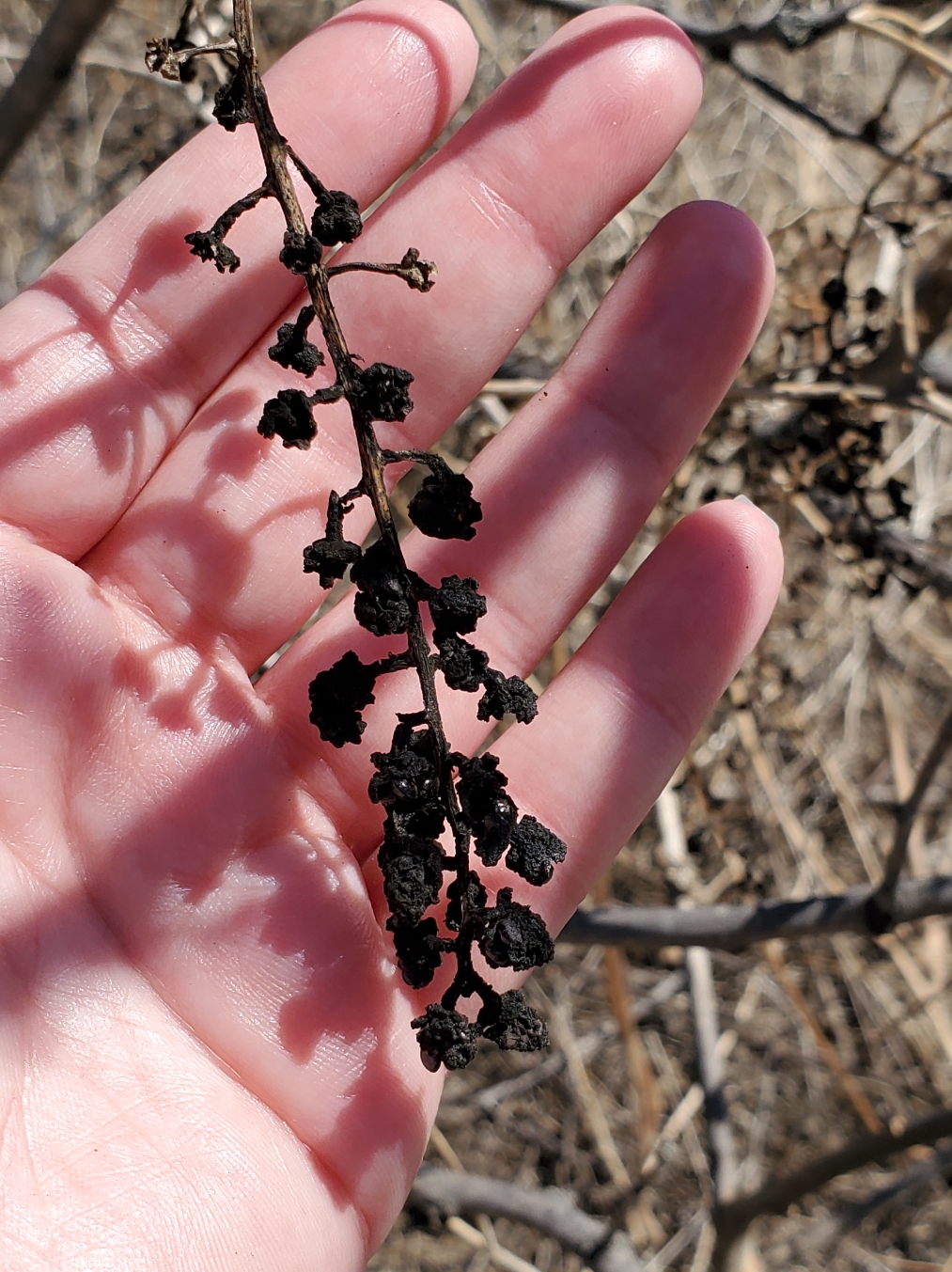
Dried up old fruit is the 
best way to pre-find pokeweed

Finding young pokeweed

When it first pokes out of the ground, pokeweed will mostly be visible by the leaves, which at this stage will be bright green, almost neon, wrinkled, ruffled at the edges, and with very prominent underside veins. 

Pokeweed is perennial: once established, it will regrow from the roots year after year. For that reason, you can find pokeweed before it grows by finding last year's plants. 

The stalks of pokeweed plants are long, hollow tubes that are beige in color, but often feature grey or black streaking and spotting. There will always be some dried up clusters of pokeweed fruit dangling from one branch or another. 

Side note: because old pokeweed stalks are hollow, breaking up the tubes makes an excellent tinder/fire starter, as long as they are very dry. 


The stalk is the most important way to identify pokeweed. 
Note in the slightly older plants on the right, the skin should be peeled away from the plant base
before preparing it for consumption


Stalk color and growth pattern

Pokeweed is safest
when the skin is
super thin, like this
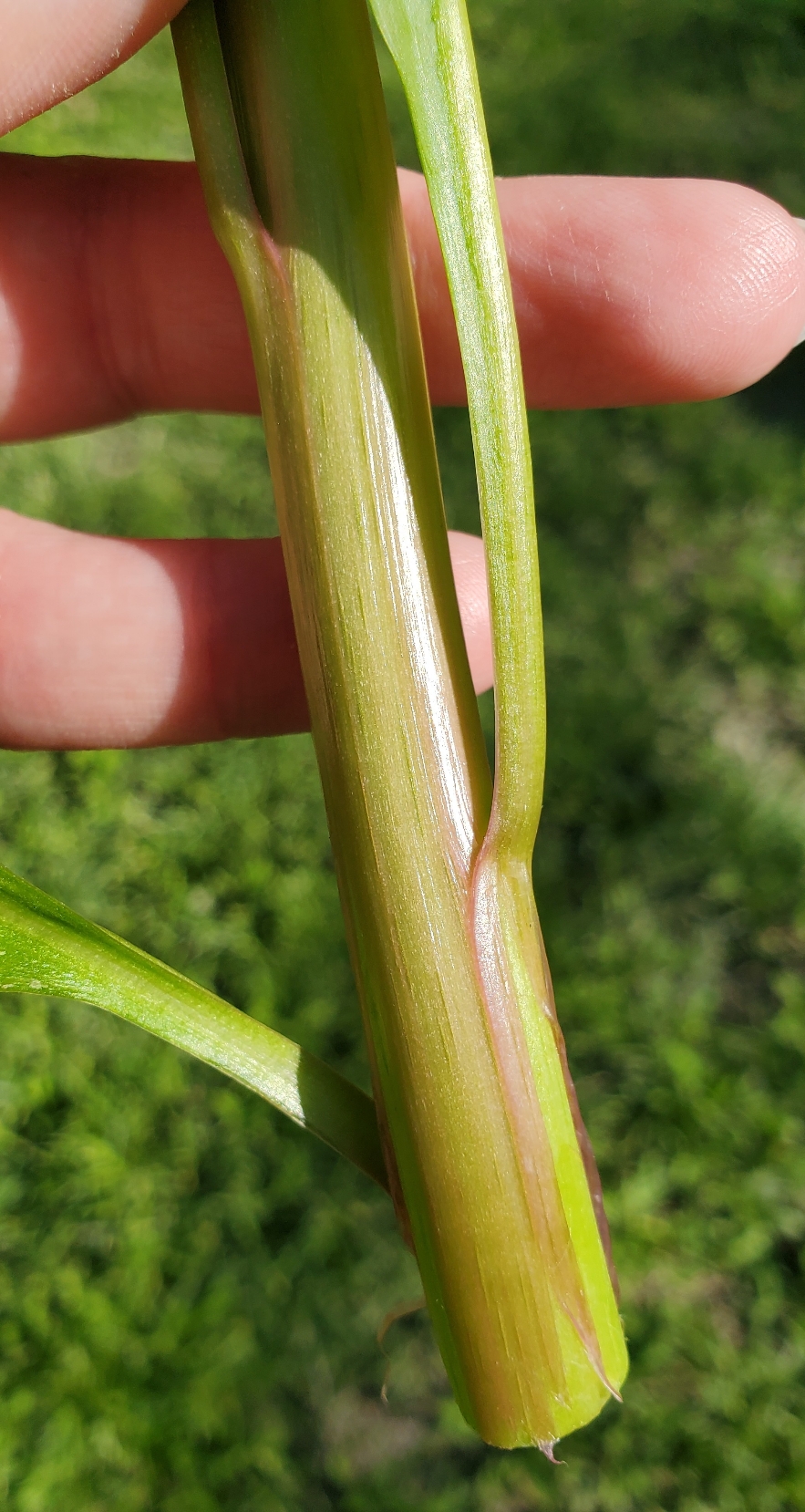
The stalk is the most important identification feature for young pokeweed. The leaves and overall plant shape resemble many other wild plants (some poisonous) but the stalk is very unique -- once you know what to look for. 

The stalk of young pokeweed is translucent neon green tube around a white core, covered with a super thin, translucent skin that peels away pretty easily from breaks. 

The white core of the stalk is actually made up of parallel, horizontal chambers, which you can see easily by breaking into the stalk with a vertical cut. However, the younger the plant, the closer and tighter together the chambers will be, making them harder to see. 

The skin should be green, yellowish or faintly red. If the red coloring is more than just a hint, or faint streaks, then your pokeweed is too mature and should not be eaten. 

There is no hair on the stem, in fact if feels super smooth -- like plastic.

As the plant grows, the skin becomes thicker, and easier to peel away as a whole unit, without tearing. The group of pictures above shows two plants, the core on the left is at the perfect stage of size and growth. The middle and right are at just the last stages, and require a little extra prep work.  Notice on the left how the skin holds together and doesn't tear when pealed away from the central stalk. On plants of this age, I would peel the skin away from the base of the plant, and not cook it. The skin carries more of the dangerous chemicals than the green interior. 

Friday, March 17, 2017

Identifying and foraging common wood sorrel. A common edible weed, often mistaken for clover or shamrock. Perfect for beginners.


Identification difficulty: Beginner

Happy St. Patrick's Day! I'm going to try and get this post up early so I can go out drinking :). I'm not Irish, but who does't love a good beer? (Note: I said a GOOD beer. Not that swill they dye green and pour out by the barrel-full!)

In honor of the occasion, I'd like to talk about how to identify common yellow wood sorrel, sometimes called the American Shamrock.

Wood sorrel isn't a shamrock, as a shamrock is a type of clover (Latin genus: Trifolium), and wood sorrel is part of the genus Oxalis. Then again, there is some confusion about what a shamrock actually is! You see,  we associate the classic "3 heart" shape with shamrocks, yet no clover actually has this shape. Clovers are all 3 ovals! Instead, sorrels (Oxalis species) have the 3 hearts.

So who knows, maybe wood sorrel really is a shamrock after all?


As I've mentioned before, wood sorrel holds a special place in my heart. It's the first wild food I ever ate, that I didn't harvest with my mother or one of my grandmothers. No member of my family ever pronounced it as safe, I never picked it with them. I watched other children enjoy it, and picked and ate it for myself. They called it lemon clover. I ate it without hesitation, rather a dangerous precedent when your "expert" is an 8-year old, but it all turned out all right in the end.

Anyway, wood sorrel is easy to identify, and grows throughout North America. It also tastes great, and is a very versatile ingredient in the kitchen, all-in-all, a perfect plant for beginners to forage.

One small note of caution: Oxalis species contain oxalic acid, and shouldn't be eaten by those with kidney or liver diseases, or by those with certain autoimmune diseases, like Rheumatoid arthritis. 

On to identification . . .

Saturday, May 7, 2016

Identifying and sustainably harvesting Smilax (greenbriar, carrionflower)


Smilax species, often called greenbriars, bullbriars, or catbriars, are a plant not often addressed in foraging circles, and I'm not sure why. Maybe because identification, while actually pretty easy, seems so complicated at first.

Identification difficulty: Novice

I was scared to eat greenbriar too; I had tried it when in the company of more experienced foragers, but unwilling to forage it on my own.

After all, it has over 300 varieties, with a wide array of leaf shapes, colors and mottling. Leaves are a big part of identification, and it's easy to get distracted by the differences. And then there's the berries, which can be dramatically different too: red, blue, black, hanging in clusters like grapes or in pairs or globes! Finally, there are so many dangerous vines to look out for, it just seemed like too much risk to  take.

Well after spending a little time with the plant, which grows abundantly in Texas, I'm pleased to say that greenbriar are actually a very easy ID.  Yes, the leaves of different varieties look different from each other, but they do have key similarities, and leaf shape is only a secondary element to identification.

As always, please read the disclaimer before using these tips to identification.

Greenbriar quick history

Smilax is a rite of spring in the Black Sea region, like Turkey and Georgia (the country). It was also used in Central and South America to enhance male libido. Early European settlers brewed a drink from the roots, early sarsaparilla, and used it not only as an aphrodisiac, but also to treat genital diseases, like syphilis. I would seriously doubt it's effectiveness on STDs, but I'll leave amorous experimentation up to you.

Thursday, March 3, 2016

Foraging: Identifying Wild Edible Chickweed


Many people describe chickweed (Stellaria media) as their favorite wild edible green of spring. Many gardeners consider it a difficult-to-remove, annoying weed. Those gardeners just haven't tried it yet!

The foodie world is starting to follow along with the former group, and chickweed is showing up on menus of restaurants that focus on seasonal and/or local organic produce. Chickweed is also starting to show up in places like farmers markets and in the form of herbal supplements and teas at Whole Foods.

There's really everything to like about chickweed: it has a mild, fresh sweetness which some people compare to young corn or iceberg or boston lettuce, it grows in super abundance, easy to harvest and quick to grow back in the early spring when little else is growing, fairly easy to identify AND it even looks pretty!

Technically, chickweed isn't native to the Americas, so it's also an invasive species. Of course, it's been here for generations, so any ecological damage has already been done, but if you're into invasivore eating (eating invasive species) that's something to consider as well.

So let's get started on how to find, identify, harvest, prepare and eat this tasty little weed!

Identification difficulty: Beginner