Showing posts with label horseweed. Show all posts

Thursday, December 11, 2025

Curly dock rollatini | Vegetarian cusine with foraged ingredients


This foraged take on Italian American rollatini comes together much quicker and easier than any eggplant dish could ever dream of. It's quite tasty too! 


Rollatini is an Americanization of the word involtini, which is apparently Italian for "small bundles," an accurate description of the dish. 

Regardless of what you call them, when you swap the eggplant for curly dock you don't have to bread or pre-fry the rolls, cutting calories from breadcrumbs and oil. More important to me, it cuts over 20 minutes (more like 30) off the cook time! 

But this dish comes together FAST. Almost too fast, to be honest, as it can be easy to over-cook the curly dock leaves. They are no less delicious overcooked, but the texture is more pleasing when it's just a little bit toothsome. 

For this reason, the recipe works best if your curly dock leaves are largely the same size, thickness/toughness, and maturity, so they all cook together the same amount. 


Wild garlic


Curly dock rollatini with wild garlic & horseweed

Serves 4 as a main course

8 large, mature, curly dock leaves *
15 oz. ricotta cheese 
1 cup shredded mozzarella, divided
3 cups tomato sauce, homemade or store bought 
~ 10 wild garlic stalks with bulbed heads, minced *
6 - 8 horseweed leaves, minced *
5 fresh basil leaves, thinly sliced
1 tsp. garlic powder
1 egg
Salt to taste
Olive oil, optional

  1. For around 1 minute, lightly cook the minced garlic in a drizzle olive oil over medium heat, stirring constantly to keep from burning. Use the same pan you will cook the meal in. This step is optional. 
  2. In a medium or large bowl, mix the ricotta, half the mozzarella, wild garlic, basil, egg, garlic powder, a pinch of salt, and horseweed.
  3. Rinse your curly dock leaves carefully. Don't trim the petioles (leaf stems). Spread the curly dock leaves out and coat thinly (1/4 inch) with the ricotta mixture. 


  4. Starting with the narrow end, roll your leaf up on itself till you have a little bundle. Wrap the petiole loosely around the bundle.


  5. Place your bundles in the pan, petiole side down. Generously pour tomato sauce over and around the bundles. Cover the pan and simmer over medium-low for 10-15 minutes, or until petioles are tender. 


  6. In the last 2 minutes of cooking, uncover and sprinkle the remaining mozzarella cheese. (Though, of course, I forgot to do this.)
  7. Remove from heat and serve immediately.  Also makes good leftovers!


You can use skim or part-skim for the ricotta and mozzarella. 

* You can substitute 4 cloves of regular garlic for the wild garlic, and oregano for the tarragon. Unfortunately, there is no substitute for the curly dock. For this recipe, I recommend leaves that are 10-14" long and at least 3" wide at the widest part. 

When it comes to portion size, it's important to remember that these rollatini have a larger cheese to vegetable ratio than traditional eggplant rollatini, as the leaves are thinner. 2 rollatini should be a portion size, and pair nicely with a side salad. 


Tuesday, July 16, 2024

Horseweed, lavender and parmesan savory shortbread

Over the past few years, my husband and I have been trying to fill in some holes in the landscaping of our front yard. During the bad winters of 21 and 22 several very, very, very large bushes died, leaving a bare area of more than 20 feed wide and about 12 feet deep in front of the dining room window. 

We didn't want to refill the area with more non-native, water guzzling landscaping bushes, and have instead been trying to find shrubs and perennial plants that fit our very restrictive list:

  • Early flowerbud on my surviving lavender
    Native or easy to naturalize, but without the risk of becoming invasive
  • Low water or true xeriscape
  • Good for pollinators
  • Edible or medicinal (or both!)
  • Grows densely enough that I don't have to weed
So far we have a large mat of native-to-the-southwest blanket flower (Gaillardia) surrounding the ginkgo tree (which fortunately survived), an English lavender shrub that was supposed to be 6 plants but only one survived, a seedling Feijoa (Acca sellowiana) which I believed had died twice but came back stronger each time, and a native-hybrid "hot lips" sagebush (salvia microphylla) which seems to be trying so hard to die and I just won't let it. There were supposed to be 3 different sages with 3 different flavor profiles, but this is the only one which has (so far) survived. 

Given all the plant deaths, what has survived covers barely 1/10th of the available space. But on the plus side, the weeds that have popped up in the remaining area are all edible. The crown jewel of wild plants in the space must be the very large black nightshade, Solanum nigrum, which produces an insane amount of fruit, but must be cut back repeatedly or it will fully engulf the salvia. Also popping up are wild lettuce, Asiatic dayflower, purslane, and some other nightshades I can't quite identify yet, but I think might be groundcherries (Physalis).

An ancient understanding of herbs

There is a historical tradition in many parts of Italy, that when it comes to curing meats, like capicola, you want to season the meat using the same herbs plants that the pig itself has been eating. So while a generic capicola curing packet might contain thyme, juniper and fennel, the small, local batches that have been done the same way for centuries will use ONLY fennel from the region, only thyme from the hillsides where the animals roam, and only the local juniper berries that fall and are gobbled up by the pigs. 

Horseweed & lavender,
I actually added a bit more than this
The thought behind this is that when things grow together it is both flavorful and healthful to consume them together. 

Why do I bring this up?

Well, this is what inspired me to make this recipe. You see, I saw the horseweed growing so abundantly in and around the lavender that I couldn't help but wonder if the two would taste good together. And the combination is WONDERFUL!

Savory shortbread recipes have been trending for a while. Or maybe they are past trending, I tend to only become aware of trends by the time they have largely ceased to be trends any longer. But regardless, they often contain thyme and rosemary. I do like thyme in small amounts, but I really don't care for rosemary. So I was excited to try the idea of the recipe with other herbs I enjoy. 


Savory horseweed, lavender and parmesan shortbread recipe

Makes 25-30 shortbreads, depending on size. Can be doubled or tripled.

  • 1 1/4 cups all-purpose flour
  • 8 tbs / 4 oz / 1 stick of butter (I used grass-fed European butter)
  • 4 oz parmesan cheese, grated*
  • 1/2 cup finely chopped, freshly picked horseweed and lavender, about 3/4 cup un-chopped
  • 2 medium navel oranges, juice and zest
  • Pinch of kosher salt (omit if using salted butter)
*Don't buy pre-grated cheese here, it's worth it to grate your own--and very easy to do in a food processor. Pre-grated parmesan has cellulous added to keep it from sticking together, and that will really mess with the subtle flavors here. 

Images a bit out of order, from left to right: 
The butter softened and whipped, the finely chopped herbs, and the zested orange. 
All of this was done in the food processor.

Thursday, June 8, 2023

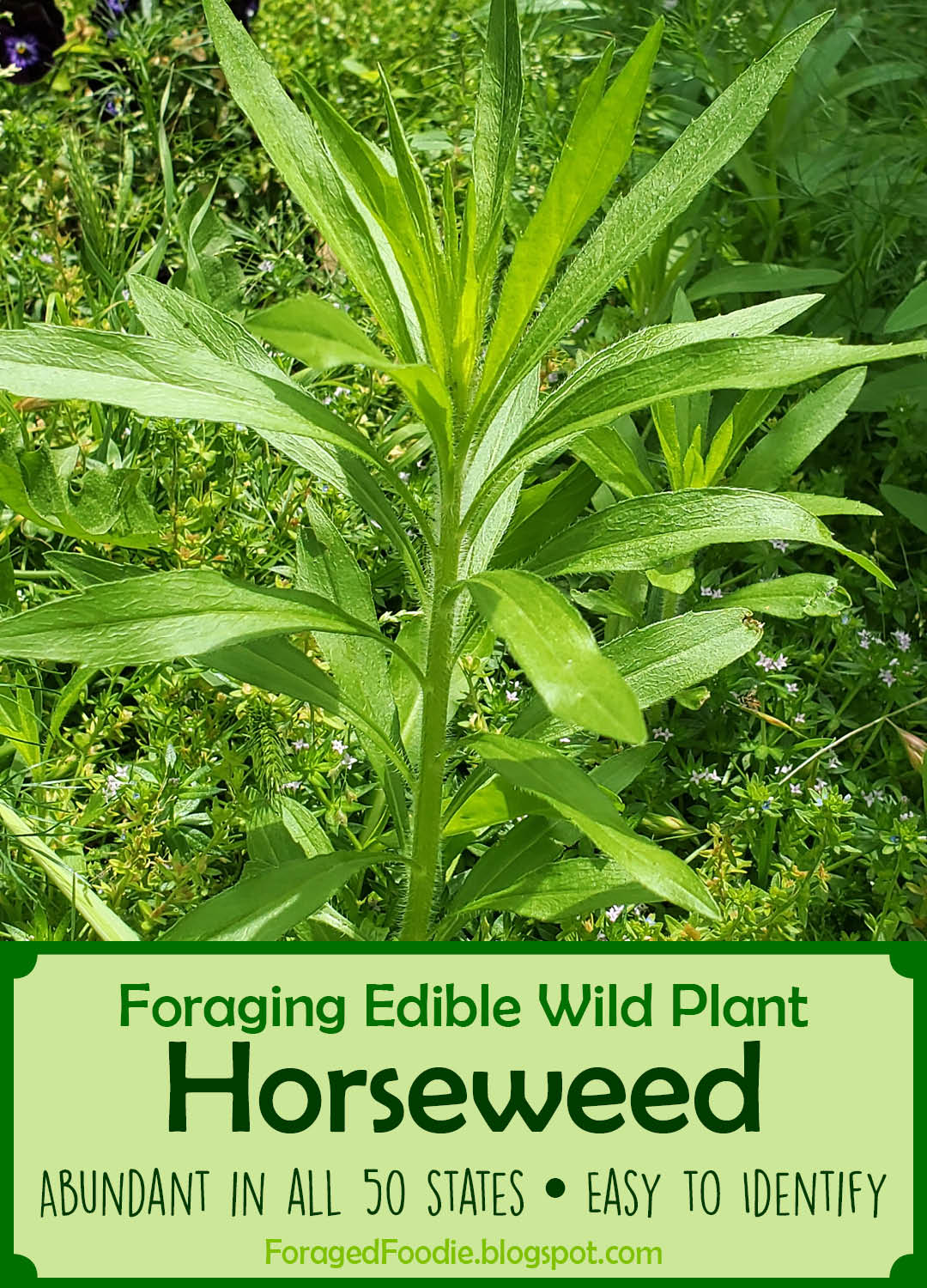
Foraging: How to identify edible wild plant Horseweed. Abundant and easy to ID


Horseweed, also known as Erigeron canadensis and formerly as Conyza canadensis, is a widespread, native, edible wild plant in the greater Aster family, Asteraceae. In some areas it's known as fleabane, butterweed, mare's tail or colt's tail.  

It's incredibly abundant as it grows natively in the 48 continental states, and has been introduced into Alaska and Hawaii. In Canada, you can find it all throughout British Columbia and P.E.I. and along the southern edges of every Provence except Labrador, Nunavut and the Northwest Territories. It can be found throughout Mexico and in most of the non-island Central American Countries.

It's almost certainly in your neighborhood. 

Horseweed patch from my yard, early May

Horseweed gets little attention in the foraging community, with no really good reason as to why. It's easy to identify, less bitter than the well-known dandelion or plantain, more flavorful than clover, and provides more food than wood sorrel. Despite this, horseweed is only barely mentioned, while those others are brought up every season. 

Perhaps it's because horseweed has an unpleasant tendency to grow in some of the least savory of places, including out of sewer grates in the middle of dense and dirty cities. In fact, while I will often find a plant or two on my neighborhood stroll, I often find horseweed growing most densely and abundantly in urban environments: city parking lots, sewers and underneath highway overpasses. 

Horseweed is actually quite popular in the survivalist communities, though not as food! But more on that later. 

Fortunately, a large patch recently chose to grow right in my own yard! So I've finally been able to see what all the fuss is about, and, let me tell you, this is one tasty little (actually, BIG) weed!


Horseweed taste; edible and medicinal uses

When plants are quite young, 3-4 inches, you can use the whole plant. The central stem gets tough and stringy very quickly, after the plants are around 5 inches high, you will only want to use the leaves. Once the plant is over a foot high or so, you will only want to use the leaves at or near the top, the rest will be dry and flavorless. Once the plant is flowering, it's no longer good for food. 

Apparently horseweed is most commonly steeped as a tea, though I only recently tried it that way.

Horseweed can also be used as a flavorful herb, which is how I've been applying it. Simply strip the leaves off the central stalk, chop and add to your dish. I would describe the flavor as being a bit like oregano, but with a freshness like parsley, some almost citrusy brightness and, at the back of the pallet, some anise or tarragon flavor. For me this taste only ever comes at the end of the meal, which is interesting. 

Once the flower stems form the leaves are no longer flavorful, but you can harvest the flower buds. These can be added directly into dishes as a vegetable, or pickled if you like. Make sure to get the buds and not the post-bloomed flowers. 

Horseweed lends itself to Italian and Indian dishes for sure and I'm looking to branch out further in my experimentation. 


Horseweed identification

Growth and Stem features

  • Hairy stalk
    Horseweed grows as a single, straight central stalk, no branching until flowering
  • Horseweed can grow up to 8 feet tall, but will most often flower between 4 and 5 feet, though you won't want to be harvesting when it gets that old
  • When fully grown, the stalk will develop a hollow core, but again, you probably won't want to eat the plant at that stage. 
  • The stalk is quite hairy, and have shallow vertical grooves or striations running up the whole length
  • The leaves grow directly off the stem on slender petioles (leaf stems), no fibrous stems
  • The leaves rotate around the stalk as they grow, they do not grow in opposite pairs


Horseweed leaves | Left: young leaf, still a little rounded
Center: assorted mature leaves to show variations
Right: leaf detail to show barbs

Leaf features

Hairy leaf underside and edges,
also note the veins that run parallel to the leaf edge
  • Horseweed leaves are lanceolate, which is to say they are much longer than they are wide; they will become even more so as they age
  • Like the stalk, the leaves also have hair, though only on the underside and around the edge of the leaf, not on the top side.
  • Horseweed leaves are sometimes described as serrated (like the edge of a saw or a bread knife), but I think this is misleading; rather, they have occasional "barbs" on the leaf edges, anywhere from 2-6 per leaf, (older leaves can have 8)
  • These barbs start out as small triangles, but will develop a more fish-hook shape as the leaf ages and grows larger
  • One of the best identification features is the randomness of these barbs; almost every leaf will be unique in number of barbs, unique barb positioning, and unique barb size
  • All leaves will have prominent veins that run parallel to the central vein, and to the leaf edges; this is easier to see on the underside of the leaves

Flowers

  • Before flower buds form, horseweed will start to grow lots of small stems/branches at the top of the stalk. These stems will be 4-12" or so long, and will vary in length with the height of the plant.
  • Once these stems form, the plant is no longer good for food as the leaves will become papery and flavorless
  • If you are familiar with the aster family as a whole, horseweed has very typical aster flowers - the petals are so narrow they almost appear like hairs or lashes around the bloom
  • The petals are white and the centers are yellow
  • Each flower is about the size of an American or Canadian dime
  • Once bloomed, the flowers will turn into puff heads, similar to dandelion's, but smaller


Look-a-like plants

Note: as long as you are careful about looking for hair, there are no poisonous look-a-likes for horseweed, though there may be allergens that effect some people strongly, even dangerously, on an individual basis. 

Monday, May 8, 2023

Pasta fagioli with foraged horseweed, edible wild weedy plant

Pasta fagioli, pronounced pasta fazool by my Italian American in-laws, is a traditional Italian peasant meal whose name means "pasta and beans."

Like most peasant fare, pasta fagioli was derived of simple, affordable ingredients and cooked as a soup or a stew to make those ingredients go farther. It's warm, filling and nutrient-dense, with lots of protein, packing a ton of flavor in every bite. It's one of my all-time favorite soups!

The version I make is vegetarian, though you can add bacon, pancetta or prosciutto if you aren't tied to a vegetarian diet. Honestly though, I've never found that meat adds anything of value. Using chicken stock instead of veggie can be quite nice though. 

You certainly have this plant near
you somewhere
Horseweed is an incredibly common and abundant plant in the aster family. It can be found in all 50 states (introduced into Alaska and Hawaii), every Canadian Provence except Nunavut and the Yukon, throughout Mexico and in most of the non-island nations of Central America. It has been introduced into Eurasia and North Africa.

Horseweed is somewhat related to the herb tarragon, though not especially closely; I only mention it because they have a similar flavor profile, though horseweed tastes more like oregano and less like anise. I also think horseweed is less versatile, though certainly a flavorful, enjoyable herb in its own right. It has a mild version of the famous/infamous "aster" flavor. And it smells amazing. 

Because horseweed reminds me of oregano, I tend to put it in Italian dishes, egg dishes, and soups and stews of all kinds. I've made it in pasta fagioli before, but this is the first time I really feel like I got everything right--the base soup recipe and the horseweed balance--so now I'm sharing it with you. 

A nice patch of horseweed in my yard

Pasta fagioli with foraged horseweed wild plants

Serves 4-5 as a main course

8 oz (1/2 lb) small pasta, like ditalini
12 cups of broth or stock*
Two cans of white beans, cannellini or great northern, drained and rinsed
One can of red kidney beans, drained and rinsed
One can of diced tomatoes
Two large handfuls of young horseweed leaves, roughly chopped
4 oz parmesan cheese or cheese rind, cubed (omit for vegan)
1 large, sweet yellow onion, diced
1 entire head of garlic, peeled and minced
1/2 stick of butter, or equivalent olive oil
Optional (omit for vegan/vegetarian): 2 oz diced pancetta, bacon or prosciutto 

  1. Heat butter or oil in a large stockpot, add in onion and sauté until translucent.
  2. When onion starts to brown, add in garlic, horseweed, and meat if you are using, continue to sauté until onion is caramelized, garlic is fragrant and horseweed is soft. Remove all from pan. 
  3. Add beans, cheese, tomatoes and broth or stock to the pot and bring to a simmer. 
  4. In a separate pot, bring water to a boil and cook pasta according to package directions. 
  5. Continue to simmer the beans, stirring only occasionally, for around 30-40 minutes, until the beans are super soft, almost mushy. 
  6. Using a slotted spoon, strain about 1/2 of the beans from the pot and add to the onion/garlic/herb mix you set aside. Try not to remove any of the tomatoes or the cheese, leave them in with the broth. 
  7. Using a hand-mixer or food processor, puree the stock, tomatoes, 1/2 beans and cheese. This will make the soup thick and hearty. 
  8. Add the pasta, the onion/herb/garlic mix and the removed beans back to the main pot and heat till warmed through. Season as desired with salt and/or pepper. Serve immediately with crusty bread and/or a salad. 
*I used "Better than Bouillon" Italian Herb base

I really cannot emphasize enough how delicious this soup is. It's my favorite pasta fagioli version of all time!