Wednesday, February 21, 2024

Healthy green marinara with sow thistle


Those of you who follow me on Instagram might remember seeing the image I shared of my green marinara sauce last March, when I promised a recipe to follow on my blog soon. 

And then I did not do that. 

But better late than never, as they say. A warmer than usual February has triggered the earliest spring plants to sprout, including one of my annual favorites, prickly sow thistle. 


Early spring prickly sow thistle, picked last Friday


That vivid green color is all natural

I really, really love this recipe. Unlike a pesto, this is completely vegan (unless you add cheese on top). It's also low in fat, since oil isn't a key ingredient. And each serving is also a full serving of leafy vegetables! That last point is especially important since sow thistle is incredibly nutritious, rich in potassium, calcium, magnesium, iron, zinc, selenium and a number of important vitamins. 

It's really surprising how creamy this sauce is, considering that it has no cream, milk, coconut milk or cheese. 


Sunday, February 18, 2024

Foraging prickly sow thistle: pictures, flowers, leaves & identification for Sonchus asper

Latin Name: Sonchus asper
Common Names: Prickly sow thistle, spiny sow thistle, sharp sow thistle, rough milk thistle
Season: Early spring
Edible: Yes 
Flavor: Good
Medicinal and nutritional value: Vitamin rich, antioxidant strong, liver and kidney purifying 
Identification difficulty: Beginner


The leaves of this plant are at a good stage for harvest

Despite the texture, prickly sow thistle is one of the edible wild plants I look forward to the most every spring. 

If you can work around the prickles, which is easy enough to do when planning dishes that need to be pureed (like sauces and soups), you are rewarded with a wonderfully rich leafy green. The flavor is generally very mild with only a slight bitterness, comparable to swiss chard or belgian endive, to add complexity. Most everyone who eats leafy greens will enjoy properly prepared prickly sow thistle. 

Perhaps even better, prickly sow thistle is extremely common 


Nutritional & medicinal benefits

The sow thistle family (Sonchus) is one of the ones where a significant amount of research has been done into nutrition and potential medicinal benefits. Sow thistles have long been accepted as health foods, associated with liver and kidney purification. 

Recent studies have shown that the sow thistles, particularly the prickly sow thistle, are antioxidant powerhouses. Antioxidants have been shown to reduce the effects of aging, both on the body and mind. They also lower your cancer risk. 

While antioxidant extractions are available in pills, syrups, etc., studies show that the best way to gain the positive effects of antioxidants might simply be to incorporate a large number of antioxidant-rich foods into your diet. 

All three sow thistles were found to be rich dietary fiber and in vitamin E, though smooth sow thistle (Sonchus arvensis) had the highest concentrations. Like most leafy greens, sow thistles have a lot of valuable minerals, including potassium, calcium, magnesium, iron, zinc, sodium and selenium. Smooth sow thistle is the best of the 3 for potassium, common sow thistle has the highest concentration of iron and prickly sow thistle offers the most calcium. 

As an added bonus, sow thistles DO NOT have large amounts of oxalic acid, even though they exhibit red coloration. They contain less than 10% of the oxalic acid found in spinach or swiss chard, for example, and less than 5% of the oxalic acid in purslane. 

To learn more about the antioxidant properties of prickly sow thistle, check out this article from the National Library of Medicine. 

To learn more about the nutritional qualities of the sow thistle genus, please read this article from the National Library of Medicine. 


History as a food crop

There are three, common, wide-spread sow thistles: Common sow thistle (Sonchus oleraceus), prickly sow thistle (Sonchus asper) and smooth sow thistle (Sonchus arvensis). They are native to Europe, particularly the Mediterranean regions. They are now found throughout temperate North and South America, Australia and New Zealand, the Middle East, and much of Asia and Africa. 

A good-sized haul of prickly sow thistle leaves,
ready to cook and eat

Our earliest record of sow thistles as a food comes from the ancient Greeks, who considered it to be strengthening, and used the non-prickly varieties in salads, especially during winter time when greens were scarce.

Europeans in the middle ages valued the sow thistles for animal feed. The name "sow thistle" comes from farmers feeding the plant to sows with piglets; it was believed that this plant increased lactation.

As traditional agriculture became the standard in Europe and European colonies, like the U.S., sow thistles came to be regarded as common weeds, and a great deal is spent to eradicate them. 

But that is not always the case in areas where sow thistles have spread. 

As European agricultural practices spread with colonization, many native species of plants, which were essential food sources for the native peoples, were wiped out. Eurasian plant species had evolved a centuries-long history of competition, due to exposure to other plant species spread via trade routes. As a general rule, these plants could out-compete native species, which is why dandelions, plantains, sow thistles and others are considered common weeds today. 

But many native peoples have embraced the "weeds" traditional agriculture rejects, and have used them to supplement or replace native plants that have been decimated. Sow thistles in particular are consumed by the Māori of New Zealand and the by the native peoples of the rural Brazilian rainforest regions.

In addition to the three most wide-spread sow thistles there are many regional species, especially in Africa and some hype-local species in places like the Canary Islands, some of which are used for food. 

Friday, October 6, 2023

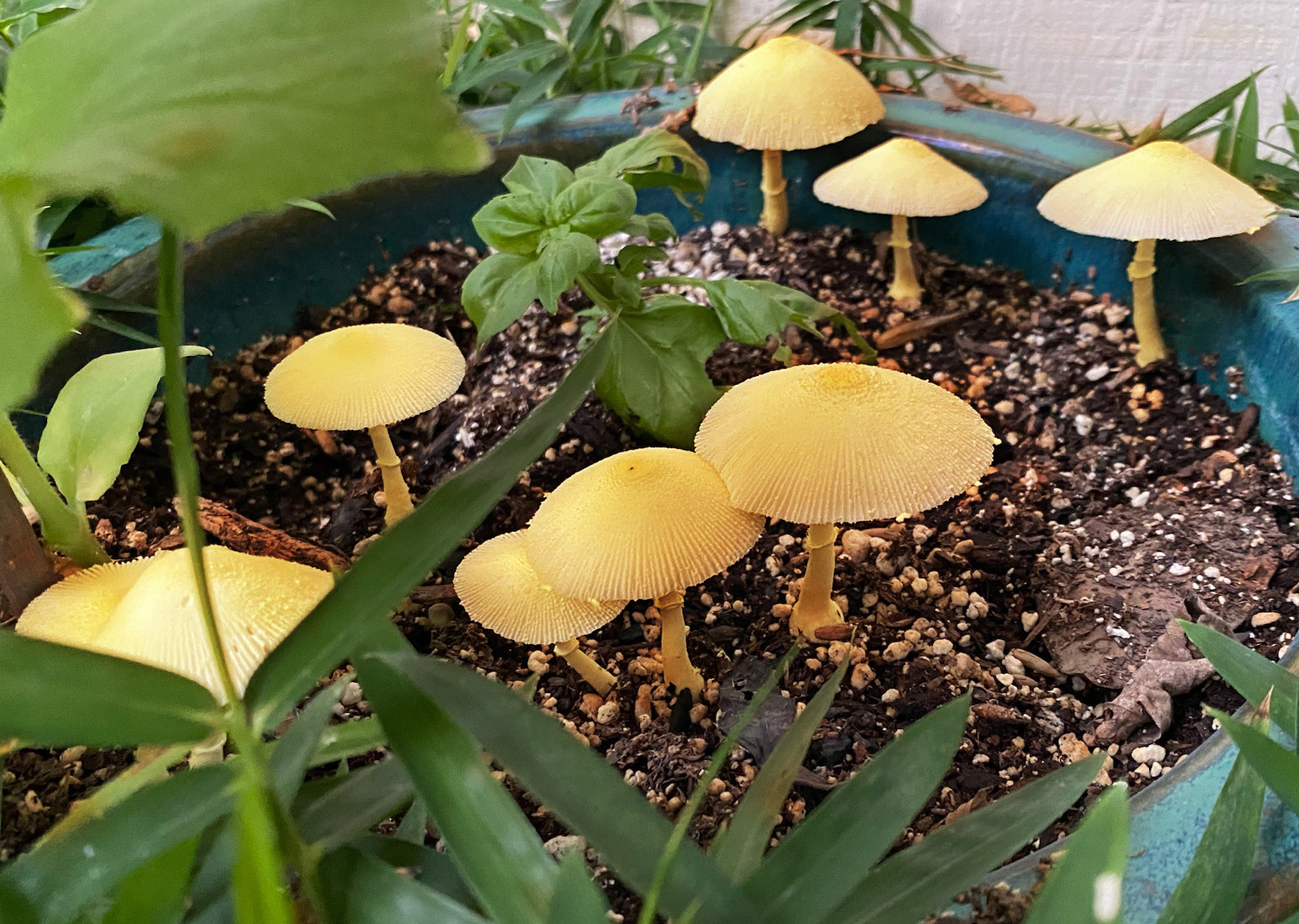
What's this yellow mushroom growing in my houseplant or garden

Nothing edible to share today, but I wanted to make a post about a mushroom that gets asked about all the time on Reddit and Instagram.  

The question "What is this yellow mushroom growing in my house plant / planter / garden?" is one I see every day, and today I'm here to answer it.

95% of the time you are looking at Leucocoprinus birnbaumii, sometimes called the yellow parasol mushroom, the painted dapperling, or the flowerpot parasol. Yes, it's so common in flower pots that it actually has that in the common name. The other 5% of the time you might be looking at the closely related Leucocoprinus straminellus, which is generally a paler shade of yellow, or Leucocoprinus flavescensm which generally has a brown area in the center of the cap.

Both L. birnbaumii and straminellus are tropical or subtropical mushrooms, so finding them in nature in the continental US, Canada or northern Mexico is extremely rare, but extremely common in potting and gardening soil. This is most likely due to the common usage of tropical materials, like orchid bark, in purchased soils. These organic materials may be contaminated with L. birnbaumii spores which then grow mushrooms when conditions are warm enough.

For most North Americans this means late spring, summer or early fall, but if you have a greenhouse, the yellow parasol might pop up anytime. 

Bell shaped when young


Yellow parasol mushroom description 

A bright, dainty mushroom that's yellow all over, cap, stalk and gills. L. birnbaumii is bright yellow and L. straminellus is pale or whitish yellow.

The cap shape starts out as a bell or cone or occasionally a marshmallow shape, then expands to an umbrella, and then the classic, nearly flat, parasol shape. When in the umbrella stage, the edges of the cap generally have fine striations (lines) and the cap will have small fibrous or warty raised areas all over, and the middle area will usually be raised -- this is called an umbo. At maturity, the cap will be anywhere from 1.5" to 3.5" in diameter. 

The stems are narrow near the cap and thicker at the base, even somewhat bulbous as they enter the soil. The stems will usually feature a ring, sometimes a double ring. The mushroom should be 2" to 3.5" high at maturity, but might be as tall as 4.5" in rarer cases. 


Is the yellow parasol mushroom poisonous or edible?

Reports are conflicting on whether L. birnbaumii is toxic, but it definitely should NOT be eaten. Many  Leucocoprinus species are severe sickeners, and symptoms can be dangerous. 

Thursday, June 8, 2023

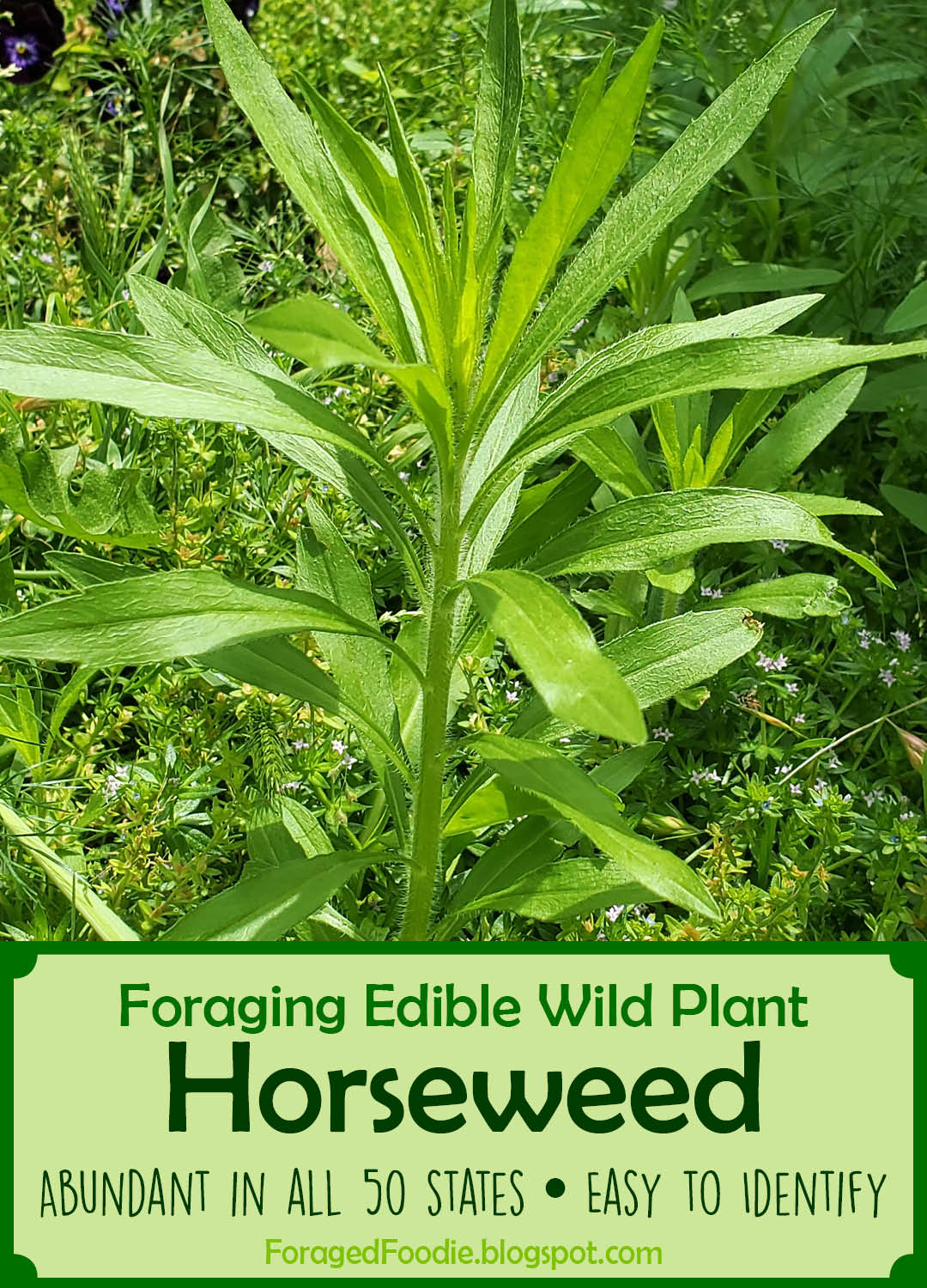
Foraging: How to identify edible wild plant Horseweed. Abundant and easy to ID


Horseweed, also known as Erigeron canadensis and formerly as Conyza canadensis, is a widespread, native, edible wild plant in the greater Aster family, Asteraceae. In some areas it's known as fleabane, butterweed, mare's tail or colt's tail.  

It's incredibly abundant as it grows natively in the 48 continental states, and has been introduced into Alaska and Hawaii. In Canada, you can find it all throughout British Columbia and P.E.I. and along the southern edges of every Provence except Labrador, Nunavut and the Northwest Territories. It can be found throughout Mexico and in most of the non-island Central American Countries.

It's almost certainly in your neighborhood. 

Horseweed patch from my yard, early May

Horseweed gets little attention in the foraging community, with no really good reason as to why. It's easy to identify, less bitter than the well-known dandelion or plantain, more flavorful than clover, and provides more food than wood sorrel. Despite this, horseweed is only barely mentioned, while those others are brought up every season. 

Perhaps it's because horseweed has an unpleasant tendency to grow in some of the least savory of places, including out of sewer grates in the middle of dense and dirty cities. In fact, while I will often find a plant or two on my neighborhood stroll, I often find horseweed growing most densely and abundantly in urban environments: city parking lots, sewers and underneath highway overpasses. 

Horseweed is actually quite popular in the survivalist communities, though not as food! But more on that later. 

Fortunately, a large patch recently chose to grow right in my own yard! So I've finally been able to see what all the fuss is about, and, let me tell you, this is one tasty little (actually, BIG) weed!


Horseweed taste; edible and medicinal uses

When plants are quite young, 3-4 inches, you can use the whole plant. The central stem gets tough and stringy very quickly, after the plants are around 5 inches high, you will only want to use the leaves. Once the plant is over a foot high or so, you will only want to use the leaves at or near the top, the rest will be dry and flavorless. Once the plant is flowering, it's no longer good for food. 

Apparently horseweed is most commonly steeped as a tea, though I only recently tried it that way.

Horseweed can also be used as a flavorful herb, which is how I've been applying it. Simply strip the leaves off the central stalk, chop and add to your dish. I would describe the flavor as being a bit like oregano, but with a freshness like parsley, some almost citrusy brightness and, at the back of the pallet, some anise or tarragon flavor. For me this taste only ever comes at the end of the meal, which is interesting. 

Once the flower stems form the leaves are no longer flavorful, but you can harvest the flower buds. These can be added directly into dishes as a vegetable, or pickled if you like. Make sure to get the buds and not the post-bloomed flowers. 

Horseweed lends itself to Italian and Indian dishes for sure and I'm looking to branch out further in my experimentation. 


Horseweed identification

Growth and Stem features

  • Hairy stalk
    Horseweed grows as a single, straight central stalk, no branching until flowering
  • Horseweed can grow up to 8 feet tall, but will most often flower between 4 and 5 feet, though you won't want to be harvesting when it gets that old
  • When fully grown, the stalk will develop a hollow core, but again, you probably won't want to eat the plant at that stage. 
  • The stalk is quite hairy, and have shallow vertical grooves or striations running up the whole length
  • The leaves grow directly off the stem on slender petioles (leaf stems), no fibrous stems
  • The leaves rotate around the stalk as they grow, they do not grow in opposite pairs


Horseweed leaves | Left: young leaf, still a little rounded
Center: assorted mature leaves to show variations
Right: leaf detail to show barbs

Leaf features

Hairy leaf underside and edges,
also note the veins that run parallel to the leaf edge
  • Horseweed leaves are lanceolate, which is to say they are much longer than they are wide; they will become even more so as they age
  • Like the stalk, the leaves also have hair, though only on the underside and around the edge of the leaf, not on the top side.
  • Horseweed leaves are sometimes described as serrated (like the edge of a saw or a bread knife), but I think this is misleading; rather, they have occasional "barbs" on the leaf edges, anywhere from 2-6 per leaf, (older leaves can have 8)
  • These barbs start out as small triangles, but will develop a more fish-hook shape as the leaf ages and grows larger
  • One of the best identification features is the randomness of these barbs; almost every leaf will be unique in number of barbs, unique barb positioning, and unique barb size
  • All leaves will have prominent veins that run parallel to the central vein, and to the leaf edges; this is easier to see on the underside of the leaves

Flowers

  • Before flower buds form, horseweed will start to grow lots of small stems/branches at the top of the stalk. These stems will be 4-12" or so long, and will vary in length with the height of the plant.
  • Once these stems form, the plant is no longer good for food as the leaves will become papery and flavorless
  • If you are familiar with the aster family as a whole, horseweed has very typical aster flowers - the petals are so narrow they almost appear like hairs or lashes around the bloom
  • The petals are white and the centers are yellow
  • Each flower is about the size of an American or Canadian dime
  • Once bloomed, the flowers will turn into puff heads, similar to dandelion's, but smaller


Look-a-like plants

Note: as long as you are careful about looking for hair, there are no poisonous look-a-likes for horseweed, though there may be allergens that effect some people strongly, even dangerously, on an individual basis.