Friday, April 21, 2023

20 minute 5 ingredient Austrian garlic soup with foraged wild garlic


Super easy and quick meal to share today: A simple garlic soup, based on a traditional Austrian recipe, but made with wild garlic. The soup is called knoblauchcremesuppe, and the name is about 10x more complicated than making it, as the soup has a mere 5 ingredients and comes together in 20 minutes. 

Early spring wild garlic,
this is crow garlic
Wild garlic is one of the earliest and most important greens of spring. The vibrant stems and leaves start to poke up early, when everything else is dead and brown. 

That pungent garlic or onion flavor is actually intended as a defense mechanism, especially against herbivores. 


Early humans developed at taste for Alliums (the family that has garlic and onions) specifically because we were searching for nutrition after a long winter. 

Now, almost every culture on earth adds garlic and onion to a variety of meals. We plant and cultivate Alliums, so really the plants lost the battle but won the war. 

Anyway, while this soup in Austria is currently made with garlic bulbs, so comes out a creamy white color, it most likely started out as a green soup, like this one. Way back at its origins, this soup and recipes like it, were developed to take advantage of the nutrients in these early spring greens. 


Wild garlic, rinsed and chopped


Austrian wild garlic soup, knoblauchcremesuppe

8 cups wild garlic greens, or greens and bulbs, rinsed and roughly chopped 
4 cups chicken or vegetable stock*
2 cups whole milk (or vegan milk)
1 cup flour
1 stick of butter (or vegan alternative), divided
salt

  1. Melt a 1/2 a stick of butter, sliced, in a large stockpot. Add the chopped garlic greens with a sprinkle of salt, and sauté until softened, they won't be fully soft. 
  2. Remove garlic and set aside. Add remaining sliced butter and melt. Add in flour and whisk until smooth.
  3. Add in stock and simmer while stirring, till thick. 
  4. Add in the sauteed wild garlic and simmer while blending with an emersion blender until as smooth as you like it. 
  5. Turn off heat, but keep pot on the heat, add the milk while whisking constantly.
  6. Remove from heat, season with salt and serve with croutons and/or sour cream. 

*I used "Better than Bouillon" roasted garlic stock


Pin this picture please!


Monday, December 26, 2022

New DNA sequencing results in new Latin names for Wood Ear, Ringless Honey and Velvet Shank,Enoki mushrooms

As some of you may already know, the fungi kingdom has been the target of an historic effort by the scientific community to analyze DNA and properly categorize fungi. Before DNA analysis, identification was based solely on appearance, behaviors and microscopic features. 

Things are changing dramatically as we learn more and more about fungus. Many mushrooms that look and act very similar -- which we had previously assumed meant they were related -- are actually not closely related at all. And may, in fact, be related to other fungus that look nothing like each other. 

As a result, I have updated my blog posts to reflect the current proper Latin/scientific names for the mushrooms I have featured on my site. 

NOTHING about identification or toxicity has changed. ONLY Latin NAMES. 

Sunday, May 29, 2022

Chanterelle no kneed, dutch oven bread, made with dried foraged wild mushrooms

Making bread never really interested me much. It seemed like it tied you at home in the kitchen, waiting for yeast to fart just so you could periodically punch it back down. My weekends are very precious and loosing hours that could better be spent outside in the woods, swimming, hanging out or even doing chores has never appealed to me, even though homemade bread is crazy delicious. 

So needless to say, I was intrigued when I started hearing about dutch oven breads, which had as little as 15 minutes of prep time, can rise in the refrigerator for hours or days, so you can get to them when you get to them, and who only need about 40 mins in the oven. 

Mushrooms infuse the bread 3 ways:
powdered mushrooms in the flour,  mushroom
reconstitution liquid and mushrooms baked on top

This manner of bread-making produces a small, dense, oval loaf with a crispy crust that becomes more like a sourdough if you leave it for a longer period in the fridge. 

These loaves are often baked simply, perhaps with some poppy seeds, or olive oil and fresh herbs, but I speculated there was no reason not to infuse the bread with other ingredients and flavors, and so I did. Having just come back from another foraging trip, our larder is rich with chanterelles, especially Cantharellus texensis. 

A pepper-tasting Texas red chanterelle

Unlike the fruity classic golden chanterelle, C. cibarius, the Texas chanterelle is mostly peppery in taste, with the fruitiness fading into the background, and I felt like that flavor would work well in a savory, crusty loaf. 


Plus, chanterelles and their closely related cousins, are often famously ground into powders and used as seasonings. Since they are very thin-fleshed, they dehydrate and grind easily, but their strong flavors mean even a small amount go a long way in terms of taste. So I decided to basically make an infused flour with ground cinnabar chanterelles. 

The darker color and speckled texture looks like whole wheat, 
but actually the color comes from specs of ground-up mushrooms 


The flavor of this bread is excellent, very, very umami and a bit peppery, with a hint of fruit-like sweetness on the very tail end of the palette. Traditional yellow chanterelles would probably make a sweeter loaf.

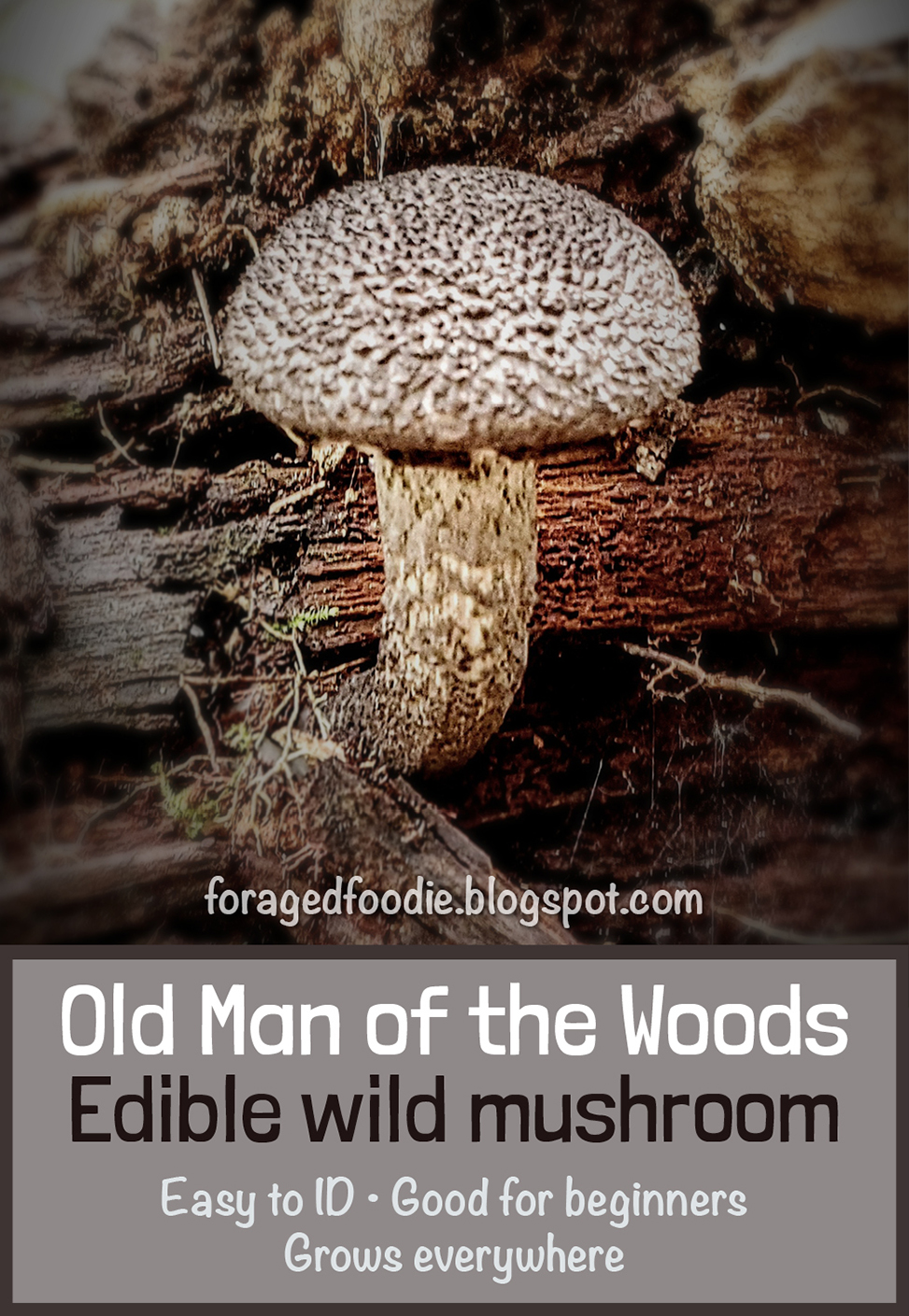
Beginner foraging: old man of the woods mushroom identification


Identification difficulty: Beginner

Meet the old MEN of the woods, "Strobilomyces strobilaceus" (though most books will use the term Strobilomyces floccopus) and Strobilomyces confusus. 

Old MEN, you ask? Yes, in the Americas the common name "old man of the woods" is often used interchangably for two different species of Strobilomyces that look rather similar. And there is still a different "old man of the woods" in Europe and Asia.

Confused yet? The naming gets worse.

The Latin name Strobilomyces strobilaceus applies only the European species. DNA studies have shown that the American mushrooms--previously believed to be identical--are genetically different, but a Latin name hasn't been chosen yet. 

From a foraging and edibility standpoint, none of this matters. All species share the same identification features, but if you're curious about species naming, check out the taxonomic confusion section at the end of this post. 

Old man of the woods identification

  • A cap and stalk mushroom 
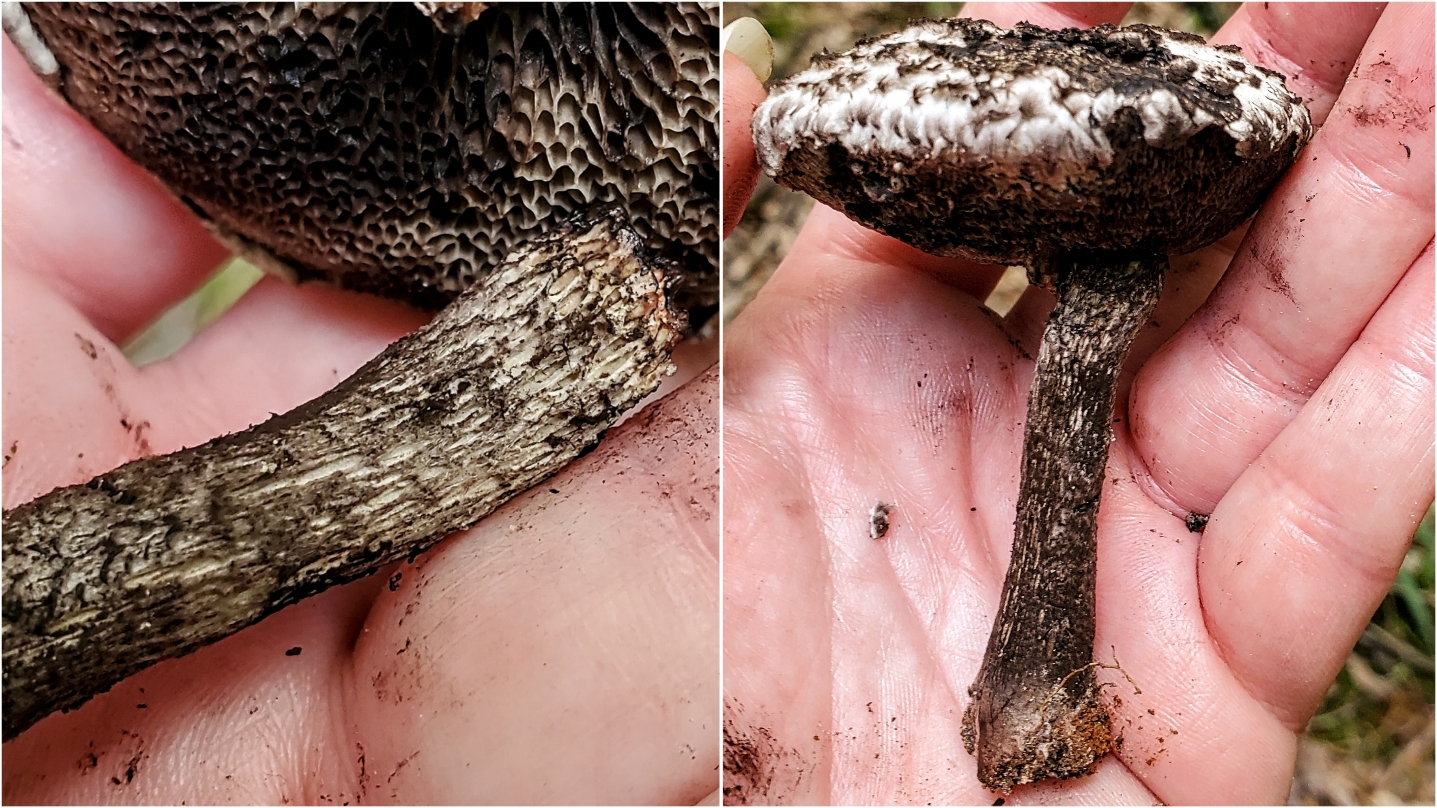
  • Pores under the cap instead of gills.
  • Mushroom cap is light gray with dark gray to black textural elements. Textures can resemble large gray/black "flaps" that hang down (S. strobilaceus), or small gray/black pyramids that stick up (S. confusus). 
  • Pore surface is pale gray to charcoal gray to black. 
  • Pores aren't round, instead they are angular polygons, often elongated.
  • Stem is also dark gray or black and textural, with dark scales along most of the length.
  • Entire mushroom bruises pink or red when bruised or cut. This color slowly fades to gray or black. 
  • Found in the woods, growing terrestrially (on the ground) or on logs so well-decayed they are basically soil.

That's really all there is to know about identification, this really is an easy group of mushrooms to ID.