Saturday, May 7, 2022

Garlic lovers creamy wild garlic parmesan chicken. Foraging recipe.


I love garlic. Most people do, it's one of the most universally utilized spices in all global cuisines. Did you know that humanity is actually specially ADAPTED to love garlic? Most animals are repulsed by the smell and taste of Alliums (the genus that contains both garlic and onions); the pungency is actually a defense mechanism of the plant. And it's a good defense! Against anything except humans that is. Even in people, the smell illicits the same physical reaction as pain: it makes us cry. 

Garlic cultivation dates from at least 4,000 BC, coming out of Far East Asia, however it was almost certainly gathered/foraged much, much earlier, at least 2,000 and perhaps 4,000 years before that.

But why? Why would we eat a plant that illicits a pain response when we smell it?

Well, the entire plant is edible, relying on the smell/taste for defense, rather than poisons, thorns, etc. It's also one of the earliest spring greens to appear, and probably was initially sampled for this reason--little else was available. When our ancient ancestors found that the green part of the plants were non-poisonous, they probably would have sampled more, including the bulb. The bulbs of Alliums would have proven to be an essential resource for early hunter/gathers, as many are full of calories in the form of carbohydrates and sugars. 

Post-flowering garlic bulbils have all
the garlic flavor but don't
need to be peeled
Furthermore, after flowering, garlics and onions grow above-ground clusters of bulbils/bulbettes, which are also filled with essential carbs and sugars. Like nuts, berries and other fruit, these bubils are a source of calories and nutrients that are easy to harvest. In a hunter/gatherer society, calorie deficiencies are death. If you burn more calories to GATHER food than you gain, you will die. 

Which brings us to this recipe.

Right now wild garlic is producing the post-flower bulbils, which are perfect for the lazy garlic lover. 

Why dig when you can pick? Why chop when you can prepare whole? And, my favorite, why peel freaking garlic bulbs which I hate and takes so much time and frustration, when you can pick garlic bulbils. 

Garlic bulbils are the bomb because they have fantastic garlic flavor and don't have to be peeled! 


You're gonna need a lot more garlic


Lazy garlic-lovers creamy garlic parmesan chicken

Serves 4-8, total time about 40 minutes. 

2 lbs skinless, boneless chicken thighs (or breasts)

2 cups chicken stock

1 1/2 cups garlic bulbils, flowers and stalks, unpeeled, clusters broken up

1 cup heavy cream

1 cup shredded parmesan cheese

3 pats of butter

3 tbs. flour or almond flour

Salt & pepper

Olive oil

Parsley, optional

  1. Heat olive oil over medium-high heat in a large, flat-bottom pan. I used my favorite 5 quart sauté pan. 
  2. Lightly dredge the chicken in flour or almond flour, and add to the hot oil. Fry both sides until browned, about 5 min per side. I used the browning time to break up and lightly chop the garlic. Remove the chicken from the pan, and set aside on paper towels. 
  3. Add the garlic and 1 pat of butter to the pan, with more oil if needed. Sauté, stirring constantly, and scraping up the bits of chicken in the pan, until garlic is fragrant, translucent and browned. Because these garlic are inside their skins, you can let them get brown or even a little blackened and they will taste like garlic you roasted in the oven -- fantastic!
  4. Reduce heat to medium or medium-low. Pour in the chicken stock and heavy cream and stir completely. Add in the parmesan cheese and stir once more. 
  5. Return the chicken to the pan, and settle as far into the broth/cheese mix as you can. 
  6. Cover and cook over medium or medium-low heat for about 10 minutes, then flip the chicken and cook for another 8 minutes or so. Test for doneness. Stir in parsley, if using, and cook for one minute more. Remove and serve immediately. The sauce is also great on roasted veggies and potatoes.


Tuesday, May 3, 2022

Keto teriyaki steak rolls with curly "docksparagus" and garlic scapes


The long flower stalks of curly dock
can be cooked like asparagus
Curly dock, Rumex crispus, is one of the most versatile and abundant wild plants around. The broad, vitamin-rich leaves are the most-known part of the plant, and can be used like spinach or kale. 

As a biannual plant, curly dock produces only energy-gathering leaves over its first growing season. During the second season, the plant will shoot up a central stalk that will flower and eventually go to seed. 

These stalks are a very tasty and unique vegetable, similar in texture to asparagus, but with a sour/tart flavor, more pronounced than the leaves, but less than lemon or rhubarb. Due to the look and the texture, foragers sometimes call this part of the plant "docksparagus".


For dinner last weekend used  made teriyaki-marinated, steak-wrapped wild veggie bundles, topped with a teriyaki glaze, inspired by negimaki. I used docksparagus, wild garlic scapes, and some bell peppers for color and texture. The rolls were very easy and quick to put together, not counting marinade time, with a pretty early clean up as well. 

You can even do the bulk of the work (preparing the marinade) in advance, and store in the fridge.

They came out delicious, while still being healthy: low calorie, keto / low carb, full of nutrients, and dairy-free. 


Using the bulbils of wild garlic is super easy:
no peeling 
required!

I opted to use wild garlic bulbils (i've been calling them bulbettes al this time) heads instead of store-bought garlic here. I love using this garlic stage, it's so easy. The skins on the garlic bulbils are so incredibly thin you don't have to peel them for cooked applications, just mince everything -- bulbils, skins, flowers, stalks, flower stalks -- together and use in place of commercial garlic.  


Teriyaki steak rolls with wild plants 

Makes around 12 rolls 

2lbs sirloin, flank, top or bottom round, sliced to 1/8 thick

24 long, thin docksparagus stalks, remove tough or dried-out leaves

1 red, yellow or orange bell pepper, or 2 half peppers for variety 

Around 36 wild garlic scapes&

For the marinade / glaze

Beef stock 3/4 cup

Soy sauce 1/2 cup

Rice wine vinegar 1/2 cup

Garlic chili oil 1/4 cup, more or less for your spice level

Olive oil 1/4 cup

Sesame oil 2 tbs

Whole bulb garlic or equivalent wild garlic, minced 

2tbs fresh grated ginger

1 tsp white pepper 

1 tsp. corn starch or other thickener

  1. Mix all marinade ingredients together in a large bowl or 9x12 baking pan. 
  2. Add in the sliced beef and marinade at least one hour, or overnight. Marinade in the fridge if marinating longer than a couple of hours.
  3. If you've marinaded in the fridge, remove and allow the beef to come to room temperature before cooking
  4. Preheat the oven to 375.
  5. Cut the docksparagus and garlic scapes into spears around 4inches long. Slice the bell peppers into long strips. 
  6. Line a baking sheet with parchment paper. Remove the sliced beef from the marinade and lay out on the parchment. Do not discard the marinade
    Next time I would only use garlic scapes inside the rolls, 
    no garlic heads with bulbils

  7. Place a mix of veggies on each strip of beef. I used 2 bell pepper slices, 3-4 docksparagus spears and 3-4 garlic scape pieces.*
  8. Roll the beef around the veggies and fasten with a toothpick. Repeat for all beef slices. Drizzle with marinade. 

  9. Roast in the oven for 15 minutes, then flip each roll and roast for another 10 minutes. 
  10. While the rolls are roasting, bring remaining marinade to a rolling boil over high heat. Boil for at least 2 minutes. 
    For real though, remove the toothpicks before serving. 
    Don't make the same mistakes I did

  11. Mix 1 tsp. Corn starch in a small amount of water. Add to the boiling marinade and reduce heat to medium. Allow to thicken, stirring, and remove from heat. 
  12. Remove the rolls from the oven, plate, REMOVE THE TOOTHPICKS and cover with the teriyaki glaze. Serve hot.

*Special note about the wild garlic. Right now north Texas wild garlic is in a variety of stages: garlic scape (one enclosed bulb at the top of the stalk), flowering and bulbils, the post-flowering mini-bulbettes at the top of the stalk. The bulbils are excellent in the marinade or in any other minced application, however, they are too thick to cook all the way through if you use them (as I did) inside the rolls. Next time I will definitely keep to the scapes inside the rolls and the bulbils only in the marinade, as they were just a bit undercooked inside the rolls.

Obligatory note on curly dock. Rumex crispus contains substantial amounts of oxalic acid. While there are many commercially grown plants that contain oxalic acid, curly dock may have a larger content. Oxalic acid should be only eaten by healthy people in moderation. (If I do a meal prep with curly dock, I will generally only eat the meals every other day, rather than every day.) People with kidney or liver issues -- especially a tendency for kidney stones -- should avoid oxalic acid, as should breast-feeding women, it can have a laxative effect that can be passed to the baby through the milk. 


Sunday, April 24, 2022

Foraging: Identification of edible, young spring pokeweed / poke sallet


Identification difficulty: Novice

This post is a long time coming, I really should have made this post a long time ago. You see, it's bothered me for a while that pokeweed, Phytolacca americana, is such a popular edible wild plant, such a well-known plant, such a historically significant plant, and yet there is so very little info out there helping identify it when it's young and harvestable. 

There is a ton of info to help identify the mature plant, which is very easy to ID. But as I wrote once before, you can't EAT pokeweed when it's mature -- it becomes fatally poisonous. 

But in the early spring, they young shoots and leaves can be harvested, and, if properly prepared, are safe to eat -- even delicious. Like the best baby spinach you've ever imagined. 

It's such a popular food of the American South that it's been a part of our nation's cultural heritage, even becoming the theme of a hit song, Poke Salet Annie, in the late 1960s. 

If you've been curious about how to safely identify pokeweed when it's young, you've come to the right post!


Common places to look for pokeweed

Pokeweed is a transitional understory plant. Transitional meaning it thrives in the transitional period where as field and meadow become forest. It gets crowded out fairly easily by trees, so you will rarely find it in deep forest, instead look for small forest clearings (usually where a massive old tree has fallen, leaving an open space), on the edges of meadows or farmland and along man-made or animal trails. In nature, "washes" -- places where spring rainwater frequently comes down the sides of hills, clearing out small trees, frequently grow pokeweed.

This pokeweed is too mature to eat.
But it is growing in a classic spot: on
the edge between a field and woodlands
Pokeweed seed reproduction is very complicated. The seeds can't germinate UNLESS they've been swallowed and digested by a bird--exposed to that specific mix of chemicals inside an avian GI tract--and deposited in the highly acidic bird feces. 

However, if pokeweed roots get broken up, any piece of root about 2-3" long can grow a new plant. For this reason, human activity can spread pokeweed around like crazy. During excavation, construction and earth-moving, people may inadvertently break up a pokeweed plant, creating dozens more at the edges of construction, where the root-bearing dirt has been deposited. 

Consequently, look for pokeweed for along the edges of suburban developments built within the past 5 years, or along any area kept clear of trees by human activity: farms, parks/playgrounds, the edges sporting fields and along trails are all good places to look. 

The most pokeweed I personally ever saw was when my parents had their new Connecticut home build in 1990, when I was 10. The land had been farmland until the early 1900s, at which point it had been allowed to grow feral, reverting to forest, with tree ages not that much older than 50 years at most. There were also several clearings. In one of those clearings, where my parents build their house, there must have been at least one pokeweed plant, because when they dug the foundation, they disturbed those roots. For several years after, we had literally HUNDREDS of pokeweed plants surrounding the clearing of our home, until eventually small saplings started to grow into small trees, forcing the pokeweed out. 


Young spring pokeweed identification 

Many North Americans already know mature pokeweed by sight. It's hard to miss, as the plant can grow 6 feet tall and equally wide, in arching red boughs, bearing large, deep green leaves and 4-6 inch clusters of deep purple-black fruit on red stems.  

The problem is, by the time pokeweed is easy to spot and identify, it's well past the point where it can be safely eaten. This post will help you identify young pokeweed in the spring, when its safe to consume (after proper preparation): 

Super young pokeweed growth. Note the stalks of last year's plants in the background

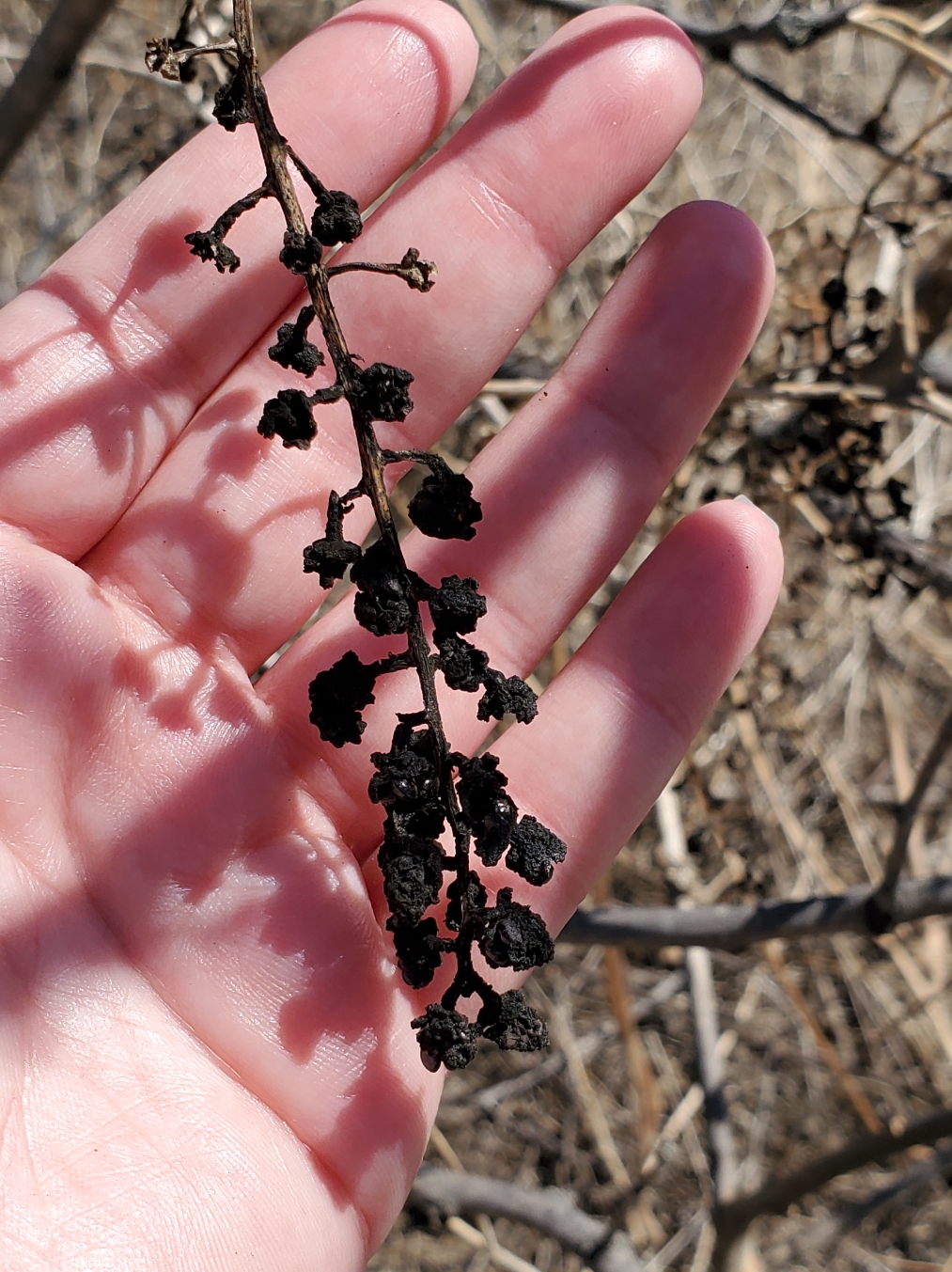
Dried up old fruit is the 
best way to pre-find pokeweed

Finding young pokeweed

When it first pokes out of the ground, pokeweed will mostly be visible by the leaves, which at this stage will be bright green, almost neon, wrinkled, ruffled at the edges, and with very prominent underside veins. 

Pokeweed is perennial: once established, it will regrow from the roots year after year. For that reason, you can find pokeweed before it grows by finding last year's plants. 

The stalks of pokeweed plants are long, hollow tubes that are beige in color, but often feature grey or black streaking and spotting. There will always be some dried up clusters of pokeweed fruit dangling from one branch or another. 

Side note: because old pokeweed stalks are hollow, breaking up the tubes makes an excellent tinder/fire starter, as long as they are very dry. 


The stalk is the most important way to identify pokeweed. 
Note in the slightly older plants on the right, the skin should be peeled away from the plant base
before preparing it for consumption


Stalk color and growth pattern

Pokeweed is safest
when the skin is
super thin, like this
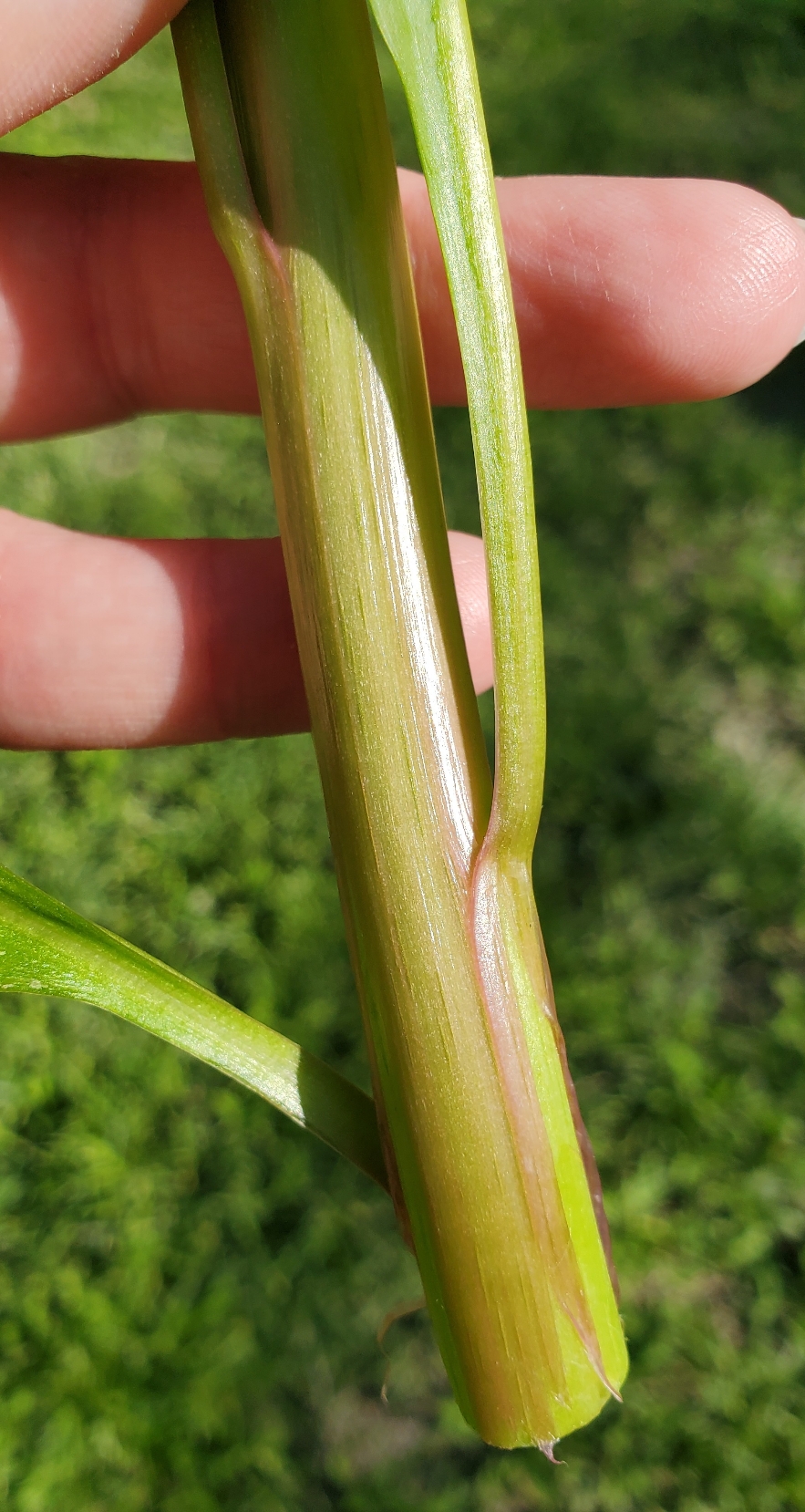
The stalk is the most important identification feature for young pokeweed. The leaves and overall plant shape resemble many other wild plants (some poisonous) but the stalk is very unique -- once you know what to look for. 

The stalk of young pokeweed is translucent neon green tube around a white core, covered with a super thin, translucent skin that peels away pretty easily from breaks. 

The white core of the stalk is actually made up of parallel, horizontal chambers, which you can see easily by breaking into the stalk with a vertical cut. However, the younger the plant, the closer and tighter together the chambers will be, making them harder to see. 

The skin should be green, yellowish or faintly red. If the red coloring is more than just a hint, or faint streaks, then your pokeweed is too mature and should not be eaten. 

There is no hair on the stem, in fact if feels super smooth -- like plastic.

As the plant grows, the skin becomes thicker, and easier to peel away as a whole unit, without tearing. The group of pictures above shows two plants, the core on the left is at the perfect stage of size and growth. The middle and right are at just the last stages, and require a little extra prep work.  Notice on the left how the skin holds together and doesn't tear when pealed away from the central stalk. On plants of this age, I would peel the skin away from the base of the plant, and not cook it. The skin carries more of the dangerous chemicals than the green interior. 

Saturday, April 16, 2022

Scallion pancake with garlic scapes - Chinese restaurant style


If you're like me, sometimes you say to yourself, "Sure, everyone loves Chinese restaurant scallion pancakes, but how do I ward off vampire attacks?"

Well friends, today I have a recipe for you: make scallion pancakes, but substitute garlic scapes for the scallions. And wild garlic scapes are going crazy in north Texas right now. 

What are garlic scapes?


Garlic is a member of the Allium genus, along with onions, scallions, shallots, chives, and others. The garlic we buy in the store is a bulb, and, if planted, will grow a round-stalked green plant that eventually forms another bulb on top. This bulb is actually a cluster of "bulbettes" each of which will eventually form a flower. These bulbettes can break off the main cluster, fall to the ground, and grow a new garlic plant; it's the primary way garlic reproduces. 

In commercial garlic farming, farmers will pick the green plant before it can form this top bulb. You see, if the plant focuses energy on reproduction, it will drain the garlic bulb below the ground for energy. Garlic farmers don't want that, as they want to keep that bulb big and heavy to sell. Picking the green plant will force the bulb (the garlic) to retain it's energy and stay large. 

Recently, people have realized that the picked green plant, called a garlic scape, is a wonderful vegetable in it's own right: with a mild garlic flavor, a texture similar to leeks or scallions, and a zesty green freshness. Though only available in the early spring, you can find garlic scapes at farmers' markets and higher-end grocery stores, where they easily command prices of $10 a pound. Or you can also forage them on your own, for free. 


About the dish

Unlike many of my recipes, this dish requires a lot of time and effort, but it's well worth it. Just like in the best restaurants, these pancakes come out with an incredible balance of flavors and textures. They are crispy on the outside, flakey throughout, and super dense and a little chewy inside. The taste is predominantly garlic, as you would imagine, paired with warm spices and that delicious greasy flavor you can only get from fried foods. 

Though these take a lot of work, you can make extra and freeze them at about 3/4 of the way through the prep work, saving you a bunch of time in the long run. 


Garlic scape Chinese restaurant style pancakes

Makes 4 large (serves 6) or 6 medium (serves 4) appetizer-sized pancakes. Can be halved or quartered. Dish can be prepared up until frying and frozen for later. 

4 cups of all-purpose flour, plus 1 cup

2 large handfuls of garlic scapes

4 scallions, optional

Frying oil of your choice

2 tbs. sesame oil

1 tbs. salt

1 tsp. sugar

Chinese five spice powder

White pepper, optional but suggested if not included in your 5 spice mix 

Sichuan peppercorns, optional

Hot water, as hot as you can touch with your hands

For the dipping sauce

Dark soy sauce (or regular if you don't have dark)

Rice vinegar

Chili oil and/or chili garlic sauce or paste, optional

Sesame seeds, optional

Sesame oil

  1. Mix 4 cups of flour, the salt and the sugar in a large bowl with just enough hot water for the flour to come together into a sticky dough ball, about 1.5 - 2 cups. Mix it in a little at a time.
  2. Scrape the dough ball out onto a floured surface and to kneed until it comes together and firm up a bit. If you don't work with dough enough to get a feel for it, try 7 minutes of vigorous kneeding. Add more flour to your hands or the work surface, if needed, but try not to add too much or the dough won't be flakey. 
  3. Return the dough ball to the bowl and let rest for at least 30 minutes, while you prepare next steps. 
  4. Separate the heads of the garlic scapes from the stalks and leaves. Halve or quarter the heads, based on size, and mince the stalks and leaves.


  5. The garlic, while flavorful, tends to get a bit soft when cooked. I like to finely chop a few scallions in, for crispness. If you are using scallions slice them into thin coins and add to the chopped garlic.
  6. Add 3/4 of a cup of frying oil and a generous glug of sesame oil to a sauté pan and heat to medium high. Add in some of the garlic scape heads/bulbs, for extra flavor, and stir till fragrant.

  7. Whisk in about 1/3  a cup of flour and reduce heat. Continue to whisk until the flour is complete emulsified with the oil, and both are a warm tawny color. Remove from heat.
  8. Prepare the dipping sauce: mix equal parts dark soy sauce with rice vinegar. Mix in a drizzle of sesame oil and chili to your taste, if using. Optional: Sprinkle with sesame seeds and/or minced garlic and sliced scallions. 
  9. Once your dough ball has sat for 30 minutes, divide it into 4 or 6 pieces. If you divide into 4, each pancake will be about 9in in diameter; if you divide into 6, each pancake will be about 6in in diameter. 
  10. Roll out the portion of dough into a rounded rectangle about 1/8 in thick, is ok if it gets a little thin in the middle, it's even ok if it gets a small hole or two. 
  11. Using a pastery brush, thinly spread the dough sheet with the flour and oil mixture over the surface of the sheet. It should go close to the edge, but not drip off.
  12. Sprinkle with Chinese 5 spice powder, white pepper and ground Sichuan pepper, if using. 


  13. Generously cover the sheet of dough with the garlic and scallions.
  14. Working from the long side, start to roll up your sheet of dough into a tube. Don't worry if your roll isn't tight, or if some garlic pokes through, or if some air gets trapped inside. 


  15. Grab each end of the tube and raise in the air. GENTLY bounce up and down like a jump rope, pulling slightly on each edge, to stretch the tube.
  16. Lay the tube of dough to rest, and brush the top side with more oil/four mix. Roll the tube into a spiral, like a cinnamon bun, keeping the oil side inside the coil. Set your "bun" aside to rest. Repeat the process with each chunk of dough. 


  17. Sprinkle flour over your rolling surface and with your first spiral of dough and garlic. Use a rolling pin to roll out the spiral to about 1/4 inch thick. You don't really have to worry about runaway garlic, but if you want to, you can remove any that poke through. 
  18. Repeat for each spiral. At this point, if you don't plan on eating each pancake right away, you can separate them with freezer paper and freeze in a zip-lock bag.
  19.  Heat plain cooking oil a large sauté or cast-iron pan to medium high. Add the flattened spiral pancake to the oil and fry for about 2 minutes. Flip the pancake, and fry for another 2 minutes. Repeat the process for 1-2 minutes more per side, till golden brown and cooked thorough. Repeat for as many pancakes as you like, allow each to cool slightly on paper towels, cut and serve right away with or without the dipping sauce. 

Thanks to Inga Lam's video on scallion pancakes, which I borrowed heavily from when creating this dish. 


This one was my favorite because it came out looking like a certain famous spaceship we all know
but can't legally use the name of :D