Saturday, January 8, 2022

How to identify shaggy mane mushrooms, perfect for beginners


Identification difficulty: Beginner

Coprinus comatus, commonly known as the shaggy mane mushroom, shaggy ink cap, or the lawyer's wig, is generally considered to be a very easy mushroom to identify, but care must still be taken when identifying it. 

In fact, it's generally considered to be one of the "foolproof five" which includes chicken mushrooms, black trumpets, morels, and giant puffballs. 

I personally cannot emphasize enough, the "foolproof five" is a myth! 
Shaggy mane starting to deliquesce, 
at this stage easy to ID, but less
desirable as food
No mushroom is completly foolproof. Morels are commonly misidentified as potentially deadly Gyromitra species. I've seen chicken mushrooms confused with Flavolus (edible), orange mock-oysters (poisonous), berkleys polypore and other polypores. Even black trumpets, the mushroom I find most "foolproof" can be confused with devil's urn, though the mistake is harmless. 

Shaggy mane mushrooms can be, and frequently are mistaken for:  Coprinopsis atramentaria (potentially poisonous), Chlorophyllum molybdites (very poisonous--but not deadly), and Amanita thiersii (possibly poisonous).

If you aren't trying to eat shaggy manes and can afford to wait thier whole life cycle, they are really easy to identify. The problem is, by the stage of thier life when they become easy to identify, they are no longer suitable to eat, because of deliquescence.  As the mushroom ages, it deliquesces, eventually turning into a black goo.


The black goo is easy to identify, but not something you would want to eat. 

As a forager, the trick is to find and identify the mushrooms before they start to deliquesce, and at that stage its possible to confuse the mushroom with a couple of others. 

Sunday, January 2, 2022

Chickweed frittata with prosciutto, potatoes and shallots. High protein, gluten-free foraging recipe.


Happy New Year everyone!!

I hope you've had a fantastic holiday season: safe, healthy, fun and full of family and friends. 

For us, Texas has been magnificently warm, with temperatures in the 60s and even into the 70s throughout the month of December. 

As a result, the plants have been seriously confused as to season, with many spring plants sprouting and even flowering. The strangest I've yet seen are violets in flower!

Foraging has been superb, when I can get to it. A major project at work has kept me working late, and sometimes even weekend overtime. 

One of my favorite, generally spring-only ephemeral plants -- chickweed -- has been coming up in large patches or dense matts everywhere. 

Chickweed is delicious, one of the few wild greens that I will eat both fresh or cooked. It has a flavor like spring peas, with a hint of sweet corn and Boston lettuce. When you cook it it becomes slightly herbal, like spring onions. A very versatile plant, no one I know who has tried it has disliked it, making it great for new foragers. 

A quick recipe for today: a decedent frittata. This time I've made it properly, starting everything over the stove and only finishing in the oven. Previously, I've often made frittatas in the oven-only, which saves time and cleanup, but at the cost of flavor. 


This recipe is delicious, easy to do (though somewhat time-consuming), gluten-free, high in protein and great as a main course for breakfast, brunch, lunch or dinner. 

Chickweed frittata with prosciutto, potatoes and shallots. 

Prep time: 10 minutes, cook time: 45 minutes. Serves 4-8 as a main course. 

6 eggs

4 cups of roughly chopped fresh chickweed

3/4 lb of prosciutto, diced

1/2 lb fingerling potatoes, chopped bite size

3/4 cup of sliced shallots

4 cloves of garlic, minced

1/4 cup heavy cream

5 oz. grated hard cheese (asiago, parmesan, etc.)

1+ sticks of butter

Salt, pepper, ground celery seed

  1. Lightly salt 8 cups of water and bring to a boil. Once boiling, add your chopped potatoes and reduce heat to a slow boil. Continue until potatoes are soft, then drain.
  2. In a separate bowl, whisk together eggs and heavy cream. Set aside. 
  3. In an oven-safe 11" sauté or cast iron pan, melt 1-2 pats of butter over medium-high heat. Add in your sliced shallots. Sprinkle with salt and celery seed and cook, stirring often, until shallots are translucent and beginning to brown. 
  4. Add in your garlic, and more butter if needed. Continue to sauté until shallots are fully caramelized. 
  5. Add the prosciutto and sauté about 5-7 minutes until the meat has softened. Add in the cooked potatoes, season with ground black pepper and celery seed, and stir. 
  6. Working in batches, stir in chickweed. When each batch wilts you can add in more. 
  7. The chickweed will release a lot of liquid. Make sure you cook, stirring frequently, until all the liquid has dried. You can increase heat to do so. 
  8. Reduce heat to low. Stir for about 10 minutes to allow the temperature to reduce.
  9. Add in 4 oz. of your grated cheese, stir to mix until melted. 
  10. Slowly pour in your egg and cream mixture. Gently stir the pan, once or twice to allow the eggs to fill in around all the ingredients. 
  11. Continue to cook over medium-low heat, without stirring, until the eggs are fully cooked. You can occasionally turn or shimmy the pan over the heat. 
  12. Preheat the oven to 400 degrees. Top the cooked egg mixture with the remaining grated cheese. Bake in the oven for 5 minutes, until cheese melts. Remove from oven. 

  13. Raise oven temperature to a broil. Return frittata to the oven, and broil for 3-5 minutes until cheese is browned and bubbly. 


Enjoy! My pictures really don't do this dish justice!


Sunday, December 5, 2021

Mushroom bacon with foraged wild oysters. Vegan, keto and oven-fried.

Super short but oh-so-delicious post for you today. 

Oyster. Mushroom. Bacon.

It's salty. It's savory. It's blackened, but not smoked.  It's both crisp and chewy. 

Oven roasting or grilling oyster mushrooms has long been my favorite way to prepare them fresh. They just get so super umami over high heat.

The middle of the caps are the most meaty in terms of texture, and really showcase the best mushroom flavor, but the most delectible bits are always the outer edges. Those edges, thin fleshed and naturally drier, get crispy brown or blackened, almost like deep fried. 


I came upon this decent-sized haul of winter oyster mushrooms yesterday, while hunting for pecans. The caps were enormous, 6 to 12 inches across, and very thick in the middle. In the summer, oysters at this level of maturity would be fully infested with bugs, but because this is the winter they were flawless  inside, very fresh, and exceedingly dense: full of moisture. 

That said, mature oyster mushrooms that have already dropped their spores tend to be a little less flavorful than when they are younger and still have in-rolled edges. 

With that in mind, I was thinking about ways to make the entire mushroom more like the crispy/oven fried bits, with less of the chewy/meatiness. I decided to salt them and let them sit and drain for a while, desiccating the mushrooms somewhat, so that the whole thing would crisp up and get caramelized. This added to the total prep time, but as I had plenty else to do -- and the mushrooms were just kinda sitting around--it worked out great. 

Keto, vegan oyster mushroom bacon

2 lbs oyster mushrooms, caps whole or nearly so
1/2 cup olive oil or high-heat oil of your choice
1 tbs. kosher salt
3 tbs. smoked paprika
2 tbs. garlic powder
1 tbs. freshly ground black pepper
1 tsp. ground celery seed

  1. Rinse your mushrooms, cleaning off any debris, and lightly pat dry -- leaving them still slightly damp. 
  2. Sprinkle the mushrooms with salt, paprika, garlic powder, celery seed and black pepper and set in a colander or on layers of paper towel to drain. The salt will help draw the moisture out of the mushrooms, encouraging them to really crisp up in the oven. Let sit for 40-60 minutes. 
  3. When the mushrooms are ready (they should be about 3/4 the size they were before, with a lot of water having been drawn out of them, preheat the oven to 400 degrees. 
  4. Arrange the mushroom caps on a foil-coated baking sheet, they shouldn't touch or overlap each other. 
  5. Drizzle with olive oil, flip and drizzle the other side as well. Brush both sides to coat. 
  6. Bake at 400 for 30-60 mins, depending on the cap thickness. After that, check and see if your caps are crispy fried. If your caps are thick, you will need to flip them and keep them in for another 15-30 minutes. 
  7. Enjoy however you would bacon!
These mushrooms are low-carb, low-fat, keto, vegan and vegetarian, and paleo. They can be served as a side dish, snack or main course. The only real thing to watch out for are high amounts of salt. 

Unrelated note, here are some of the things I foraged yesterday: 


Saturday, December 4, 2021

The velvet foot or velvet shank mushroom: Flammulina velutipes. Identification tips and toxic look-a-likes


Caution: this is NOT A BEGINNER's mushroom.

This mushroom cannot be positively identified by observing features alone. A spore print must be made for positive identification. This mushroom has many lookalikes, some of which are deadly, others will make you sick. Use the following tips as a guideline only, but confirmer your identification with other reliable sources and a trusted local expert.


As always, it's your responsibility to make 100% sure of any while plant or mushroom you consume.


Identification difficulty level: Intermediate

Flammulina velutipes, commonly known as the velvet foot, velvet shank, velvet stem, or winter mushroom, is officially a cold-weather fruiting fungus, which can be harvested even in the dead of winter in some places. This makes it a great find for winter survivalists, or for any forager who just can't get enough, and wants to hunt year round.


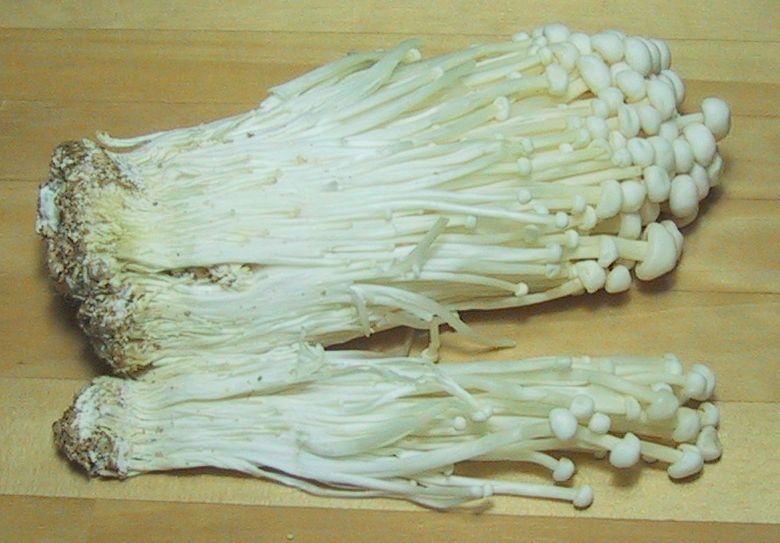
Cultivated Flammulina velutipes, called enoki mushrooms.
Image courtesy of Wikipedia user Chris 73, via Wikipedia Commons


Do you know the enoki mushroom?

If you know the skinny white enoki mushrooms you buy in the store, then you actually know the velvet shank, kind of. The enoki is also Flammulina velutipes, but it's cultivated in very specific ways, to make it look, and in many ways taste, like a different mushroom. By growing it in complete darkness, it turns white instead of cinnamon brown, and forcing the stems to grow long and skinny keeps them tender, where in the wild they are tough and chewy. 

Despite the more tender texture of the cultivated variety, I GREATLY prefer the stronger, more umami flavor of the wild version. When cultivated they become tender and mild, but wild they are a very exciting mushroom, with a very meaty texture and a buttery, nutty flavor. 

Keep reading to learn more on how to accurately identify the velvet foot mushroom, and avoid the very similar-looking, DEADLY Galerina.